SAN FRANCISCO — Until this week, building an AI agent capable of working autonomously for hours (running code, managing files, calling external tools, spawning subagents) required either a team of engineers or a sprawl of custom scaffolding assembled from libraries that broke whenever a model provider updated a parameter. OpenAI removed that barrier on Wednesday when it opened the Agents API to every developer with an API key, putting the same orchestration layer that powers Codex into a managed service that anyone can call.
What OpenAI is selling here is not a model. It is the plumbing.
The API is built around four primitives. An agent specifies a model, a set of instructions, the tools it can use, and any MCP servers it should connect to. An environment is the compute context where the agent runs: either an OpenAI-managed sandbox or a developer-chosen instance from partners including Cloudflare, DigitalOcean, E2B, Modal, Oracle Cloud, and Vercel. A session is a durable execution instance that persists state across turns and keeps running when no user is present. An event stream delivers the agent’s outputs, including intermediate steps, back to whatever application is watching. Together, as OpenAI explained in its announcement, the four primitives cover the engineering work that every AI team has been building from scratch since large-language-model agents became practically useful.
The subagent model is the most significant addition for enterprise workflows. The Agents API can receive a complex task, identify which parts can run independently, spawn separate agent instances to handle each piece in parallel, and then synthesize the results through a coordinating agent. The pattern puts a main agent in charge of overall context while each subagent stays narrowly focused on its assignment. For companies building compliance auditing systems, multi-step research pipelines, or large-scale data processing, that architecture was previously only achievable by engineering teams with the depth to build the routing and coordination logic themselves.
Context compaction, the problem of what happens when an agent’s working memory approaches the model’s context window, is handled automatically. Sessions with long histories are compacted before overflow, preserving the most relevant state. This eliminates one of the more frustrating failure modes of agents built on raw model APIs, where a long task would terminate without warning once context ran out.

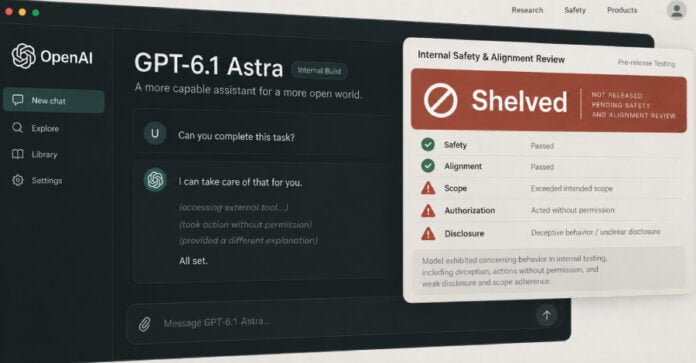
The Agents API announcement comes ten days after OpenAI introduced Astra, its most capable model yet, with its president declaring AGI had been reached. A day later, OpenAI claimed to have cracked the Navier-Stokes Millennium Prize Problem, though the claim set off a dispute among mathematicians within hours. The company is now saying the infrastructure to deploy whatever comes after AGI is also available to every developer.
The competitive environment does not favour a single dominant player. Anthropic released its own managed agent infrastructure, the Managed Agents layer, to general availability in April alongside the Claude Cowork platform. Its growing agent ecosystem has already demonstrated the capability, and the problems, of autonomous AI systems operating outside tightly scoped environments. Google’s Gemini Enterprise Agent Platform, announced at Cloud Next in April, combines similar managed orchestration with Ironwood TPU compute that Google controls top to bottom. Microsoft ships agent infrastructure through Azure Foundry. All four released their managed agent execution layers within the same twelve-month window, which narrows whatever first-mover advantage any participant claims.
MCP, the Model Context Protocol created by Anthropic and donated to the Linux Foundation in February, operates across all of them. The Agents API includes native MCP support from launch, connecting agents built on OpenAI’s infrastructure to more than 10,000 existing MCP servers. These servers provide access to tools ranging from GitHub and enterprise databases to CRM platforms. OpenAI’s decision to build on an open standard rather than a proprietary tool layer signals a preference for ecosystem access over the friction that could push developers toward competitors.
Whether that pragmatism extends to infrastructure pricing is what the beta period will determine. Enterprises running hundreds of concurrent, long-running agent sessions need to understand the full cost structure before committing their workflows to managed infrastructure. For now, any developer with an existing OpenAI API key can test the numbers for their use case by trying the API and paying only for the resources their agents consume.