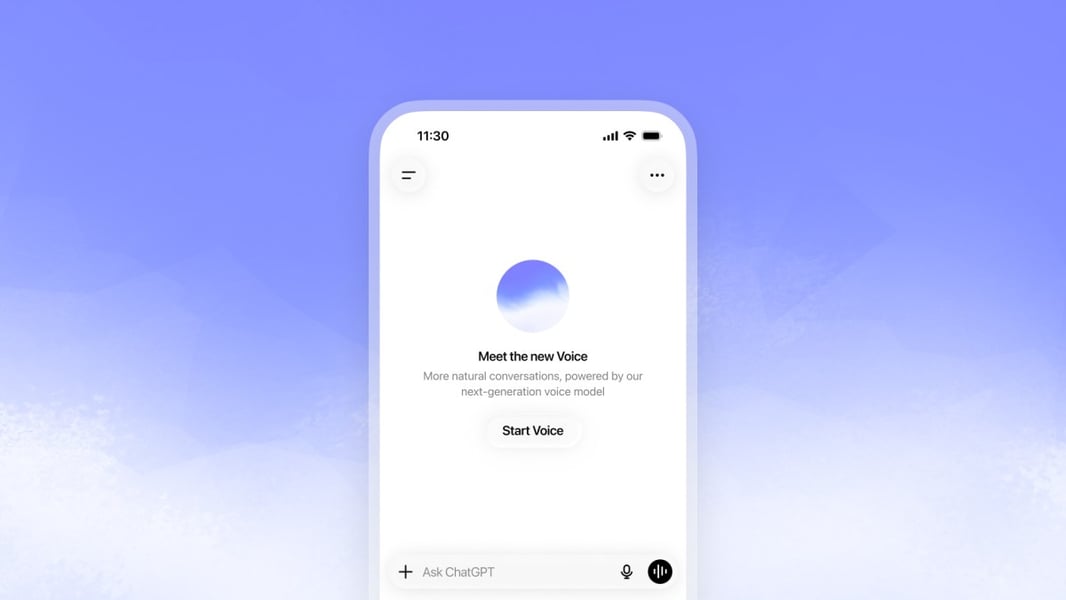

MOUNTAIN VIEW — For two months, OpenAI’s most capable voice model sat behind a wall developers could not reach. GPT-Live-1 had been running inside ChatGPT since July 8, handling interruptions and conversational timing in ways that made the previous generation sound mechanical. On September 10, OpenAI made it commercially available in its API, priced at five cents per minute for the voice layer alone.
That billing boundary matters. GPT-Live-1 does not reason. It listens and speaks simultaneously, managing the live audio conversation while delegating complex tasks to whatever backend model, tool, or agent framework the developer connects to it. OpenAI described the architecture in its API release announcement as separating the conversation from the cognition, billing each separately.
The problem it solves is not obvious until you have been on the wrong end of it. Traditional voice agents work in turns: they detect silence, interpret it as the user finishing, then start generating a response. The cycle of listen, pause, think, and speak introduces a lag that users learn to route around by slowing down and not interrupting. It makes talking to a machine feel like talking to a machine. GPT-Live-1 removes the turn detector from the audio path entirely. The model listens and responds in real time, the way a person does, which means a caller can correct themselves mid-sentence, push back on something the agent said, or simply pause to think without triggering a premature response.
Language learning app Speak says that change cut its wrong interruptions by nearly 80 percent. Those interruptions are the moments a voice assistant jumps in the instant a learner pauses to think, confusing a silence with a finished turn. They are one of the persistent failures of every voice assistant in production. Speak’s figure is not a hypothetical benchmark. It is a metric on actual user behavior that the company says shifted materially after switching to GPT-Live-1.
OpenAI reports a 30-point gain on its Full Duplex Bench evaluation over GPT-Realtime-2.1, the previous API-available voice model. One developer told OpenAI the migration removed 23,000 lines from their codebase. Those lines covered detection logic, fallback handling, and timeout management that full-duplex architecture renders unnecessary. GPT-Live-1 launches with 12 voices across accents and languages; custom voices require a separate arrangement through OpenAI sales, the same gated model the company uses for voice cloning elsewhere in its product line.
GPT-Live-1’s arrival in the API closes a gap that had frustrated developers since the July 8 ChatGPT consumer rollout. TechCrunch reported at the time that GPT-Live-1 and its smaller sibling GPT-Live-1 mini replaced ChatGPT’s Advanced Voice Mode entirely, with the mini variant becoming the default for all users and the full model available to paid subscribers. Developers watching the consumer launch had no timeline for when they could build with it directly. Two months later, they have an answer and a pricing sheet.
The model builds on a trajectory OpenAI has been accelerating throughout 2026. In September, OpenAI’s Astra model drew attention for scoring a perfect result on a cybersecurity evaluation that no prior model had reached. A week later, a dispute emerged over whether OpenAI’s systems had solved a century-old fluid dynamics problem, with outside mathematicians contesting the methodology. The company is publishing results at a pace that makes independent audit difficult.
The API targets phone agents, customer support, scheduling, reservations, and tutoring. Those are the workflows where the difference between a voice that feels present and one that feels procedural is the difference between a product customers use and one they abandon mid-call. SynthID watermarking was added to GPT-Live audio on July 31, signaling that OpenAI is thinking about provenance as voice AI proliferates, though what enterprises make of that requirement when deploying phone agents remains to be established.
The question GPT-Live-1’s commercial launch raises is whether voice quality and API availability together are enough to shift enterprise voice infrastructure. Companies that built their own stacks on GPT-Realtime or on competitors’ speech APIs have sunk costs, familiarity, and existing integrations on the other side of the calculation. What OpenAI does not yet control is the deployment decision that happens after a developer reads the pricing page. The timing of an API launch sets the starting line for a capability. The interesting number is what the adoption curve looks like six months from now.