
STRASBOURG — The drone that circled Leipzig airport last month had no weapons aboard. It did not need any. Its purpose, according to German authorities who attributed it to Russian intelligence operatives, was to demonstrate that it could get there at all — close enough to a major European aviation hub to force a brief closure, delay departing flights, and remind European governments how much of their critical infrastructure sits exposed to threats that fall below any legal threshold of conventional military attack.
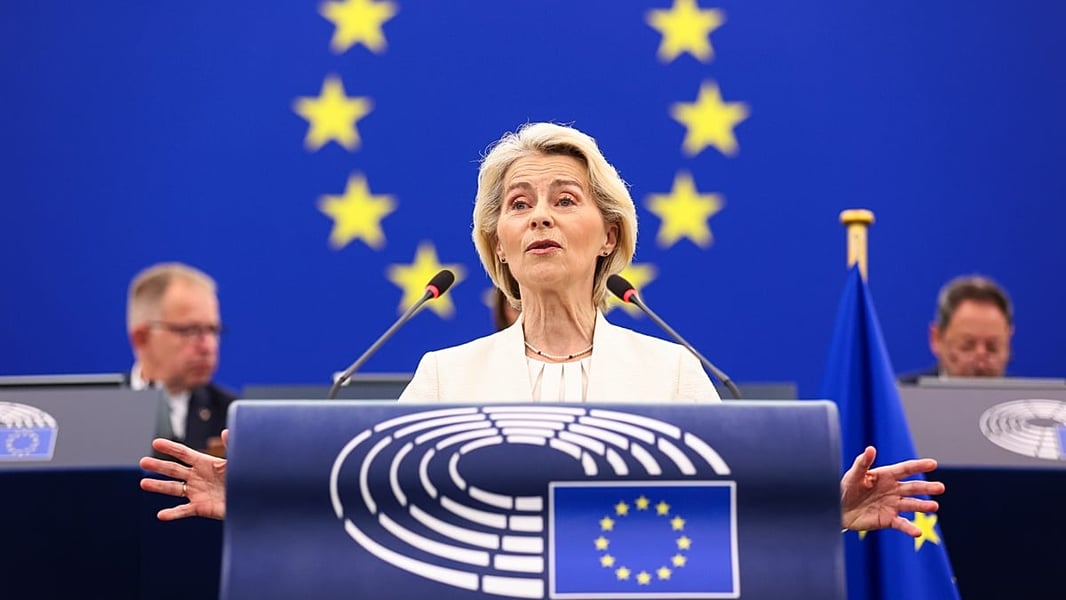
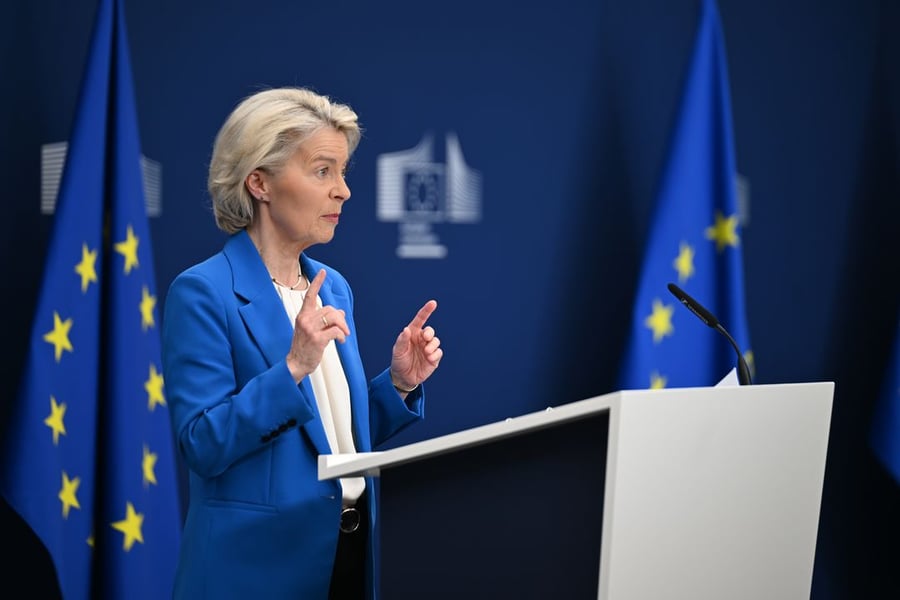
On Wednesday, European Commission President Ursula von der Leyen told the European Parliament in Strasbourg that Europe’s security doctrine had not kept pace with that reality. She proposed two structural remedies: a European Security Council that would seat EU leaders alongside counterparts from Britain, Norway, Ukraine and Canada, and an Emergency Security Protocol under which any EU member state could trigger a collective European response to sabotage, arson, cyberattacks or drone incursions without waiting for unanimous agreement.
“Europe needs its own counter-hybrid playbook,” she told the chamber.
The Emergency Security Protocol is explicitly modelled on NATO’s Article 4, which allows any alliance member to request consultations when it feels its security is threatened. Under von der Leyen’s version, a single EU member state activating the protocol would be enough to convene all twenty-seven member states, coordinate a common response, deter further escalation, and mitigate the impact of the incident. The Commission said it would publish specific legislative and institutional proposals before the end of the year.
The proposals mark the furthest the Commission has gone in asserting that Europe must build a security architecture that does not depend entirely on NATO, or on Washington’s willingness to sustain it.
The European Security Council, as von der Leyen described it, would function as a leaders’ forum rather than a formal treaty body. Its membership would extend beyond EU capitals to include Canada, Norway, Ukraine and Britain, none of whom are EU members. Euronews reported that she described the format as “focused on the security of our continent, with partners like Canada, Norway, Ukraine, the United Kingdom and others involved.”
Canada’s inclusion carried a particular weight. Prime Minister Mark Carney was seated in the chamber as a guest of honour, one day after von der Leyen proposed that Ottawa become the EU’s first associate member — a legal category that has never previously existed in the bloc’s treaties. Carney said afterward he welcomed the discussion.
Germany formally attributed the Leipzig drone incident to Russia in early September, making it one of the few cases where a member state has put its name publicly to that specific finding. Russia has also demonstrated a consistent pattern of frustrating multilateral security mechanisms, including at the UN Security Council, where it has blocked international oversight bodies from reconstituting.
What von der Leyen did not provide was an enforcement mechanism for the Emergency Security Protocol, a clear implementation timetable for the European Security Council beyond the Commission’s promise to “set out its ideas,” or any specification of what a coordinated European response to a confirmed hybrid attack would actually look like in practice. A consultative forum that brings together twenty-seven member states and four non-EU partners can produce consensus. It can also produce disagreement that leaves the triggering member state handling the threat alone.
The British reaction was absent on Wednesday. London’s post-Brexit relationship with Brussels has been carefully calibrated — warm on defence cooperation, cautious about any format that resembles formal re-integration. A European Security Council that seats the United Kingdom alongside EU heads of state moves onto institutional terrain that the Brexit settlement did not map. The British government has not commented.
The proposals arrive six days before the UN General Assembly high-level week opens in New York, where European leaders will negotiate in an environment shaped partly by their uncertainty about Washington. The Trump administration has not formally revoked its commitment to NATO’s collective-defence guarantee, but its framing of alliance obligations as bilateral bargaining instruments has pushed European governments to ask whether a guarantee that depends on continuous American political will is a guarantee in any operational sense. According to the European Commission, von der Leyen’s proposals are intended to establish European security coordination that functions independently of that question.
Germany, France and Poland have each articulated distinct visions of European strategic autonomy over recent years, with enough variation to guarantee friction when the Commission’s legislative proposals arrive. Von der Leyen named the right problem in Strasbourg on Wednesday. Whether the institutions she described become a genuine security architecture or remain a speech is a question the next few months will begin to settle.