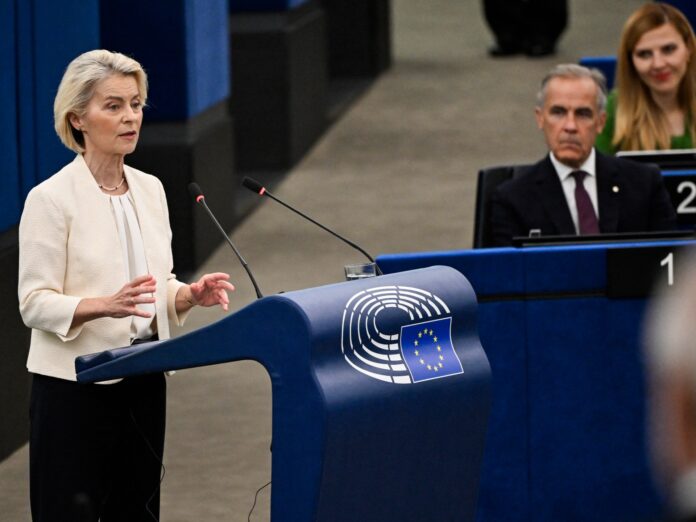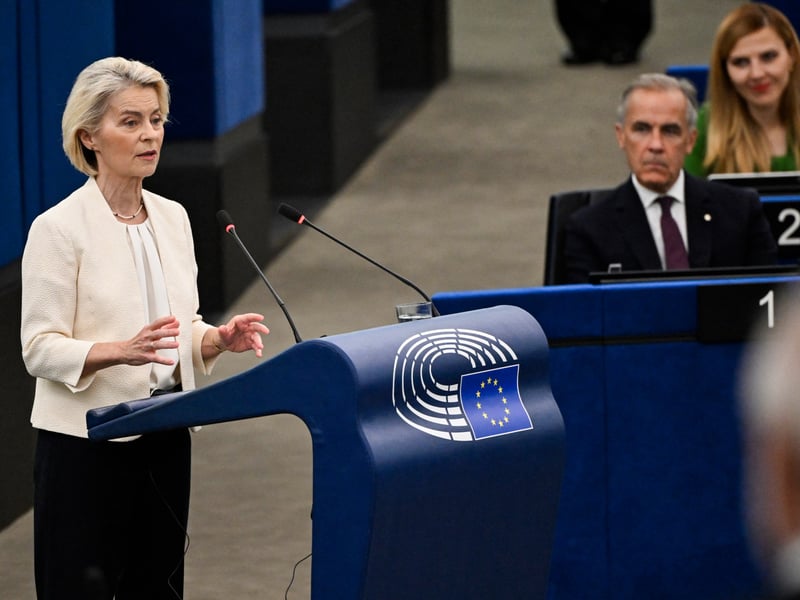

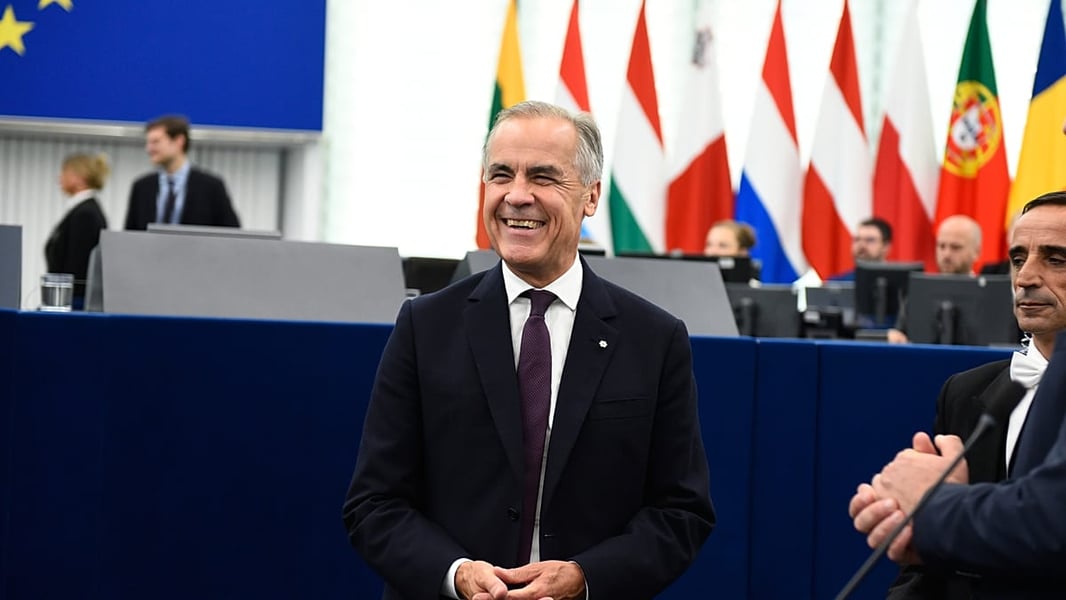
STRASBOURG — Mark Carney walked into the European Parliament on Tuesday and left with an offer no country outside the European continent has ever received.
European Commission President Ursula von der Leyen, delivering her annual State of the European Union address, invited Canada to become the bloc’s first associate member — a designation so novel it has no basis in any EU treaty and no established legal framework. Canada’s prime minister, there as a guest of honor, received a standing ovation from members of the European Parliament before the speech even began.
“We share one ocean, one set of values, one way of seeing the world,” von der Leyen told the chamber. The alliance she outlined was expansive: advanced manufacturing, a tech partnership, integrated defence industrial bases, an Arctic flagship project, energy and critical minerals, batteries, artificial intelligence, quantum computing, and cybersecurity. “We will move from CETA to an alliance for the future,” she said, describing a “common prosperity and economic security space” that would succeed the existing Canada-EU free trade agreement.
What the designation means in practice remains undefined. Associate membership is a concept the EU has never formally applied. German Chancellor Friedrich Merz first proposed the idea for Ukraine in 2023, but Ukraine is pursuing full EU accession. Canada, which has no geographic relationship with the European continent, represents something categorically different — and requires an entirely new legal architecture that European officials privately acknowledge does not yet exist.
Canada’s ambassador to the EU was measured. “We’re not there yet” on the label, the ambassador said, signaling that Ottawa may welcome deeper ties while remaining cautious about a term with no legal meaning.
All 27 EU member states would have to approve any such framework, a requirement that has historically taken years and fractured on domestic politics. Hungary’s Viktor Orbán has blocked EU decisions on far less contentious grounds.
Still, the context framed the moment as something more than ceremony. Von der Leyen’s pitch arrived against a backdrop of US tariffs that have hit both Canada and the EU, a Federal Reserve rate hike cycle that is compressing growth in commodity-dependent economies, and a broader unraveling of the US-led trade order that has pushed both Ottawa and Brussels to build alternative arrangements. Carney has been quietly deepening ties with BRICS-adjacent economies and multilateral forums outside Washington’s orbit, a strategy made more urgent by Trump’s tariff offensive.
Canada’s hesitation also has a domestic dimension. Any formal institutional alignment with the EU invites scrutiny from Canadian provinces with deep trading ties to American states. Quebec and Ontario together account for more than 60 percent of Canadian GDP, and both are enmeshed in North American supply chains no EU framework can quickly replace. Carney’s minority government faces real political limits on how far it can reorient without triggering domestic backlash.
The tech and defence dimensions of the proposal may prove more achievable in the near term than the headline framing suggests. Canada holds rare earth and critical mineral deposits the EU urgently needs to reduce Chinese supply-chain dependence. Both sides have defence industries that have been redirected toward greater autonomy from US supply networks. The Arctic dimension adds urgency: Canada controls access to shipping routes becoming commercially viable as sea-ice retreats, and the EU has deepening stakes in Arctic governance. These are concrete, transactional areas where both capitals have political incentives to move fast.
What neither side has resolved is the broader question that US strategic overreach leaves in its wake — whether the Western alliance system can be meaningfully rebuilt around different centres of gravity without American leadership, or whether new frameworks produce overlapping commitments that satisfy no one. Von der Leyen’s standing ovation on Tuesday was real. The legal text has not been written.