
TEHRAN – The twenty-fifth anniversary of the September 11 attacks passed last week in American commemorations of sacrifice and remembered horror. In Tehran, the mood was rather more complicated — not celebratory, but perhaps quietly vindicated. The quarter-century that followed the deadliest foreign attack on American soil produced, among its many consequences, the most dramatic expansion of Iranian regional influence in the Islamic Republic’s history. It was an outcome Iran did not plan, could not have engineered, and would not have predicted. Washington did the engineering.
Two decisions made in Washington in the years after the towers fell did more to reshape the Middle East in Iran’s favor than anything Tehran itself attempted. The first was the American toppling of the Taliban government in Afghanistan in the autumn of 2001. The second, and more consequential, was the American destruction of Saddam Hussein’s government in Iraq in 2003. Together, they removed the two powers that had bracketed Iran’s strategic position for decades — one a fanatical Sunni theocracy to the east that had repeatedly threatened Iran’s borders and oppressed Afghanistan’s Shia Hazara population, the other a secular Arab nationalist dictator to the west who had fought Iran in an eight-year war that killed hundreds of thousands of people on both sides.
Saddam Hussein’s Iraq had been, in Tehran’s strategic calculus, the primary threat to Iranian security since the 1980–1988 war. The Islamic Republic had spent decades sustaining Shia opposition networks inside Iraq precisely because it understood that a hostile Sunni-dominated state on its western border was an existential vulnerability. When American tanks rolled into Baghdad in April 2003, they did not merely topple one dictator. They handed Iraq’s Shia majority — long suppressed, long connected to Iranian clerical networks, long funded by the IRGC — the keys to a country that had been Iran’s most feared adversary.
What followed was a political transformation that no American war planner had modeled seriously. Iraqi Shia parties with deep ties to Tehran moved from underground exile to the center of government. The IRGC’s Quds Force, under the command of Qasem Soleimani, became the primary external power broker in the new Iraqi political landscape. By the end of the decade, Iran’s influence in Baghdad exceeded that of Washington, even as American soldiers continued to die in the country American policy had tried to remake.
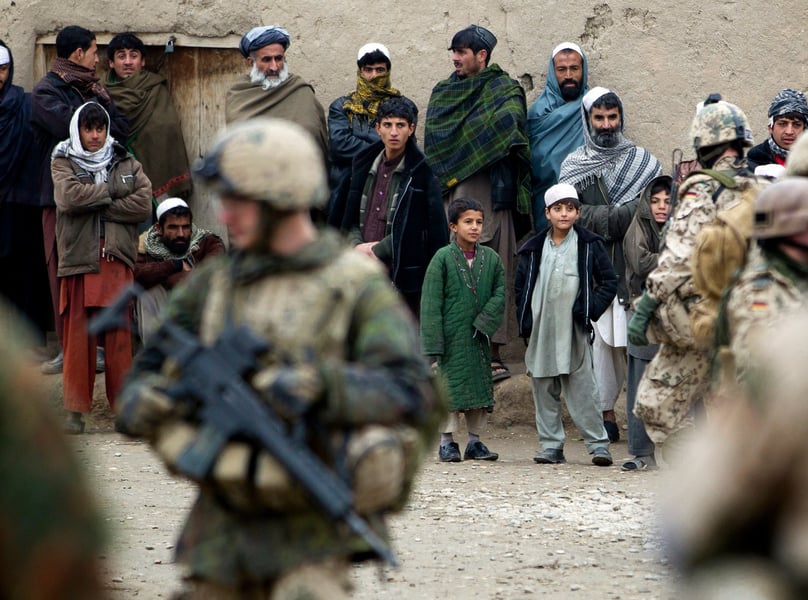
The Afghan removal created a different but equally significant strategic dividend. The Taliban had harbored not only al-Qaeda but persistent hostility toward Iran’s Shia identity and Iran’s support for Afghan Shia minorities. With the Taliban driven from power, Iran found breathing room on its eastern flank that it had not enjoyed since the Islamic Republic’s founding. The subsequent two decades of American occupation in Afghanistan never produced a stable or pro-Western state, but they did prevent the Taliban from consolidating the kind of state that would have renewed pressure on Iran. When the Taliban returned in 2021, Iran had already built the institutional relationships and strategic flexibility to manage coexistence rather than confrontation.
The cumulative effect of these two openings allowed Iran to build what its leadership came to call the Axis of Resistance — a loose but durable network of allied and affiliated forces stretching from Baghdad to Beirut to Sanaa. Hezbollah in Lebanon became, under Iranian tutelage, perhaps the most capable non-state military force in the region. Iraqi Popular Mobilisation Units, many of them IRGC-trained, added a second layer of deniable military capacity. Palestinian armed factions received Iranian weapons, financing, and training. And Yemen’s Houthi movement, which Tehran had initially regarded with ambivalence, became by the early 2020s a fourth front capable of closing the Red Sea and threatening Gulf oil infrastructure in ways that were unimaginable before 2001.
The United States attempted various approaches to reversing the tide over the years that followed. The surge of 2007–2008 disrupted some Iranian proxy networks in Iraq without dismantling them. Sanctions pressure beginning in the Obama administration imposed genuine costs on the Iranian economy but did not produce the political capitulation Washington sought. The assassination of Soleimani in January 2020 eliminated the architect of the Quds Force’s regional expansion but did not dismantle the structure he had built. Tehran’s posture toward Washington today — conditions-first engagement at best, strategic defiance at worst — reflects an institution that has spent twenty-five years learning that it does not need to match American military power to outlast American political will.
Iran’s current conflict with the United States and its regional partners is, in this sense, the logical destination of a journey that began on September 11, 2001. The IRGC that shoots down American drones over the Strait of Hormuz is an institution shaped by two decades of proxy warfare experience, sanctions adaptation, and the strategic lessons of watching American military interventions produce outcomes that benefited Tehran rather than Washington. The Houthis controlling Yemen’s coastline, the Iraqi factions capable of threatening American bases across the region, the network of precision rocket arsenals in Lebanon — all of it traces its lineage to the strategic opening that 9/11 accidentally provided.
None of this was inevitable. Tehran has made its own consequential choices over those twenty-five years: the decision to build the Axis of Resistance rather than seek accommodation, the decision to develop nuclear capacity as a deterrent and a bargaining chip, the decision to operate through proxies and deniable networks rather than conventional military buildups. These choices reflect a specific reading of Iran’s strategic situation — that the country’s geography, demography, and ideological commitments made a network-based regional posture more sustainable than direct state confrontation. Whether that reading was correct is a question the current war is now testing.
What remains genuinely unclear — and what the 25th anniversary cannot resolve — is whether the structure Iran built is durable or brittle under sustained direct pressure. The Axis of Resistance is built on alignment of interest rather than institutional cohesion. Iran’s network is powerful precisely because it is distributed; it is vulnerable for the same reason. A conflict that targets multiple nodes simultaneously imposes coordination costs that a centralized military would not face.
The United States did not intend to strengthen Iran. It intended to transform the Middle East in a direction favorable to American interests and, implicitly, to Israeli security. Neither outcome was achieved. What was achieved, through a combination of strategic miscalculation, political hubris, and institutional failure to model second-order consequences, was the removal of the two principal constraints on Iranian regional power. Twenty-five years later, the results of that removal are visible in every closed shipping lane, every stalled diplomatic conference, and every oil market shock that traces its immediate cause to a standoff Washington set in motion long before the first shot of the current conflict was fired.