
MUSCAT — The technical arrangements were complete. Seven foreign ministers had agreed on a route in which incoming commercial vessels would pass through Iranian territorial waters while outbound ships stayed close to Oman’s coast—keeping the Strait of Hormuz open without the costs and delays that had constrained global energy markets since February.
Salalah, the Omani port city on the Arabian Sea, was prepared to host the meeting.
None of it happened.
On Sunday evening, only hours before the first ministerial meeting between the six Gulf Cooperation Council states and Iran was scheduled to begin, Oman’s Foreign Minister Badr Albusaidi announced that it had been postponed.
“In the interests of consensus, the regional meeting set for tomorrow in Salalah has been postponed,”
Albusaidi wrote on X. No new date was provided.
The answer to why had arrived the day before. Bahrain’s Foreign Ministry said it would not participate, framing its absence as a matter of principle. “Security and stability in the region cannot be preserved through a policy of appeasement,” the ministry said, calling for the strait to be “open without discrimination, fees or permits.” The kingdom — which hosts the US Navy’s Fifth Fleet at Naval Support Activity Bahrain — was the lone Gulf holdout among the would-be participants. Iran, Iraq, Saudi Arabia, the UAE, Kuwait, Qatar, and Oman had all agreed to attend.
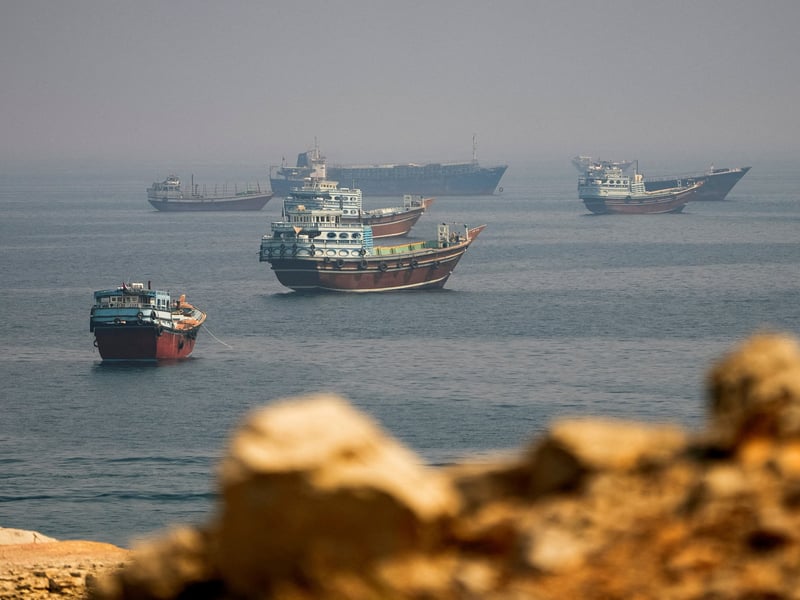
The Strait of Hormuz is not technically closed. Iran has maintained a navigational framework for vessels willing to coordinate passage with its maritime authority. But most Western insurers have declined to cover ships transiting under those conditions, and most major carriers have avoided the route since the war began in February, rerouting supertanker traffic through longer Red Sea and Cape of Good Hope alternatives at significant added cost. The proposed Salalah framework — inbound vessels through Iranian territorial waters, outbound through Omani waters — was designed to solve precisely that problem, giving insurers a defined route with Oman’s implicitly neutral waters on the exit side.
Iran’s Foreign Minister Abbas Araghchi had been direct about what the meeting was meant to accomplish — and how close it had come. Speaking before the postponement was announced, he said seven countries had been expected: the five GCC states willing to attend, plus Iran and Iraq. The technical details of new transit routes through the strait had already been finalised, Iran’s IRNA state agency reported. According to Al Jazeera, the framework would have given Iran a coordinating role in passage while ensuring commercial shipping could move without the current de facto disruption.
Saudi Arabia, whose infrastructure has already taken direct hits in this conflict — Houthi ballistic missiles struck at the King Khalid Air Base on Sunday even as the Salalah talks were being arranged — reportedly submitted amendments to the Omani-Iranian draft expressing concern that the language could inadvertently establish a new permanent status quo in the strait. Those amendments were a negotiating position. Bahrain’s refusal was something else.
That distinction matters. The GCC has long operated as a bloc that moves toward consensus, not away from it. Bahrain’s decision to stay out — and the particular language it chose to justify that decision — put the kingdom outside the room while six of its neighbours accepted an invitation to sit down together. TASS reported the postponement came after Iran and Oman agreed jointly on the delay, at the request of certain regional countries. Oman’s foreign minister did not identify which countries had objected.
The US Treasury had scheduled the designation of a major financial institution for Monday — the same day as the Salalah meeting — as part of the continuing sanctions campaign against Iran. Whether the timing was deliberate or coincidental, it produced a stark contrast: the Gulf states were moving toward a table, and Washington’s financial instruments were moving against it.
Oman has been the indispensable mediator in this conflict from the beginning — the one Gulf state that maintained functional relationships with both Tehran and Washington through multiple rounds of direct and indirect diplomacy. Salalah was not simply a neutral venue; it was Oman’s declaration that a workable Hormuz arrangement was achievable if the parties could agree on the terms. Six of the seven parties mostly had.
Araghchi said he hoped the talks in Oman would lead to more dialogue. That hope has now survived the collapse of its first major milestone. The proposed Hormuz framework remains technically agreed among six of the seven parties. What it has not yet survived is the question of whether the seventh party’s objections reflect a principled view of Gulf security — or a narrower set of interests that the other five GCC states, and Iran, were willing to set aside.