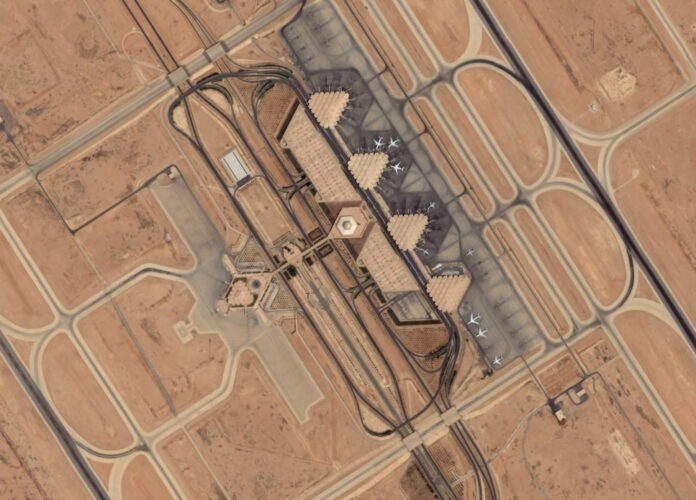

KHAMIS MUSHAIT — Khamis Mushait lies 230 kilometers from Yemen’s border, far enough inland that residents had grown accustomed to viewing the war from a distance. On Sunday night, that distance disappeared.
Yemen’s Houthi forces launched what they described as a “large-scale” ballistic-missile and drone operation against King Khalid Air Base, one of Saudi Arabia’s most strategically important military installations. The Houthis claimed direct hits on aircraft hangars, radar facilities, runways, and ammunition depots.
According to reports monitoring Houthi military communications, the strike was the second attack on the base in less than 90 minutes. For the first time in this phase of the Iran war, a major Saudi installation hundreds of kilometers from the front came under fire that the Houthis publicly claimed and described in detail.
The attack did not arrive without warning, though the warning itself is part of the story. Houthi military spokesman General Yahya Saree said the operation was launched in direct response to more than 300 Saudi airstrikes across Yemen in the five days prior. He did not specify civilian casualties in those strikes, but Houthi statements released alongside the military announcement referred to al-Hazm prison and residential areas. Saudi Arabia has not confirmed or denied specific damage to King Khalid Air Base.
What Saudi Arabia did confirm, earlier this week, is that a wave of Houthi attacks wounded 73 of its civilians and ignited fires at oil facilities and utilities across Abha, Jizan, Najran and Khamis Mushait, NBC News reported. That pattern — southern cities absorbing strikes on civilian and economic infrastructure simultaneously — is no longer exceptional. It is the baseline.
The King Khalid attack is one part of a three-front assault on Saudi Arabia’s strategic position that has unfolded since Wednesday. As this publication reported, Iraqi-origin drones struck Saudi Arabia’s East-West Pipeline on September 11, knocking out the 7-million-barrel-per-day artery that allows Riyadh to move oil to Red Sea terminals without passing through the Strait of Hormuz. The same day, Iran’s Islamic Revolutionary Guard Corps destroyed a US MQ-1 drone over the strait, a move that shut the Bab al-Mandab to normal tanker traffic. Brent crude pushed above $107 a barrel before settling back, but the structural supply problem remains unresolved as of Sunday.

Diplomacy was supposed to offer a third way out. The United States had previously ruled out a broader Hormuz framework without nuclear concessions from Tehran, as this publication reported Saturday. Oman stepped in to fill that vacuum, organizing a regional meeting in Salalah, gathering Iranian and Gulf Arab delegations to discuss a temporary shipping corridor through the strait. That meeting was scheduled for September 14. It never opened. Oman’s foreign minister Badr Albusaidi announced the postponement a day before it was to begin, writing that the session had been deferred “in the interest of consensus,” without specifying when it would be rescheduled. The Houthis struck Khamis Mushait the same day Albusaidi sent that message.
https://twitter.com/badralbusaidi/status/2099224052619735498
Bahrain’s refusal to attend the talks unless Iran restored diplomatic ties was one stated reason for the collapse. A less publicly stated factor, reported by multiple correspondents covering the Gulf, was that Saudi Arabia had grown reluctant to negotiate under active fire. As NPR’s coverage of the Salalah postponement noted, the simultaneous drone strike on the East-West Pipeline had made the kingdom’s security requirements for any deal substantially harder to satisfy. Agreeing to shipping arrangements while Houthi missiles are landing inside your air bases is a political position that no Riyadh government can hold.
The broader Iranian calculus remains difficult to read from outside. A hardline faction within Iran’s military establishment launched what are now thought to have been unauthorized Hormuz strikes in July, a pattern this publication examined when reporting on the internal divisions inside Tehran over the peace track. The Houthi attack on King Khalid Air Base, launched from Yemeni territory by a group that takes direction from but does not take orders from Tehran, adds another layer of ambiguity. Whether this was coordinated, approved, or simply enabled by Iran’s willingness to re-arm Houthi missile forces is a question Saudi Arabia and Washington will spend the coming days trying to answer.
What is not ambiguous is the geographic shift. King Khalid Air Base at Khamis Mushait is a long way from Bab al-Mandab. The war that began as a maritime and economic pressure campaign has now put ballistic missiles over a major military installation deep inside Saudi Arabia. As Al Jazeera’s reporting on Sunday’s wider Yemeni front makes clear, the conflict is simultaneously expanding on multiple axes. Every future escalation calculation, by Riyadh, by Washington and by Tehran, will have to account for a different map than the one they were using in July.
The Federal Reserve meets Tuesday. Oil is above $100. The Saudi pipeline remains closed. And the conference room in Salalah where Iran and the Gulf states might have begun talking is empty.