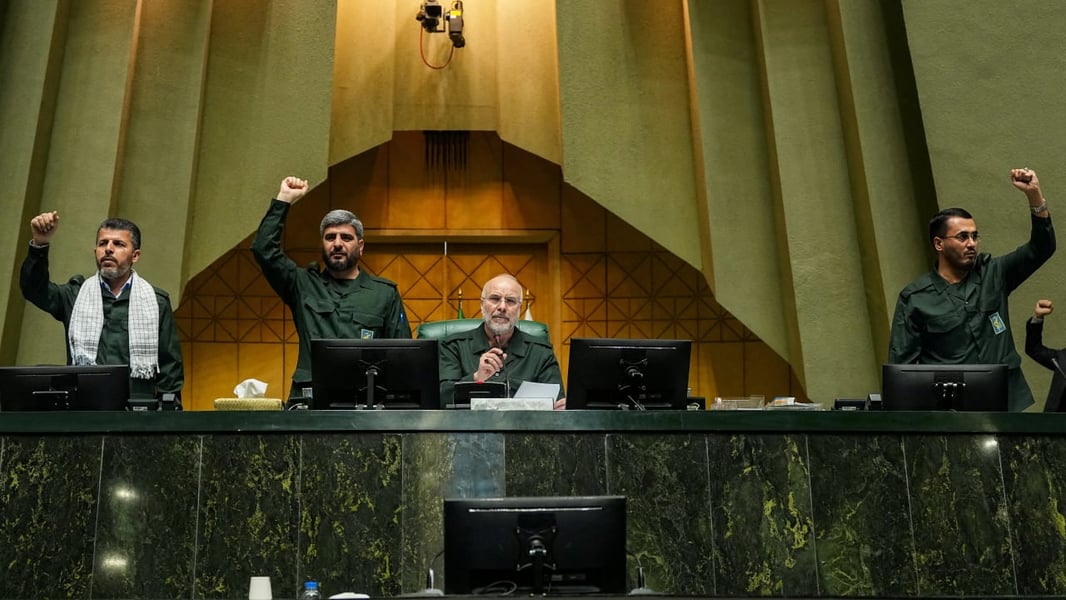

TEHRAN — When President Masoud Pezeshkian learned that Iranian vessels had struck shipping in the Strait of Hormuz in early July, he did not know it was coming. He called Ahmad Vahidi, the head of the Islamic Revolutionary Guard Corps, and asked directly. Vahidi told him he had not authorized the strikes. The Supreme National Security Council had not been informed either.
The attacks happened anyway. A hardline faction inside Iran’s military establishment, operating outside the command chain Pezeshkian believed he controlled, had effectively launched its own campaign in the Strait, destroying a Memorandum of Understanding between Tehran and Washington that had taken months to negotiate. The Times of Israel reported the details on Saturday.
The head of that faction is Hossein Taeb, a cleric who served for years as the IRGC’s intelligence chief before being reassigned to lead the Basij, the paramilitary volunteer force at the core of Iran’s internal security apparatus. Taeb has been explicit about his opposition to negotiations. The Iranian nation, he said after the MOU collapsed, accepts neither coercion nor talks whose outcome would weaken the country’s rights. It was the language of total rejection dressed as principle.
Saturday gave the July episode immediate context. An Iranian cargo vessel was struck by a projectile near Qeshm Island in the Strait before dawn, killing one crew member and wounding four, in the same hours that foreign ministers in Salalah were signing a navigation framework intended to reopen the waterway. The attack was not claimed. No party has established who launched it. But the July precedent means the question cannot be dismissed: if Taeb’s faction was willing to stage unauthorized strikes in the Strait once, without the knowledge of the IRGC chief or the president, the September 13 attack on an Iranian cargo vessel fits a pattern Pezeshkian’s government has not publicly addressed.
Iran’s officials attributed the Qeshm attack to a “terrorist enemy,” language that points away from internal actors. That attribution came from the Qeshm Island governor, a regional official, not from Tehran. The silence from the center has been notable.
At the BRICS summit in New Delhi on Saturday, Pezeshkian publicly rejected Trump’s framework for ending the war, telling assembled leaders that Iran would not yield under military pressure. That was the diplomatic face: defiant, multilateral, projecting sovereign confidence from Modi’s capital while Washington pressed coalition partners to deploy warships to Hormuz. The military reality behind it is of a government that had not succeeded in translating diplomatic confidence into operational control over its own armed factions.
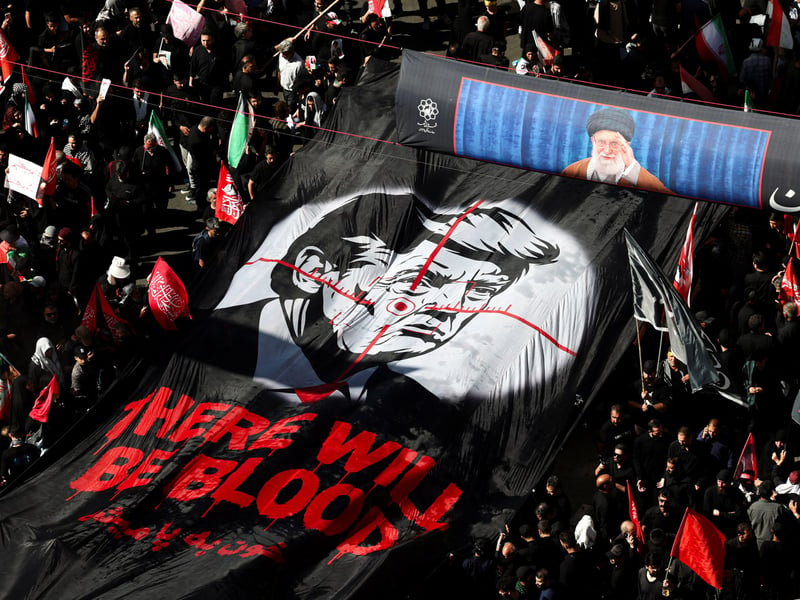
Khamenei’s public posture has been one of conditional support for the peace track while leaving the door open to the hardline position. That ambiguity is either strategy or uncertainty. If it is strategy, Taeb’s faction is operating with tacit authorization never publicly acknowledged. If it is uncertainty, Iran’s command structure is not functioning as a unified hierarchy, and the Salalah navigation framework signed this morning is being tested before its text has been formally filed.
The Jerusalem Post reported separately on Saturday that hardliner commanders had been pressing to continue the war until Washington met a full set of preconditions: sanctions fully lifted and frozen funds released before any Hormuz reopening. Those demands, attributed to Taeb’s faction, are not the position Tehran formally presented in negotiations. They are a harder line, not addressed to Washington but to Pezeshkian’s own government.
The Salalah framework, signed by Gulf Cooperation Council foreign ministers and mediated by Oman, has no Iranian signatories. Iran was present in the diplomatic process through back-channels but did not formally join the agreement. That distinction matters beyond protocol. Even if Pezeshkian’s government accepted what Salalah intends, which the government has not said publicly, the hardline faction that staged unauthorized strikes in July was not bound by any agreement the presidential track signed. What would bind them now is not established.
Trump said on Saturday that he does not care about the Oman meeting, adding that the war would end this year, possibly just after the November midterm elections. That timeline, repeated twice in a week, may be the only external pressure point that aligns with Pezeshkian’s interest in slowing the hardline faction down. A deal before midterms is something Trump wants. Whether Taeb’s faction intends to let one materialize is a different question.
What Vahidi told Pezeshkian in early July, that the strikes had not been authorized, is a statement about what the IRGC chief said. It does not establish whether anyone in a position of final authority had sanctioned what happened and chose not to inform the council above it. Those questions determine whether the July incident was genuinely rogue or a sanctioned operation dressed up as one. They also determine what the unclaimed strike in the Strait this morning means, and whether any framework signed in Salalah or anywhere else carries operational weight inside the Islamic Republic.