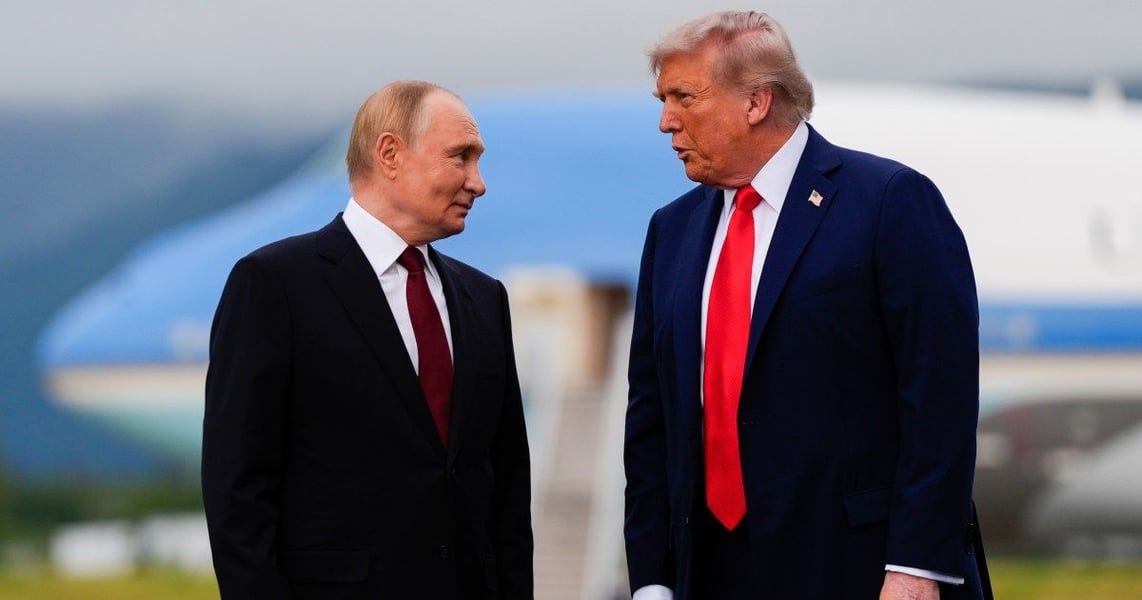

WASHINGTON — President Donald Trump announced on October 9 that Russia would supply diesel to US and global markets after a discussion with Vladimir Putin, turning to Moscow to address high fuel prices before November’s midterm elections. Washington also temporarily eased restrictions on Russian diesel transactions, a change that drew condemnation from Ukrainian President Volodymyr Zelenskyy.
Trump said Russia would supply more than 300,000 tons immediately, followed by 500,000 tons in November and 1 million tons thereafter. NPR reported the announced volumes and sequence. These figures describe Trump’s commitments, not independently verified deliveries.
A further 3 million tons would depend on the condition of Russian refineries, according to CNBC’s account of the announcement. That condition distinguishes the largest proposed tranche from the initial release and prevents the entire announced amount from being treated as an immediate addition to supply.
The Treasury Department issued a temporary license allowing Russian diesel transactions through April 2027, CNBC reported. The license provides a sanctions mechanism for the proposed trade; it does not amount to a lifting of all restrictions on Russian energy or the Russian economy.
The announcement changes Washington’s approach to one part of Russia’s energy trade. US pressure on Moscow has sought to restrict revenues linked to its war in Ukraine, while the new opening is intended to address fuel costs at home. Deutsche Welle described the decision as a reversal of years of pressure on Russia’s economy following the Russian operation in Ukraine.
Trump’s announcement covers both American and global markets. It does not identify an exclusively American allocation, and the total proposed release should not be presented as fuel destined entirely for US buyers.
The first 300,000 tons represent approximately 2.2 million barrels, according to Yahoo Finance. Tons and barrels are different measures, and the announced quantities should not be described interchangeably without that conversion.
The stated sequence also matters. Trump described an initial release, a November tranche and later supplies, rather than one shipment of several million tons. November supplies would coincide with the month of the midterm elections, but the announcement does not establish when particular shipments would arrive or when their effects might reach consumers.
CNBC reported that damage to refineries linked to wars in Eastern Europe and the Middle East has left Trump with limited options to reduce diesel prices quickly. The proposed Russian supplies address that constraint through additional fuel for the market, rather than through a reported expansion of US refining capacity.
The announcement does not, by itself, demonstrate a reduction in retail prices. Nor does a subsequent price movement alone establish how much of the change resulted from Russian supplies. Announced export volumes, fuel received by American buyers and prices paid by consumers are separate measures of the plan’s outcome.
Payment arrangements and buyers remain unresolved in the reporting reviewed for this article. The available detail does include volumes and a partial timetable, however, so the agreement should not be characterized as having no announced schedule or scale.
Zelenskyy condemned the decision to ease restrictions on Russian diesel exports. ITV reported his criticism of the arrangement as a gift to Putin, placing Ukraine’s objection alongside Trump’s promise of cheaper fuel.