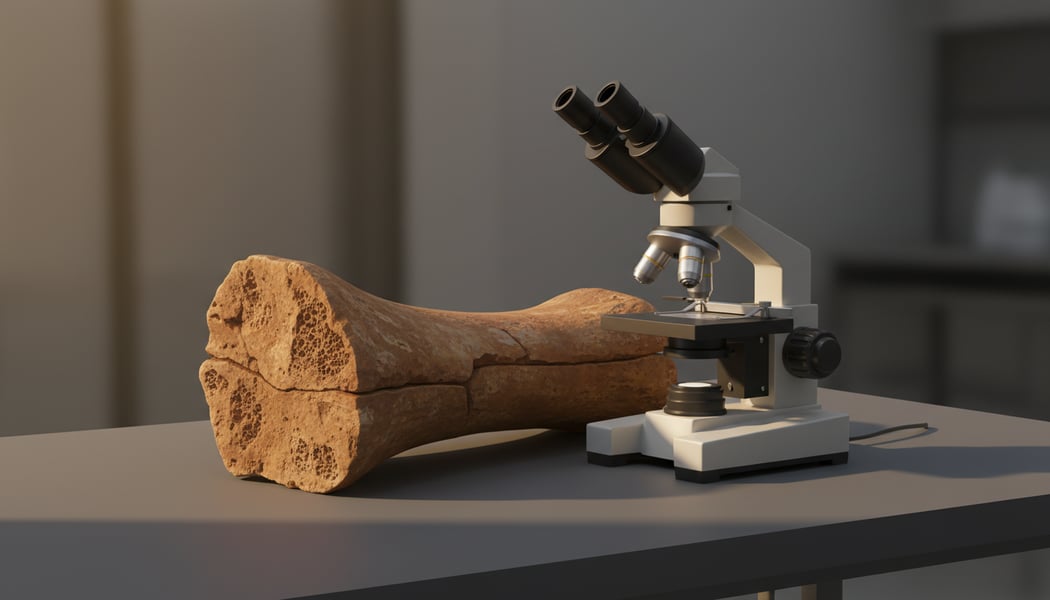

Scientists studying a dinosaur bone from Brazil say they have identified chemical evidence associated with blood inside microscopic structures resembling red blood cells, offering a possible glimpse of biology preserved for about 115 million years.
The finding concerns mineralised structures and chemical residues, not liquid blood or intact tissue. An international team led by Curtin University geochemist Kliti Grice examined limb bones belonging to Aratasaurus museunacionali, a meat-eating dinosaur from the Early Cretaceous period.
The research, published on November 2 in the Proceedings of the National Academy of Sciences, reports heme-derived compounds alongside cell-like structures inside the fossil’s vascular canals. The authors interpret that combination as evidence of ancient red blood cells, although independent specialists have questioned whether the interpretation is conclusive.
What the researchers found
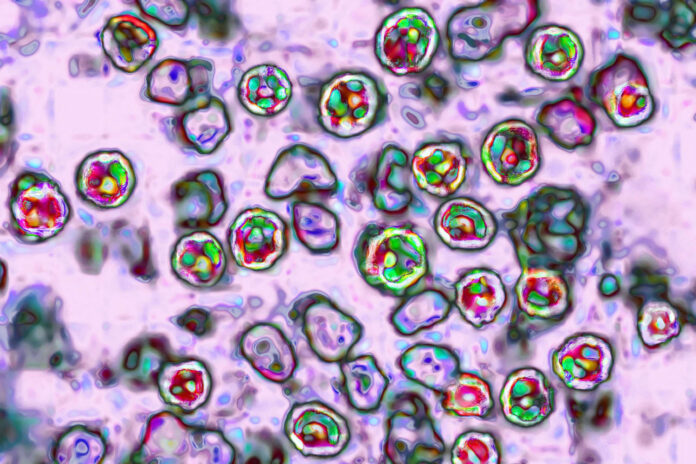
The team focused on tiny channels within the bone that once accommodated blood vessels. Inside those passages, the researchers observed numerous oval structures that resembled red blood cells. Their significance depended not simply on their shape, but on the chemical evidence associated with them.
Heme is an iron-containing component of haemoglobin, the protein that enables red blood cells to carry oxygen. Identifying heme-related chemistry in the same locations as the microscopic structures strengthens the case that the features retain a connection to the animal’s original biology.
According to Reuters’ reporting on the discovery, the fossil came from the right leg of an animal thought to have been a juvenile or young adult, approximately four years old when it died. The dinosaur lived in what is now Brazil during the Cretaceous period.
Why chemistry matters more than appearance
Shapes that look biological are not, by themselves, proof of preserved cells. The researchers therefore combined microscopic imaging with chemical analyses to investigate what the structures contained and how they were situated within the fossil.
Science News reported that the team observed ellipsoid structures about 20 micrometres across. Elemental mapping showed associations with iron, carbon and nitrogen, while molecular testing identified heme-related compounds in the bone. The location of those features within the vascular network was another part of the team’s argument.
The study describes heme-derived tetrapyrroles, a class of ring-shaped compounds, rather than claiming that every component of an original blood cell survived unchanged. That distinction is central to understanding what the discovery can, and cannot, establish.
Not a vial of dinosaur blood
Grice has emphasised that the findings should not be understood as the recovery of ordinary blood. Instead, the research concerns a mineral and molecular record of ancient biological material altered during fossilisation.
In its November 8 report, The New York Times similarly distinguished the reported chemical signatures from dried or intact dinosaur blood. The claim is about evidence linked to blood chemistry, not a sample that could be handled like blood taken from a living animal.
That makes the discovery a question of preservation and interpretation. Researchers are trying to determine how much biological information can remain within a fossil after the original organism and its tissues have undergone extensive chemical and mineral changes.
Why some scientists remain cautious
The research has attracted interest because detecting molecules alongside cell-like structures could make the evidence more persuasive than a visual resemblance alone. But the interpretation has not won universal acceptance.
Smithsonian’s coverage notes that not all experts are convinced. The key question is whether the combined evidence securely identifies fossilised red blood cells and their original chemistry, rather than another explanation for the structures and molecules.
The authors argue that the abundance of cell-like features, their mineralisation, their position inside the bone and the associated chemical signals reinforce one another. That is a stronger and more specific claim than saying a fossil contains objects that merely look like blood cells.
What the finding could change
If the interpretation holds up, the study would expand the evidence that very old fossils can preserve molecular information as well as anatomical shapes. It could also help researchers recognise which specimens merit closer chemical investigation.
For now, the most careful description is that the team reports blood-related chemical traces associated with possible red blood cells in a 115-million-year-old dinosaur bone. The importance lies in that unusual combination of chemistry and microscopic structure, while the debate concerns how confidently it can be traced to the dinosaur’s own blood.