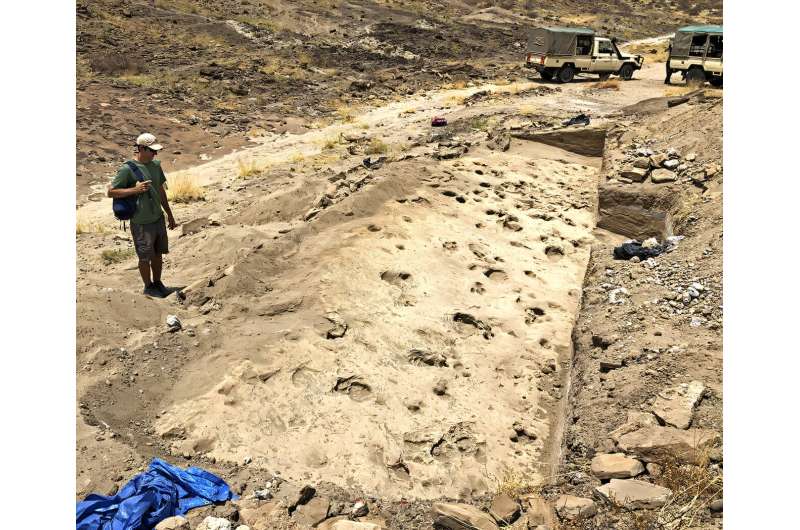

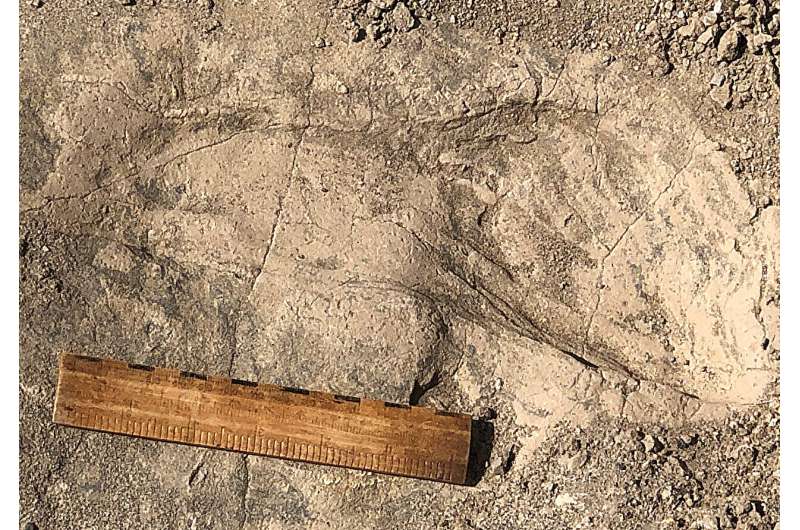
NAIROBI – On the eastern shore of what is now Lake Turkana, a group of eight individuals moved through soft sediment 1.43 million years ago. Most were adult males. They moved together, and what they pressed into the volcanic ash-laced mud survived them by more than a million years. Twenty-one footprints from those eight individuals were published Monday in the Proceedings of the National Academy of Sciences, and they are revising the scientific understanding of a species long cast as a secondary figure in human evolution.
The species is Paranthropus boisei, a hominin that shared the African landscape with Homo erectus during the early Pleistocene. For decades, P. boisei was understood as robust but slight, with wide jaws adapted for hard plant foods and a braincase smaller than its contemporaries. The footprints from the GaJi10 site, in the Lake Turkana region of northern Kenya, change that picture in two ways. They indicate a body reaching approximately six feet in height and weighing around 165 pounds, figures that bring P. boisei directly into comparison with Homo erectus specimens from the same period.
The composition of the group is the second and less expected finding. Eight individuals left tracks at the site, and the pressure distributions and stride measurements indicate that most were adult males. The researchers describe this as evidence of male-aggregation behavior – a social pattern more familiar in primates that form multi-male coalitions. What produced the grouping, whether common foraging, mutual defense, or coalition dynamics, the study does not attempt to answer from the available evidence. The site preserves a moment, not a pattern.
“The fact that eight, mostly adult male, P. boisei individuals seemingly traveled together as a group hints at a complex social structure,” said Roach, a co-author at Harvard University. Complex social structure, in this context, means males that could tolerate one another in proximity – a behavioral threshold that many competitive primates do not cross. Whether the females and juveniles were elsewhere at the time, or are simply not represented by preserved tracks, is unknown.
The GaJi10 site lies within the Lake Turkana basin, one of the richest repositories of early human fossil evidence on Earth. Volcanic ash layers above and below the footprint-bearing stratum confirmed the 1.43-million-year age through geochemical analysis. The same volcanic geology that made the basin catastrophic for its ancient inhabitants made it exceptionally good at preserving what they left behind. Research has shown that human ancestors survived the asteroid impact that killed the dinosaurs partly because of their adaptability across changing environments – the Lake Turkana evidence has repeatedly demonstrated that adaptability across millions of years of hominin history.
The body-size finding carries particular weight because skeletal evidence for P. boisei had pointed toward smaller estimates. The GaJi10 prints map to dimensions that rival contemporary Homo erectus populations, raising the possibility that the species was more physically variable than the fossil bone sample suggests. Kevin Hatala, the study’s lead author and an Associate Professor of Biology at Chatham University in Pittsburgh who also holds a position at the Max Planck Institute for Evolutionary Anthropology in Leipzig, has described the Turkana basin footprint record as uniquely capable of capturing individual variation that fossilized bones, which preserve only the dead, tend to flatten out.
The question of how P. boisei and Homo erectus coexisted has long been framed in competitive or complementary terms – two species in the same landscape with different food strategies. Evidence published earlier this year challenged the traditional view that early humans relied primarily on active hunting, suggesting instead that meat-acquisition strategies were opportunistic and flexible. If P. boisei was larger than previously thought, its ecological niche may have been less fixed than models assumed, and the dynamics between it and Homo erectus more contested.
A genetic study of Neanderthal family groupings reconstructed from 100,000-year-old teeth in Poland showed that even distant hominin cousins organized into tight kinship units – a finding that arrived this spring as a reminder that social complexity long predates Homo sapiens. The GaJi10 prints push that complexity back by more than a million additional years. Whether the male cohort at Lake Turkana represents kinship, alliance, or circumstance is a question the paper deliberately leaves open.
The research team included scientists from the Smithsonian Institution’s National Museum of Natural History, the National Museums of Kenya, Chatham University, and the Max Planck Institute for Evolutionary Anthropology. The footprints were excavated and analyzed using three-dimensional scanning that produces pressure distribution maps and stride-length estimates without disturbing the original track surface. Recent work on Asgard archaea as the probable common ancestor of all plants, animals, and fungi illustrated how evolutionary biology continues to reorganize its foundational assumptions – the GaJi10 footprints are part of that same revision at a much shorter timescale.
No footprints from females or juveniles were identified at GaJi10. The study does not assert that none were present; the preserved area may capture only a portion of the group’s movement. What the site provides is eight individuals, a single direction of travel, and a moment. P. boisei disappeared approximately one million years ago. The new size data and the evidence of male sociality may refine models of how and why that disappearance happened, but the prints are not a narrative – they are a frame of reference without a story attached to them.
A Neolithic burial site reported in June held 77 headless skeletons in a ditch in Slovakia, each detail precise, the meaning irreducibly contested. The GaJi10 tracks are older by more than a million years and more ambiguous by an equivalent distance. Twenty-one footprints. Eight individuals. Mostly male. One afternoon, 1.43 million years ago. What those eight individuals were doing together, and whether they ever crossed that particular patch of ground again, is not something a footprint can tell. What it can tell – that they were here, that they were larger than expected, that they were not alone – is already more than most of their kind left behind.