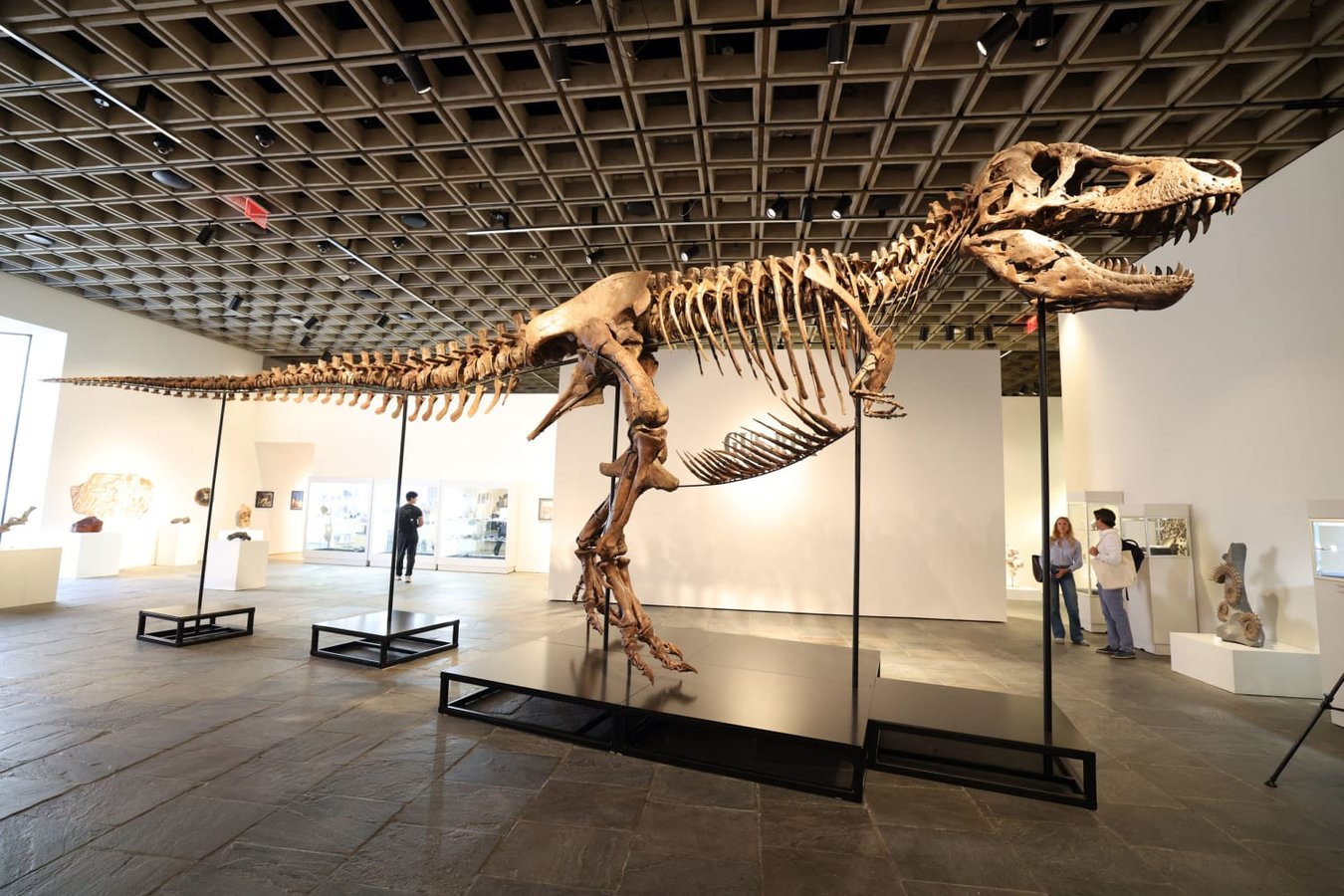

NEW YORK – When the gavel fell at Sotheby’s New York on Tuesday afternoon, “Gus” had become the most expensive fossil ever sold at public auction. An anonymous bidder paid $50.1 million for the 38-foot Tyrannosaurus rex, a price that surpassed the pre-sale estimate by more than 67 percent and reset a record that had stood for only two years.
Gus was excavated between 2021 and 2023 from the Hell Creek Formation in Harding County, South Dakota, one of the world’s most productive sites for Late Cretaceous remains. The specimen is 61 percent complete by bone count, comprising 183 individual fossil elements representing between 75 and 80 percent of the animal’s total bone mass. Standing 12.5 feet tall with a 54-inch skull and a femur measuring more than 50 inches, the T. rex dates to approximately 67 million years ago.
The previous record holder was a Stegosaurus skeleton named “Apex,” also sold at Sotheby’s New York, which fetched $44.6 million in 2024. That sale had itself shattered what observers assumed was a ceiling for natural history at auction. Sotheby’s estimated Gus would sell for $20 to $30 million. The final price, inclusive of fees, exceeded that upper bound by more than $20 million. Anadolu Agency reported that the buyer’s identity was not disclosed by the auction house.
The sale renews a long-running argument about who should own the prehistoric record. Paleontologists have repeatedly warned that private acquisitions of significant specimens remove irreplaceable material from scientific circulation. Fossils held privately cannot be studied without the owner’s permission, cannot be deposited in peer-reviewed datasets, and can be resold at any time into obscurity. When the T. rex known as “Sue” sold for $8.3 million at Sotheby’s in 1997, a museum consortium stepped in to keep it in public hands. The consortium included corporations funding the Field Museum’s bid specifically to ensure the specimen remained accessible to researchers and the public. No comparable rescue has been announced for Gus, and Sotheby’s did not comment on whether any scientific institution had been in contact with the anonymous buyer.
The Hell Creek Formation, which runs across North and South Dakota, Montana, and Wyoming, has yielded more T. rex specimens than any other site in the world. Commercial fossil hunting on private land is legal under United States law, and the Gus specimen was excavated on private ranch property over three years, from 2021 to 2023, by a team working under the property owner’s authorization. It was never subject to the federal fossil protections that apply to material found on government territory, which cover Bureau of Land Management and National Forest lands. Fossil rights on private land pass to the landowner, a legal framework that has made South Dakota a center of the commercial specimen market and a persistent source of tension with university paleontologists who need legal access to such material to do their work.
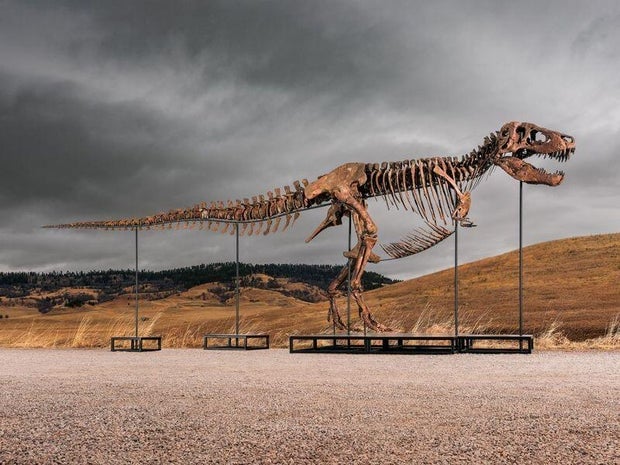
Completeness matters considerably in the T. rex market. Of the roughly 50 partial T. rex specimens ever recovered, only a small number exceed 50 percent by bone count. At 61 percent, Gus ranks among the most complete known specimens outside institutional collections. Its femur, at more than 50 inches, indicates an animal that reached the upper range of known adult T. rex dimensions. The skull, at 54 inches, falls within the parameters of the species’ largest documented individuals, an anatomical profile that adds premium to an already rare category of object.
The market for significant vertebrate specimens has shifted sharply. Sue, the T. rex sold at Sotheby’s in 1997, went to the Field Museum in Chicago after McDonald’s and Walt Disney contributed to the acquisition, briefly stabilizing expectations about where such material would end up. No equivalent institutional effort has materialized for the major specimens sold since. The Society of Vertebrate Paleontology has for years advocated for legislation restricting the commercial sale of scientifically significant fossils, but no such bill has advanced through Congress despite repeated calls from the academic community.
It is not the only category to see records set at auction this year. A sealed copy of the original 1985 Super Mario Bros. sold for $3 million at Heritage Auctions in June, a new benchmark for video-game collectibles that itself drew scrutiny over how grading firms establish provenance and condition. The Gus sale puts fossil prices in a different category entirely, one where the underlying asset is by definition finite, where every specimen removed from the ground is one fewer available to science, and where the institutional rescue model that worked for Sue looks increasingly unlikely to scale to the current price range.
Where Gus goes is the question the record cannot answer. Sotheby’s has not confirmed whether the anonymous buyer has expressed any intention to loan the specimen to a museum or make it available for researchers. Paleontologists will be watching. A specimen this complete can address questions about locomotion, growth rate, and skull morphology that a more fragmentary skeleton cannot. Whether those questions will ever be put to Gus depends on whoever signed the check, and on what they decide to do with an animal that last walked the earth 67 million years ago.