
NEW YORK – Goldman Sachs reported second-quarter net income of $6.6 billion on Tuesday, a 78 percent increase year-over-year and the bank’s strongest quarterly profit performance since the post-pandemic financial boom, as every major segment of its capital-markets franchise climbed on the back of an AI-driven surge in corporate dealmaking and trading volume.
Revenue for the quarter reached $20.3 billion, up 39 percent from the same period a year earlier. Earnings per share came in at $20.98, nearly doubling from $10.91 in the second quarter of 2025. The results arrived alongside record performances from JPMorgan Chase, Citigroup, Bank of America, and Wells Fargo, collectively making the second quarter of 2026 the most profitable earnings season in US banking history.
The performance places Goldman sharply ahead of its capital-markets peers in growth terms. JPMorgan Chase reported net income of $21.2 billion on the same day, up 41 percent, on revenue of $57.3 billion. Citigroup posted a 45 percent net income gain to $5.8 billion. Bank of America earned $9.1 billion, up 27 percent. Wells Fargo, with a heavier consumer lending book, posted the most modest gain of the group at 17 percent growth to $6.4 billion.
Goldman’s 78 percent gain dwarfs all of them in growth terms. The gap reflects structural differences in revenue composition. Goldman operates a franchise built primarily around investment banking, equity and fixed-income trading, and asset and wealth management, segments that correlate directly with market activity and deal flow rather than the net interest margin dynamics that govern most commercial bank earnings. In a quarter defined by AI-related capital expenditure driving unprecedented corporate financing demand, Goldman’s revenue mix sits closer to the center of that cycle than any other major US lender.
The second quarter included the closing period of the SpaceX initial public offering, which launched its roadshow in June at $135 a share and ranked among the largest US technology listings in years. Investment banking fees from major technology and AI-infrastructure transactions accrued to capital-markets banks throughout the period, as data center developers, semiconductor manufacturers, and energy companies tapped public and private markets to fund capacity expansion. Goldman’s revenue exposure to that pipeline is larger than any commercial bank with a consumer-lending-heavy balance sheet.
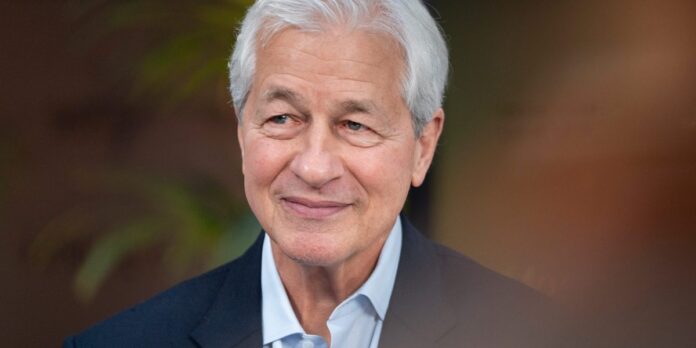
JPMorgan Chairman Jamie Dimon, whose bank posted the most profitable quarter in US banking history in absolute terms, attributed the performance to conditions he described as close to optimal. Anadolu Agency reported Dimon cited “stronger business investment, employment growth, artificial intelligence-related capital spending, and fiscal stimulus” as the primary drivers of the quarter, while adding a caution: “geopolitical tensions, persistent inflation, and elevated asset prices continue presenting significant risks ahead.”

The Federal Reserve is the most consequential variable looming over the second half of the year. Fed Chair Kevin Warsh told Congress this week that the central bank has no tolerance for persistently high inflation and declined to signal when rate cuts would begin. The rate environment has compressed net interest margins for consumer-facing lenders but has not materially dampened capital markets activity, which correlates more closely with risk appetite and deal volume than with the short end of the yield curve.
The broader second-quarter performance reinforces a structural observation that has been building since the AI infrastructure investment wave began: the financial intermediaries routing capital to the companies building AI are capturing a disproportionate share of the value being created. IBM’s shares fell more than 23 percent on Tuesday – the same day Goldman and JPMorgan reported their records – after the technology company warned that customers were redirecting capital spending toward servers, storage, and memory chips. IBM’s traditional software and consulting revenues were squeezed by the same capital flows that filled Goldman’s investment banking pipeline. The divergence between the two results is the same cycle expressing itself on both ends of the ledger.
The sector’s profitability is not without tension. US banks collectively carry significant exposure to commercial real estate portfolios that have not stabilized, and elevated interest rates have increased default rates in credit card and auto lending books at the largest consumer lenders. Dimon’s geopolitical warning was aimed at an investment community that has absorbed strong bank earnings across several consecutive quarters as confirmation that macroeconomic risks are contained rather than deferred. They may be both.
Goldman’s $6.6 billion quarter does not settle what the second half of 2026 will deliver. The bank’s earnings are highly sensitive to market conditions; a risk-off environment that suppresses deal flow and trading volume can reverse a strong first half quickly. Whether the AI infrastructure investment cycle extends or peaks, and whether the Federal Reserve begins normalization in ways that alter the dealmaking calculus, will determine how the industry closes the year. For now, Goldman’s numbers say that the conditions that produced the record are still in place. The next earnings cycle, three months out, will say whether they held.