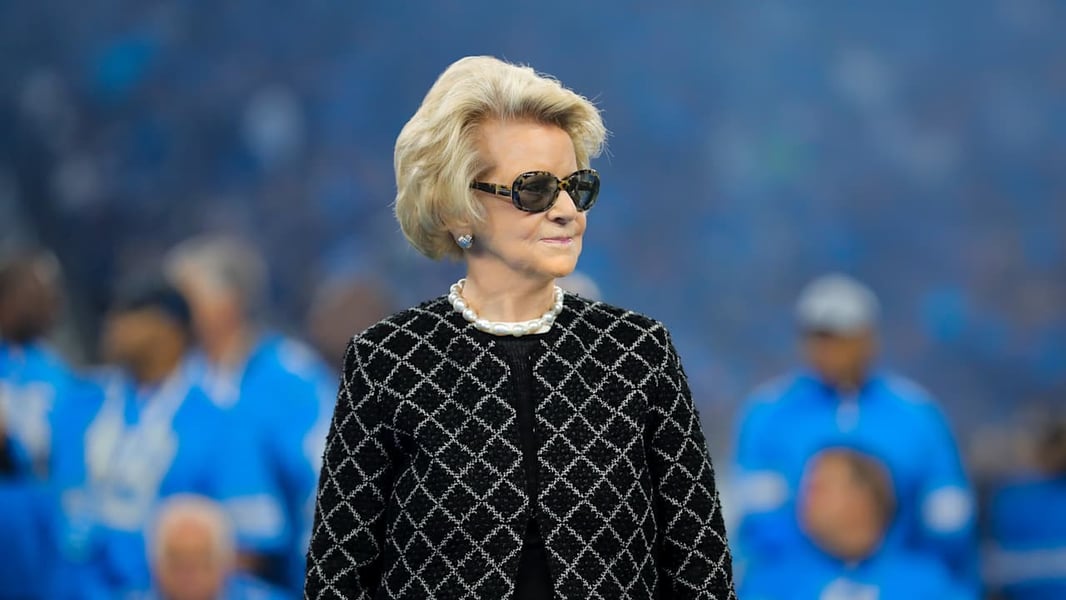

DETROIT – When Martha Firestone Ford was congratulated on reaching the playoffs in her first season running the Detroit Lions, she did not treat the achievement as a destination. Her answer was brief: “We have more to do.”
Ford, who died at 101, spent six seasons as the franchise’s principal owner and remained a presence long after handing leadership to her daughter. The Lions announced Tuesday night that she had died at home surrounded by family. Their announcement did not disclose a cause of death.
She assumed control after her husband, William Clay Ford, died in 2014, and transferred principal leadership to Sheila Ford Hamp in June 2020. Her death closes a life intertwined with the club for more than six decades, but not a new ownership transition: the succession had already taken place.
In their official announcement, the Lions said Ford was still attending games this season. That continuity, from the family purchase of the team in 1963 through her years as owner and chair emeritus, was a central feature of the tribute.
Her own period in charge was less quiet than her public profile might have suggested. Detroit reached the playoffs in 2014 and 2016. Between those appearances came a decision that made her expectations unmistakable: with the team 1-7 in 2015, she dismissed president Tom Lewand and general manager Martin Mayhew during the bye week.
Both were longtime front-office figures. Ford announced the changes personally and told supporters she still expected the team to compete for a playoff berth. The Lions won six of their final eight games, but the recovery was not enough to get them into the postseason.
The episode is important to separating her place in the franchise from the broader story of family ownership. She was not simply preserving her husband’s arrangements. Within her second season at the top, she removed the executives responsible for running the football operation.
A Lions retrospective published when she stepped aside in 2020 described a hands-on owner who attended NFL meetings, spoke with commissioner Roger Goodell and stopped to talk and pose for photographs with fans. It also recorded her response to that first playoff berth, a small exchange that conveyed the distance between making the field and satisfying the owner.
The first of those playoff teams finished 11-5 under coach Jim Caldwell. Detroit returned to the postseason two years later, but the closing years of Ford’s principal ownership were harder. After seasons of 6-10 and 3-12-1, she made clear that she wanted the team to contend for a playoff place and play meaningful games in 2020.
The record leaves a more specific legacy than a simple account of stability. Her six seasons produced two playoff berths, significant management changes and repeated demands for improvement. The championship ambition described in the team’s own records remained an ambition when she passed principal leadership to Hamp.
Her influence also reached the building in which supporters watched the team. The Lions’ official biography credits her ownership with a $100 million renovation of Ford Field in 2017. In its announcement of her death, the club called that investment a foundation for the stadium experience enjoyed by fans today.
Community spending formed another part of her tenure. In January 2019, Ford and Lions players made an initial $600,000 commitment toward Detroit Lions Inspire Change. The team’s biography identifies scholarship funding, social and educational programs, and medical and health assistance as the priorities selected by players for that work.
Those commitments sat alongside a much longer history outside football. The Lions described Ford as a longtime trustee of Henry Ford Health and a founder and longtime board member of its Maplegrove Center. Their tribute also credited her with expanding the team’s charitable work and supporting organizations serving women and children.
Born in Akron, Ohio, Ford was a granddaughter of industrialist Harvey S. Firestone. She graduated from Vassar College in 1946 and married William Clay Ford the following year. Their marriage joined two prominent industrial families; their purchase of full control of the Lions in 1963 established the football connection that continued through her children and grandchildren.
Hamp is now the principal owner and chair. Ford’s other children, Martha Ford Morse, William Clay Ford Jr. and Elizabeth Ford Kontulis, hold owner and vice-chair roles. In emeritus status, their mother supported them rather than continuing as the principal decision-maker, a distinction the team’s announcement preserved.
Ford is survived by her four children, 14 grandchildren and 17 great-grandchildren. Even in her final season, the Lions said, she was still coming to games.