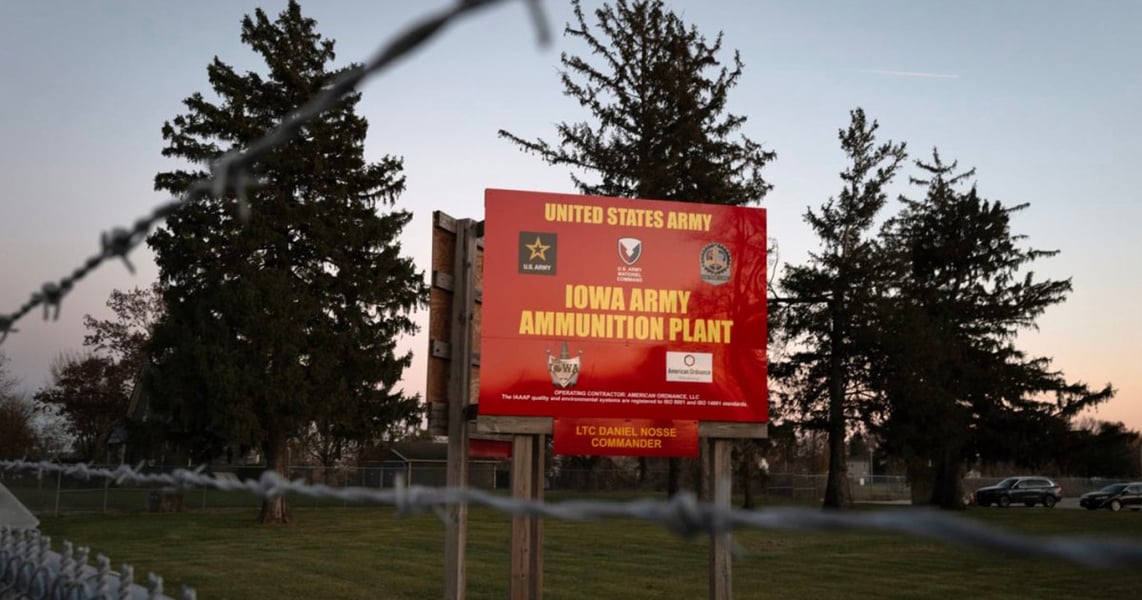

MIDDLETOWN, Iowa — In a town of about 360 people, the government’s advice on Tuesday was to pack a bag and go, but nobody was ordered out. Federal officials urged every resident of Middletown and the area around it to leave before the Army detonates the nation’s stockpile of lead azide at about 9 a.m. Central time on Wednesday.
The Army calls it a recommended relocation, not an evacuation order. FEMA Administrator Cameron Hamilton put the offer plainly: if residents in the southwest cone choose to relocate, the agency will provide transportation, food and lodging. That cone runs five miles southwest of the Iowa Army Ammunition Plant and adds a one-mile buffer beyond the modeled dispersion path.
The material is 68 drums of crystallized lead azide, more than 9,700 pounds in all, that inspectors found degrading inside earth-covered bunkers. The Army says the crystals are so sensitive to friction, heat and shock that the drums cannot be opened, moved or treated with chemicals, and that a spontaneous blast is a matter of time as temperatures swing.
The Army is leaning on engineering as much as distance. Its advisory describes sand-filled barriers about two stories high, a “water wall” and gel blocks to hold back particles, foam barriers meant to absorb heat and cut airborne dust, and misters that will saturate the soil above and around the concrete magazines before and during the blast. The Army says the aim is to reduce how much lead travels off the installation, not to eliminate it.
Hotel rooms are covered through Friday, according to the Army’s public safety advisory, with extensions available on request, and evacuees will be told by phone when they can return. Residents can register for evacuation assistance at DisasterAssistance.gov or call FEMA’s 24-hour line at 1-800-621-3362. Residents outside the cone are told to shelter in place: close windows and doors, switch heating to recirculate, shut off exhaust fans and, if possible, fit a furnace filter rated MERV 11 or higher. Iowa’s health department goes further, advising that windows stay closed for 24 to 48 hours after the blast.

What happens after the cloud passes is the least settled part. The Army says soil above 200 parts per million at a residence, the standard in its emergency permit, will be cleaned up at government expense, and that property damaged by vibration will be paid for through its claims service. EPA sampling teams were already collecting baseline samples, and the Army will publish updated deposition maps six hours before the blast and then hourly. Those maps are modeled estimates, and the state health department tells local agencies to keep modeled projections separate from confirmed sampling results.
Iowa’s health department is not recommending blood lead testing for everyone who lives near the plant or inside the modeled plume. It says testing advice will depend on soil results, which means families may wait for data before learning whether a test is worthwhile. It adds that lead exposure may not cause immediate symptoms, and that the absence of symptoms does not rule out exposure. Gov. Kim Reynolds also issued a disaster emergency proclamation covering several counties, according to ABC News.
The farm side is just as open. The U.S. Department of Agriculture told the Tuesday briefing that about 350 farms could be affected, based on the expected plume direction, but the state describes that as a projection, not confirmed contamination. Residents are told to cover livestock feed and water. NBC News reported that officials insisted the plan is necessary, even as they urged people to leave.
The decision has been argued in public for a week. Eastern Herald reported earlier on the appeals court ruling that cleared the Army, and on how Trump handed the final say to Iowa’s governor-elect.
For now, the plan rests on weather and wind that could still change the exact time. The Army said a more precise hour will follow once conditions allow, and that the all-clear will come by phone call. It has not said how long that will take, or how many of Middletown’s residents actually left.