In modern dentistry, certainty is often assumed at the chairside. A cavity appears on a scan, a recommendation follows, and treatment is scheduled. Yet beneath this clinical routine lies a growing and uncomfortable question: how definitive is the diagnosis, and how uniform is the response?
The answer is increasingly unsettled. Across dental practices, identical radiographic images can produce different conclusions, particularly in early-stage decay where enamel damage is minimal and progression is uncertain. In these cases, treatment is not purely mechanical. It becomes interpretive.
The debate is not whether cavities exist, but when intervention is truly necessary. Some clinicians advocate immediate restoration to prevent progression. Others argue that early lesions may remain stable or even reverse under the right conditions, particularly when supported by fluoride exposure, dietary adjustment, and improved oral hygiene.

At the center of this shift is a broader rethinking of how dental disease is understood. Rather than a linear condition that simply worsens without intervention, tooth decay is increasingly viewed as a dynamic process involving cycles of demineralization and remineralization. This framing has elevated the importance of risk assessment and monitoring, rather than automatic drilling.
Clinical guidance now increasingly reflects this complexity. The American Dental Association has emphasized approaches rooted in evidence-based clinical dentistry, where treatment decisions are informed by risk profiles, lesion depth, and patient-specific factors rather than uniform procedural rules.

For patients, this inconsistency raises a practical concern: when should a second opinion be sought? Increasingly, diagnosis and treatment options for cavities are understood to vary based on practitioner philosophy, risk tolerance, and training background. While one provider may recommend immediate restoration, another may prioritize observation and preventive care.
The Mayo Clinic notes that treatment pathways for cavities can range from fluoride-based interventions in early stages to fillings, crowns, or root canals in advanced cases. The variability in approach reflects not confusion, but the spectrum of clinical decision-making that exists within accepted medical practice.
A central concept shaping this debate is risk stratification. Rather than treating all lesions equally, modern dentistry increasingly classifies decay based on likelihood of progression. This approach, supported by organizations such as the ADA, reflects a shift toward risk-based model of dental care, where intervention is calibrated to disease activity rather than presence alone.
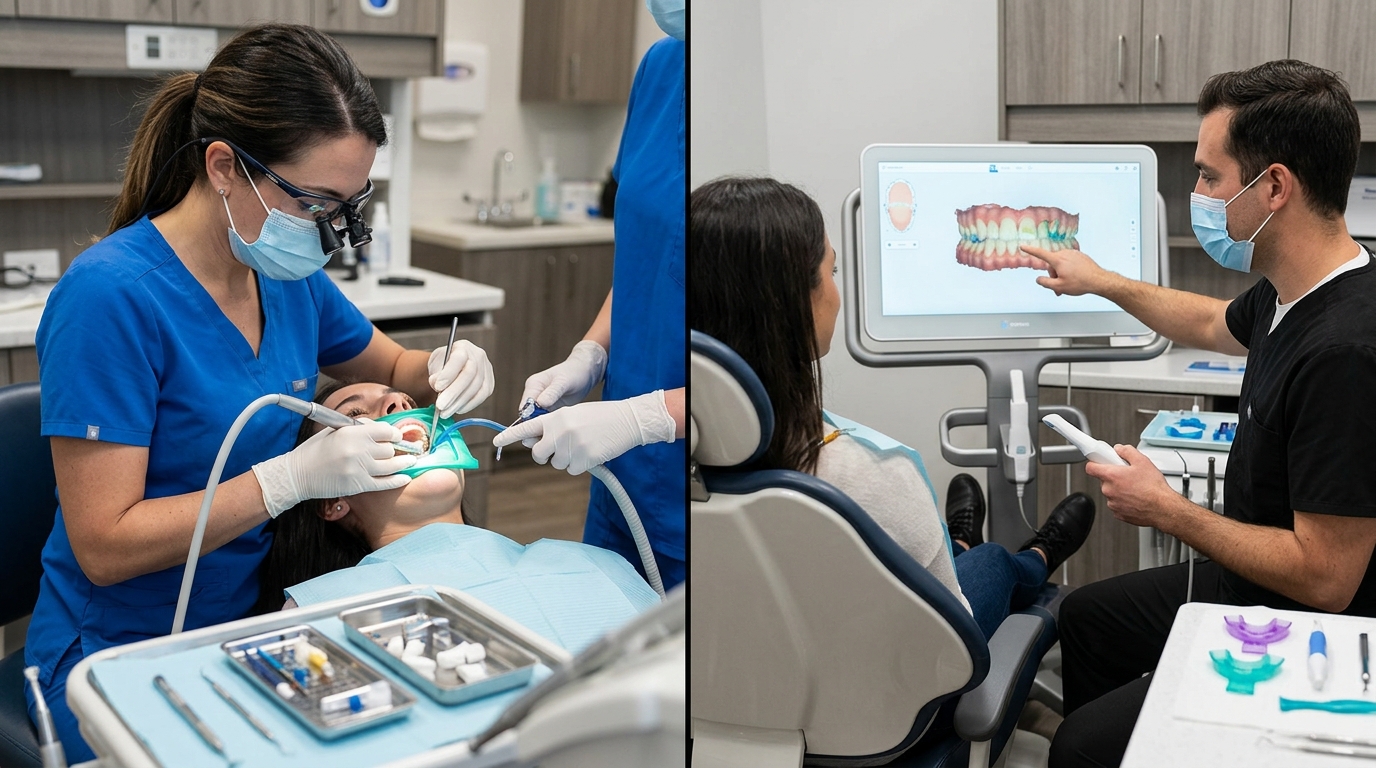
This shift is not merely theoretical. It has practical consequences for how patients experience care. In some cases, lesions once automatically drilled are now monitored over time, with fluoride treatments and behavioral interventions used to stabilize enamel. In others, early intervention remains the preferred route to eliminate uncertainty and reduce perceived risk.
The tension between these approaches reflects a broader transformation in medical thinking. Disease is increasingly understood not as a binary state but as a spectrum. In dentistry, that spectrum is particularly visible, because the threshold between reversible and irreversible damage is narrow and often difficult to define with precision.
The implications for patients are significant. Treatment is no longer solely about addressing visible damage, but about interpreting risk trajectories. This makes communication between dentist and patient more important than ever. It also underscores why divergent recommendations can arise even in reputable clinical settings.
Ultimately, the question of whether all cavities require fillings does not have a single universal answer. Instead, it depends on lesion stage, patient risk profile, and clinical philosophy. What is clear, however, is that dentistry is moving away from a one-size-fits-all model toward a more nuanced framework where observation and intervention coexist.
In that space, uncertainty is not an anomaly. It is part of the system itself.