
STOCKTON-ON-TEES — Clare Din went to her GP surgery in May 2024 because something was wrong. The bleeding she was experiencing was not normal, and she knew it. A telephone consultation had already prompted one doctor to suggest an internal scan. Then she walked into the clinic, mentioned she was having menopausal symptoms, and was told to cancel the appointment.
She left without the scan. She left with menopause medication.
Fourteen months later, she nearly bled to death in a radiology suite. A subsequent biopsy confirmed what the scan might have found far sooner: stage 4 cervical cancer.
Din, 49, from Stockton-on-Tees in northeast England, has spoken about her experience through SWNS, describing a diagnostic path that begins with a single clinical decision and ends with a prognosis she was told was terminal. Her case has drawn attention not because it is isolated; women’s health advocates have documented the pattern for years but because it traces exactly how the overlap between menopause symptoms and early cervical cancer signs can collapse the space between treatable and advanced disease.
The bleeding returned intermittently across that year. Each time, Din saw her practitioner. Each time, the dosage of menopause medication was increased. She did not push back. “I have really bad medical anxiety,” she told SWNS. “So when I’m told something, I believe it.”
That compliance, widely shared among patients who defer to clinical authority under significant anxiety, is one thread in a larger problem. The NHS’s own guidance lists abnormal vaginal bleeding between periods, after sex, or after menopause as a primary warning sign for cervical cancer. The difficulty is that heavy bleeding in perimenopause is also common, and when a patient presents with other menopausal symptoms, the clinical instinct is to treat the more prevalent condition first. In Din’s case, the medication worked, intermittently, which reinforced the diagnosis and delayed referral.
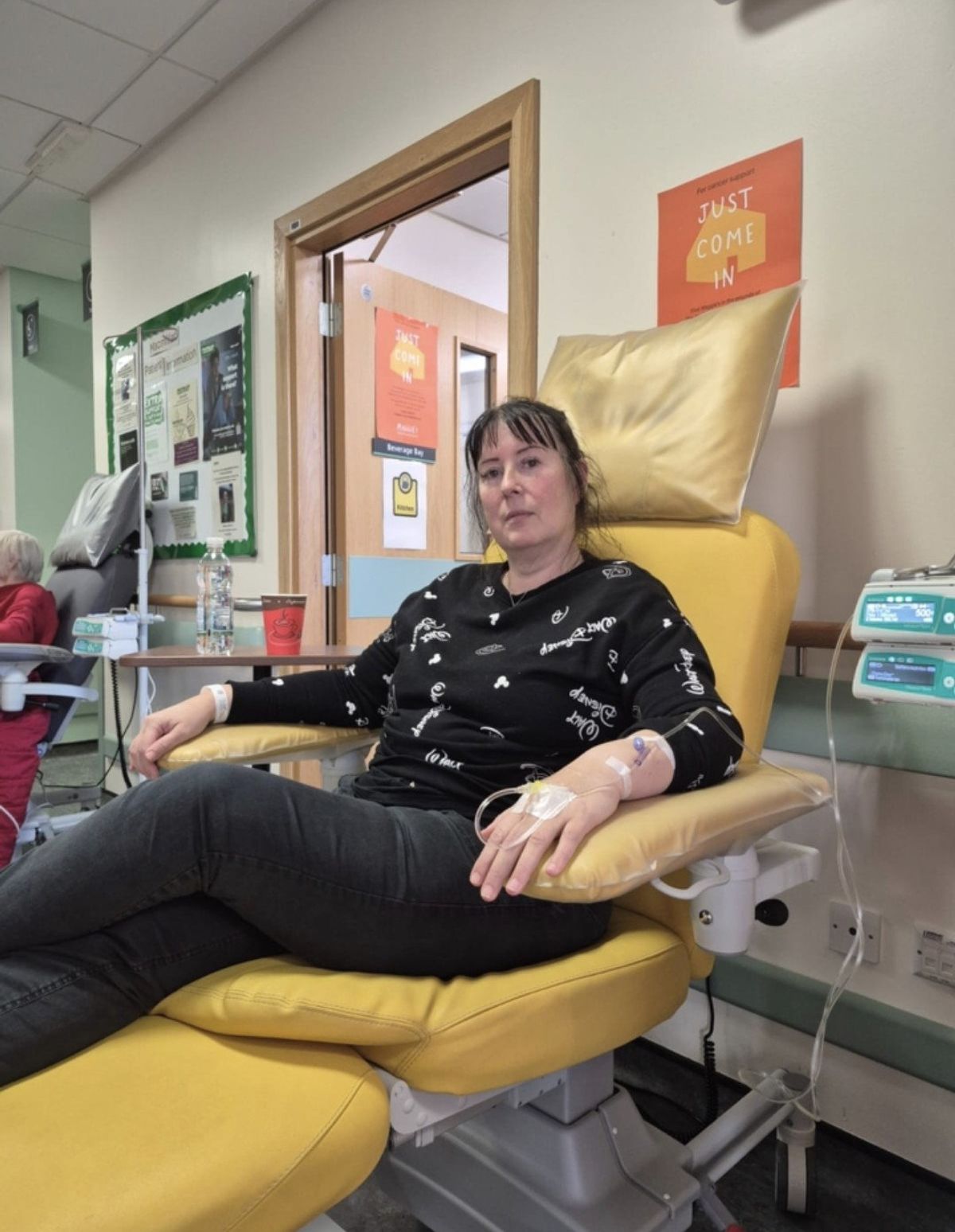
By May 2025, when she was finally sent for a scan, the cancer had progressed to the point where the scan itself triggered severe haemorrhaging. She was rushed to the emergency department after bleeding so heavily she lost 2.5 litres of blood and woke in the resuscitation unit with two drips running simultaneously.
A biopsy was taken. Two months later, in July 2025, she was given her diagnosis over the phone. She was told the cancer was stage 4, that treatment was possible but not a cure, and that she should prepare her family. “That was an awful time,” she said. “We’d all started to prepare ourselves for coming to terms with it.”
Seven weeks after that call, a consultant reviewed her case ahead of a PET scan and told her what she had been told on the phone was wrong. His aim, he said, would be to cure her. She began chemotherapy the following week. Twelve weeks of intensive treatment followed, with daily radiation in the final five weeks.
She completed treatment in the week before Christmas 2025. Her most recent scan shows no evidence of disease. The consultant told her that had treatment not started when it did, she would not have survived.
Din’s case arrives at a moment when the NHS is actively attempting to address the conditions that made it possible. The government confirmed in October 2025 that menopause questions would be incorporated into standard NHS health checks from 2026, covering women aged 40 to 55. The Health Secretary, Wes Streeting, acknowledged at the time that women had “been suffering in silence for far too long.” A separate initiative – referred to as Jess’s Rule – requires GPs to reconsider a diagnosis if a patient returns three times without resolution or if symptoms worsen.
The cervical screening participation rate makes the stakes concrete. Around a third of women invited to NHS cervical screening do not attend, meaning the programme prevents fewer cancers than it could. During 2023 to 2024, of the 5.12 million individuals aged 25 to 64 invited to cervical screening, only 3.25 million were tested – a 5.3 per cent fall from the previous year. NHS England has set an ambition to eliminate cervical cancer by 2040, but that goal depends on screening uptake that is, by its own data, declining.
Clinical misattribution of symptoms, of the kind Din experienced, is a separate problem sitting upstream of the screening programme entirely. The Christie NHS Foundation Trust lists unusual vaginal bleeding – including between periods and after the menopause – as among cervical cancer’s primary symptoms, with the specific note that women experiencing such symptoms between screening tests should contact their GP immediately. Din’s practitioner was aware of her bleeding. The gap was not in information; it was in how that information was weighed against a competing, plausible explanation.
Din does not describe her experience as straightforward negligence. She has been explicit that the consultant who eventually treated her saved her life, and she raised over £1,400 for the oncology ward where she received care. What she describes is a system in which her own deference to clinical authority, reasonable given her medical anxiety, combined with a diagnostic shortcut, produced a year-long delay. The question her case leaves open and that her recovery does not answer is how many women in similar circumstances did not reach the consultant who reconsidered.
The broader NHS context is not incidental. Workforce pressures and training post cuts have added structural strain to primary care capacity in recent months, complicating the prescription of more attentive follow-up. The systemic reforms the government has announced are a start; they do not yet address the diagnostic moment in which a practitioner tells a patient with an unresolved scan referral that she does not need to go.
A pattern of symptoms misread or dismissed, whether nutritional, hormonal, or oncological, is emerging as one of the defining fault lines in primary care. Din’s survival is the exception. “If something doesn’t feel right with your health, it probably isn’t,” she said. “So it’s okay to get checked.”