
MADRID – When the Paris police prefect took the podium on Wednesday, he did not lead with temperatures. He led with hospitals. Patrice Faure told reporters the city was “reaching a saturation point in hospital facilities,” that in 24 hours, Paris emergency services had responded to 25 cardiac arrests, compared to fewer than 10 on a normal day. He announced a ban on public alcohol. He asked Parisians to check on their elderly neighbours.
The words were calibrated and bureaucratic. They also carried the echo of a failure Europe thought it had fixed.
In the summer of 2003, inadequate early-warning systems and overwhelmed hospitals contributed to more than 70,000 deaths across the continent over six weeks. Governments spent the years that followed building heat health action plans, expanding cooling infrastructure, and designing interagency coordination protocols. Those investments are real. They are also being tested this week in ways their architects did not anticipate.
Spain’s Carlos III Health Institute, the national epidemiology agency that runs the country’s official heat surveillance system, published its weekly mortality estimate on Thursday: 327 heat-related deaths between Sunday, June 21 and Wednesday, June 25. Since the surveillance season began on May 15, cumulative heat deaths have reached 611, according to Euronews. Emergency room visits for heat-related conditions rose fourfold from seasonal averages, a figure that reflects the strain on the health system even before each case can be rigorously attributed.
The temperatures that produced those numbers were not ordinary. June 23 was the hottest June day in Spain since national meteorological records began in 1950; June 22 ranked second. The anomaly was sharpest in northern Spain, where Bilbao Airport broke records for both daytime maximum and overnight minimum temperatures, the kind of combined thermal stress that denies bodies any chance to recover between exposures.
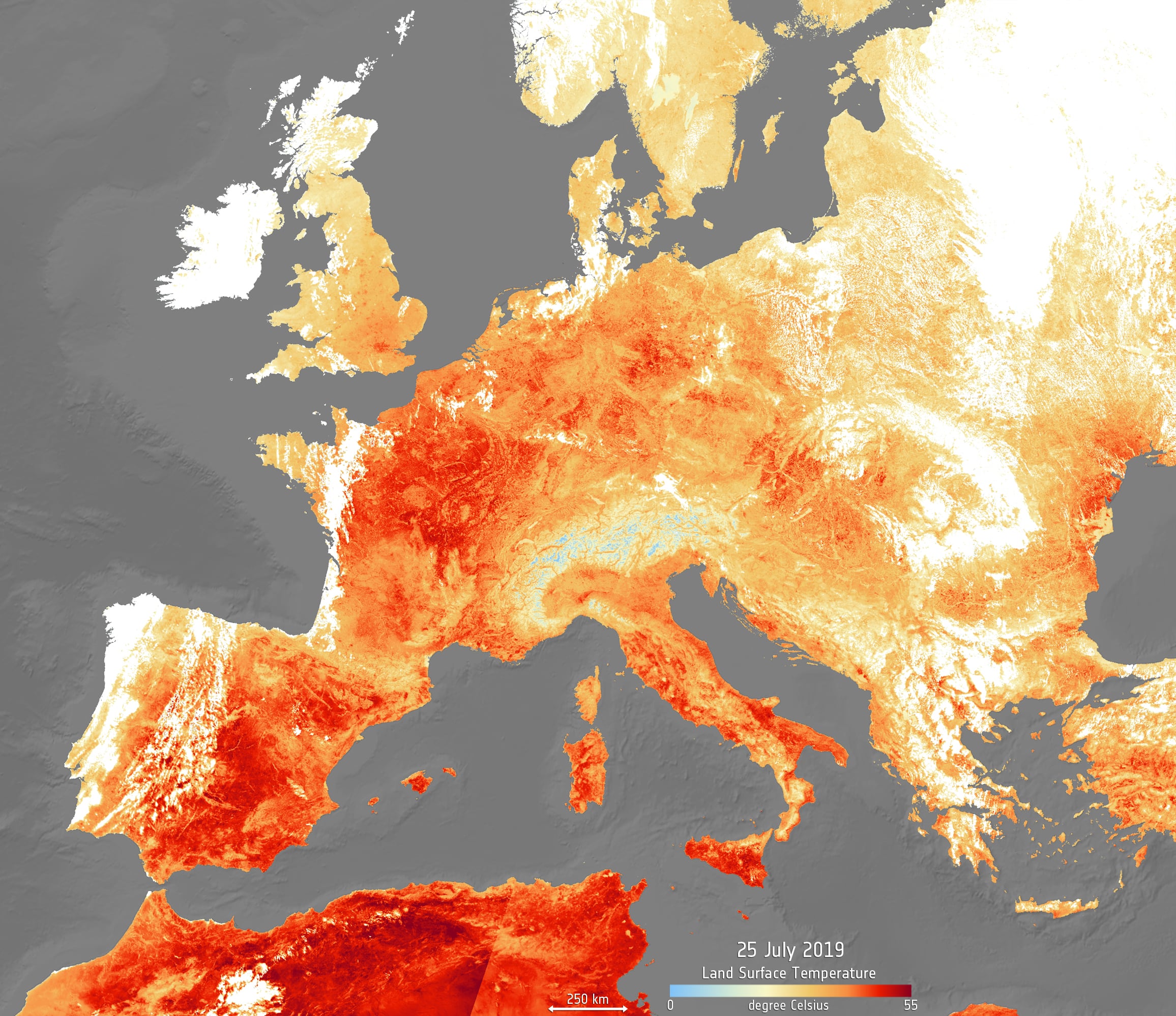
France crossed its own threshold on June 24. The Copernicus Climate Change Service recorded the highest daily mean temperature in French history, the first day the 24-hour national average exceeded 30 degrees Celsius. The service’s Sentinel-3 satellite network reported land surface temperatures above 50 degrees Celsius across parts of southern France and northern Spain at the heatwave’s peak.

The meteorological mechanism was an Omega block high-pressure system, the atmospheric configuration commonly described as a heat dome, anchored above the Iberian Peninsula since the start of the week. This type of pattern is not new. What has changed, Copernicus scientists noted, is frequency. This was Europe’s second major heatwave of 2026, following a late-May episode that struck different parts of the continent. The deputy director of the service described the June event as consistent with projections showing these systems becoming more geographically extensive and longer-lasting with each decade of additional atmospheric warming.
At a continental scale, approximately 101 million Europeans recorded temperatures above 35 degrees Celsius on Thursday alone. That figure describes the breadth of the event more precisely than any single national death count can. The deaths in Spain were concentrated in a country with an existing surveillance infrastructure and a national heat health plan. The countries about to receive the system’s eastward momentum had less experience with sustained multi-day extreme heat events.
The heat dome lifted from Spain and France on Thursday, but meteorologists recorded it moving east toward Germany, Austria, and the Czech Republic. Whether those countries had pre-positioned their hospital capacity for a heat surge comparable to what Paris experienced remained an open question on Friday. Central European heat action plans have improved markedly since 2003, but they were calibrated against a warming trajectory that the 2026 data has already outpaced.
The gap between plans designed for a warming world and the world that is actually warming sits at the centre of this week’s crisis. Across the continent, governments are balancing long-term climate adaptation against immediate policy pressures. Britain earlier this week reached a milestone in that transition, with electric cars outselling petrol vehicles for the first time, even as that transition faces political resistance. Whether decarbonisation can accelerate fast enough to prevent these heatwave patterns from overwhelming rebuilt health infrastructure is not a question 2026 can yet answer.
What this summer has produced so far is not a catastrophe on the scale of 2003. It is also not within the margins that European heat action plans were designed to absorb. Two major heat events in the same early-summer season, each stressing infrastructure rebuilt for a world that no longer quite exists, is the pattern climate projections have long described and governments have long treated as a medium-term problem.
In Madrid, the thermometers fell below 30 degrees Celsius for the first time in a week on Friday. The number that matters more is 611: the lives Spain’s health institute counts since mid-May, with the summer barely begun.