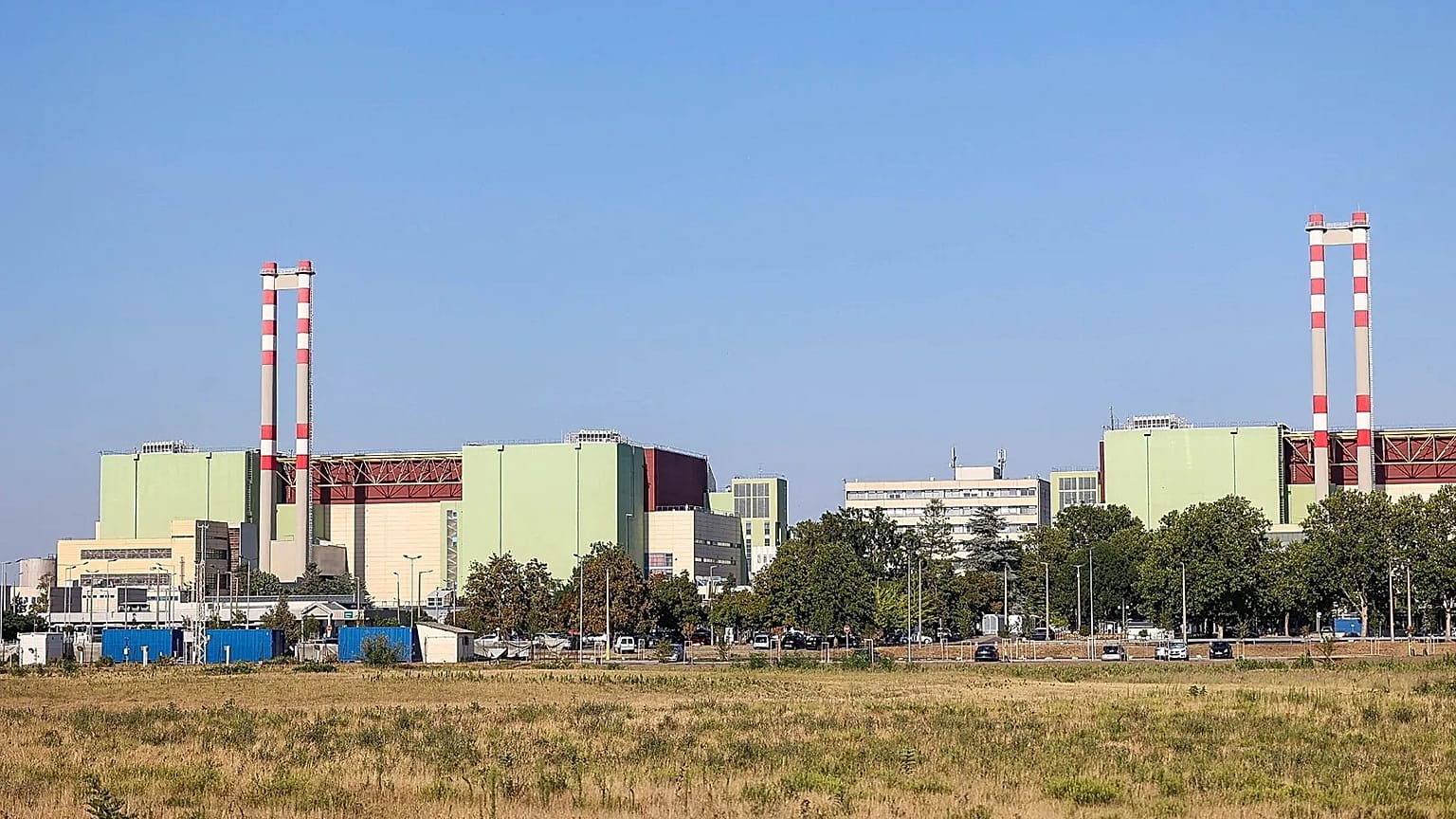

BUDAPEST – Hungarian Prime Minister Péter Magyar stepped before cameras Thursday evening and asked his citizens to stop running their air conditioning or washing machines between five and ten o’clock at night. The request felt strange for a country in the middle of summer. It became stranger when he explained the reason. The Danube River, which provides cooling water for Hungary’s Paks Nuclear Power Plant, had fallen to levels so low the facility’s reactors could no longer operate safely. The plant, which has supplied nearly half of Hungary’s electricity since opening forty-two years ago, was being taken entirely offline. For the first time in its history.
The shutdown triggered an immediate cascade across Europe’s eastern power grid. The European Commission said Thursday it was prepared to convene an emergency meeting of its Electricity Coordination Group, an admission that the crisis had already moved beyond Hungary’s borders into a regional energy balance strained by an unusually hot summer. Commission spokesperson Anna-Kaisa Itkonen told Euronews that an event of this kind could further strain the regional electricity balance, and that Brussels stood ready to facilitate information-sharing and coordinate next steps among countries in the region.
The scale of the loss is not abstract. Paks generates approximately 2,000 megawatts, and Magyar translated that figure into language a household could understand: from Monday, between a quarter and a third of Hungary’s total electricity output would vanish from the grid at precisely the moment when summer heat was driving residential and public demand toward its seasonal peak. The government had already drafted an emergency rotational consumption limit plan for industrial facilities. Citizens were being asked to manage accordingly, cutting peak-hour usage voluntarily before the state was forced to do it for them.
András Perger, an expert at the Hungarian environmental NGO Energiaklub, described the situation to Euronews as a serious test of supply. From Monday, when consumption would rise and Paks would remain offline, a more serious situation would begin, he said. His assessment of regional risk was calibrated. Hungary could cover some of the shortfall through imports from neighboring countries, but the availability of hydroelectric power across the region was itself constrained by the same low-water conditions that had shut Paks down in the first place. Perger’s conclusion was careful rather than reassuring: he did not expect serious regional problems, though he did not claim the situation was under control either.
Romania presented a partial parallel. The Cernavodá nuclear plant, which also uses river water for cooling, had one reactor taken offline for the same underlying reason. The impact there was less acute, as nuclear energy constitutes a smaller portion of Romania’s total supply than it does Hungary’s. But the coincidence of two nuclear shutdowns in the same region, in the same week, driven by the same climate signal, reinforced what Magyar’s announcement had already suggested: this was not a local infrastructure failure. It was a regional climate event hitting multiple national grids simultaneously.
The Danube levels that prompted Thursday’s action fit a pattern that hydrologists across Central Europe have been measuring for years. Reduced snowpack in the Alps and Carpathians, altered precipitation patterns, and elevated evaporation driven by consistently hotter summers have all contributed to declining summer river flows across the basin. The heat wave pushing Hungarian electricity demand upward in late July was part of the same climatic shift that had reduced the river flows the plant depended on. At a moment when the Iran war had driven global energy costs to their highest in years, Hungary found itself short of the only fuel its largest generator required: cold water.
The political framing of the Paks crisis carries an additional layer. Viktor Orbán, whose long premiership ended when Magyar’s coalition swept to power, had built Hungary’s energy strategy around secure baseload nuclear power and Russian pipeline gas, including a Russian-built expansion of Paks that remains under construction. The plant’s vulnerability being exposed under his successor is something Hungarian opposition commentators have not ignored. What the climate data cannot answer is whether the energy architecture Orbán championed would have been any better insulated against a drying river. The Danube does not distinguish between political parties.
Across Central Europe, the Paks shutdown echoes an earlier crisis in which Bulgaria broke ranks with EU sanctions to import Russian components needed to keep its Kozloduy nuclear plant operational. In Bulgaria’s case, the vulnerability was political: a supply chain running through an adversary. In Hungary’s, the vulnerability is environmental: a cooling system dependent on a river that is no longer reliably delivering what the technology requires. Both point toward the same structural gap in the region’s energy planning, which assumed nuclear infrastructure, once built, would operate in a stable physical environment indefinitely.
Friends of the Earth Hungary drew what it called the correct lesson from Thursday’s events. The organization’s executive president, Ákos Éger, said Hungary needed to accelerate its transition to a more resilient, decentralized energy system relying less on climate-vulnerable infrastructure and more on energy savings, flexibility, and renewables. The statement was pointed but not surprising. What was notable was its target. Éger’s criticism was directed not at coal or gas but at a nuclear facility that proponents of the low-carbon transition have long positioned as part of the climate solution. The Paks shutdown offered a response to that positioning that no policy document had anticipated.
Magyar said his government was increasing the output of Hungary’s remaining power sources and seeking additional import agreements from Austria and Slovakia. He offered no timeline for when Paks could restart. That answer depends on the Danube returning to levels at which reactor cooling is safe, and the Danube’s recovery timeline is not a question any government schedule can answer.
The EU emergency meeting, if the Commission convenes it, would be the first of its kind to address a climate-driven shutdown of nuclear infrastructure. Itkonen was careful to say there are currently no immediate energy security concerns at the European level, a formulation calibrated to prevent alarm rather than confirm safety. What the regional electricity market does not yet have is an answer to the question the Paks shutdown makes unavoidable: if nuclear power’s cooling infrastructure is vulnerable to the same climate extremes it was meant to help prevent, how many more shutdowns of this kind does Europe’s energy planning account for?