
BORDEAUX – When the wind shifted on Tuesday and drove fire across the D109 highway south of the city, smoke reached the Atlantic coast before dawn. By Wednesday morning, France had not evacuated this many people in a single week since the liberation of Paris.
President Emmanuel Macron measured the scale in terms French officials almost never reach for. “This is the worst we have faced since the Second World War,” he said at an emergency cabinet session, framing the crisis not in hectares but in human displacement: more than 220,000 people driven from their homes in the Gironde department, tens of thousands of them Atlantic coast vacationers who arrived a fortnight ago with no expectation that their summers would end in convoy.
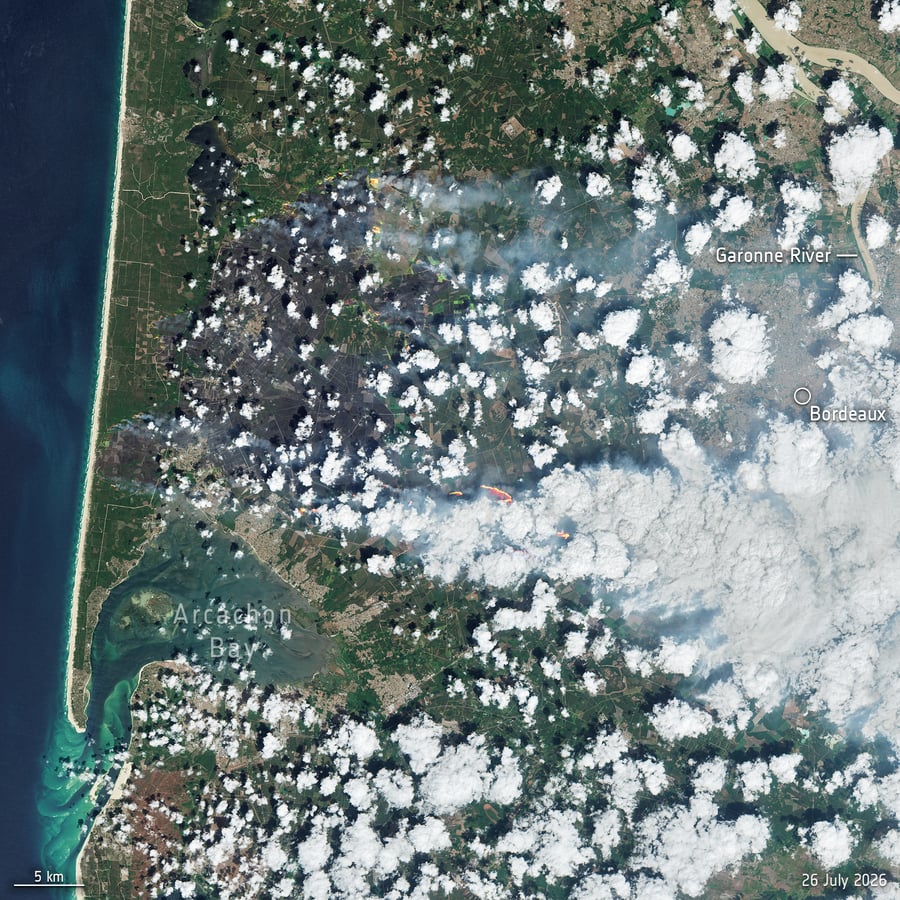
The numbers behind that statement are extraordinary and still climbing. As of Wednesday, firefighters recorded more than 42,000 hectares of Gironde pine forest burned. The Cap Ferret peninsula – a narrow strip separating the Atlantic from the Arcachon basin and one of the most coveted summer addresses in Europe – was evacuated entirely, some 40,000 residents and tourists loaded onto coaches and driven inland through corridors of smoke. Ninety-three firefighters have been injured across the French southwest since the crisis began.
France mobilized military aircraft that ordinarily carry cargo. The Airbus A400M Atlas was reconfigured to carry up to twenty tonnes of fire retardant, a deployment that signals the inadequacy of conventional aerial resources when fire moves at this speed. The planes joined Canadair tankers from France’s own fleet and reinforcements from Spain, where crews have spent three weeks on their country’s fourth heatwave of the summer.
The fires have exhibited behavior that climate scientists call pyrocumulonimbus, in which blazes grow large enough to generate their own weather. In the Gironde this week, the fires produced internal lightning that started new blazes kilometers from the front, a phenomenon fire investigators say has never previously been recorded on French soil. The speed and unpredictability this creates defeats conventional firebreak strategy: lines that held on Tuesday vanished by Thursday morning.
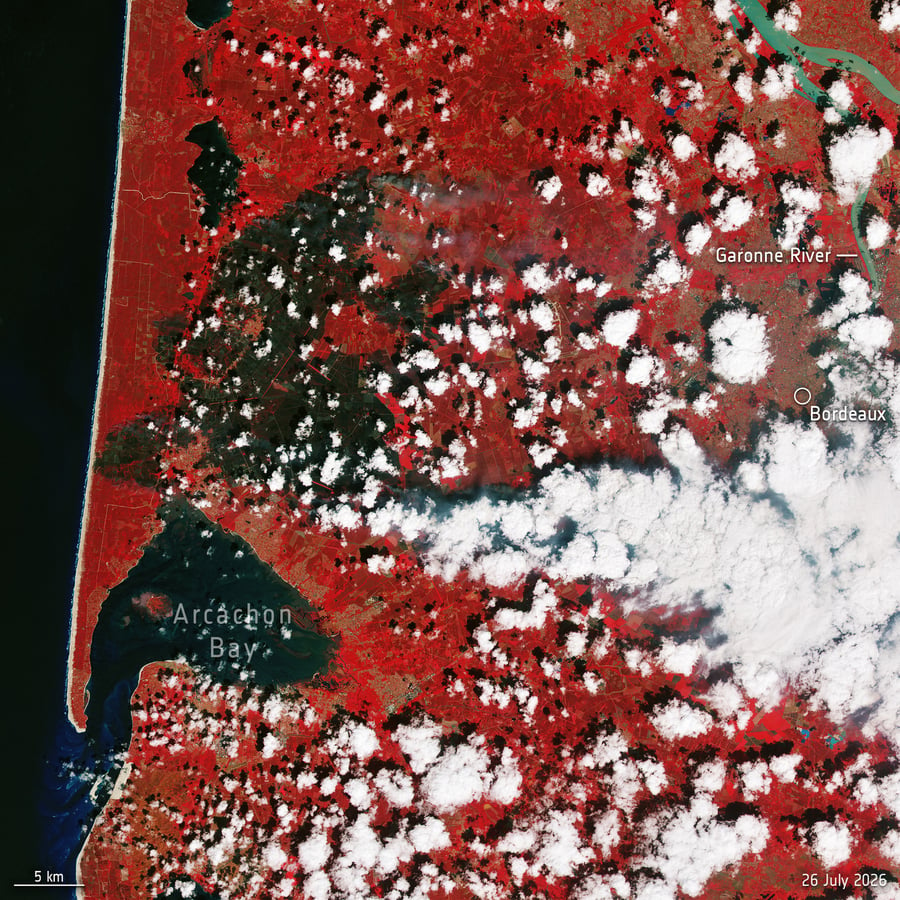
French authorities began ordering evacuations of Atlantic coast tourist zones along the Dune du Pilat last week when surveillance helicopters identified spot fires crossing firebreak lines on the forest perimeter. The response then was measured. The response this week is not. Entire communes in the Medoc wine country north of Bordeaux have received mandatory evacuation orders extending indefinitely.
The political weight of Macron’s framing is deliberate. The Second World War reference anchors this disaster in the only historical scale French public memory reliably treats as absolute. It is also precise: the last mass civilian evacuation of this magnitude from French territory, before this week, involved people fleeing German occupation or Allied bombardment, not a natural disaster. A government that has spent three summers managing growing fire seasons understood the comparison it was making.
The fires arrived while Spain was already in crisis. Fires in the Sierra Oeste west of Madrid have displaced tens of thousands and killed at least eight people in the past week. Spain declared a national emergency on July 24, and the European civil protection mechanism has been activated at a level not used since the large Iberian fires of 2022. France 24 reported that the French military was committed within hours of Macron’s Wednesday cabinet statement.
The Iberian Peninsula and the western edge of France have shared a fire weather corridor since mid-July: a persistent high-pressure system that channels hot African air north and drives humidity close to zero across the Atlantic forests. That pressure system has not moved in three weeks, and the forecast for the coming week shows no relief.
What the fires expose is a forest management problem that extends beyond this summer. The Gironde lost approximately 26,000 hectares to fires in 2022 and rebuilt significant firefighting capacity afterward. The prescribed burns and expanded firebreaks installed after 2022 were genuine interventions. That they have proven insufficient against this year’s fire weather suggests they were calibrated for a climate that no longer exists. The Landes department to the south – the largest continuous planted forest in Western Europe and one of France’s largest carbon stocks – remains exposed to the same conditions that drove this week’s catastrophe.
At seventeen reception centers across the region, relief agencies are processing thousands of displaced residents who left before they could pack medications or identity documents. The demographic of this displacement includes a significant proportion of elderly coastal nursing home residents and infant children, requiring coordination that goes beyond standard emergency protocols.
Limited returns began Wednesday in areas where the wind shifted and the immediate fire risk reduced, but the prefecture of the Gironde has not set a broader timeline. Bordeaux city, twenty kilometers to the east, has not been threatened. The Arcachon basin has held. Whether those facts remain true in seventy-two hours depends on the wind, and the wind is not cooperating.