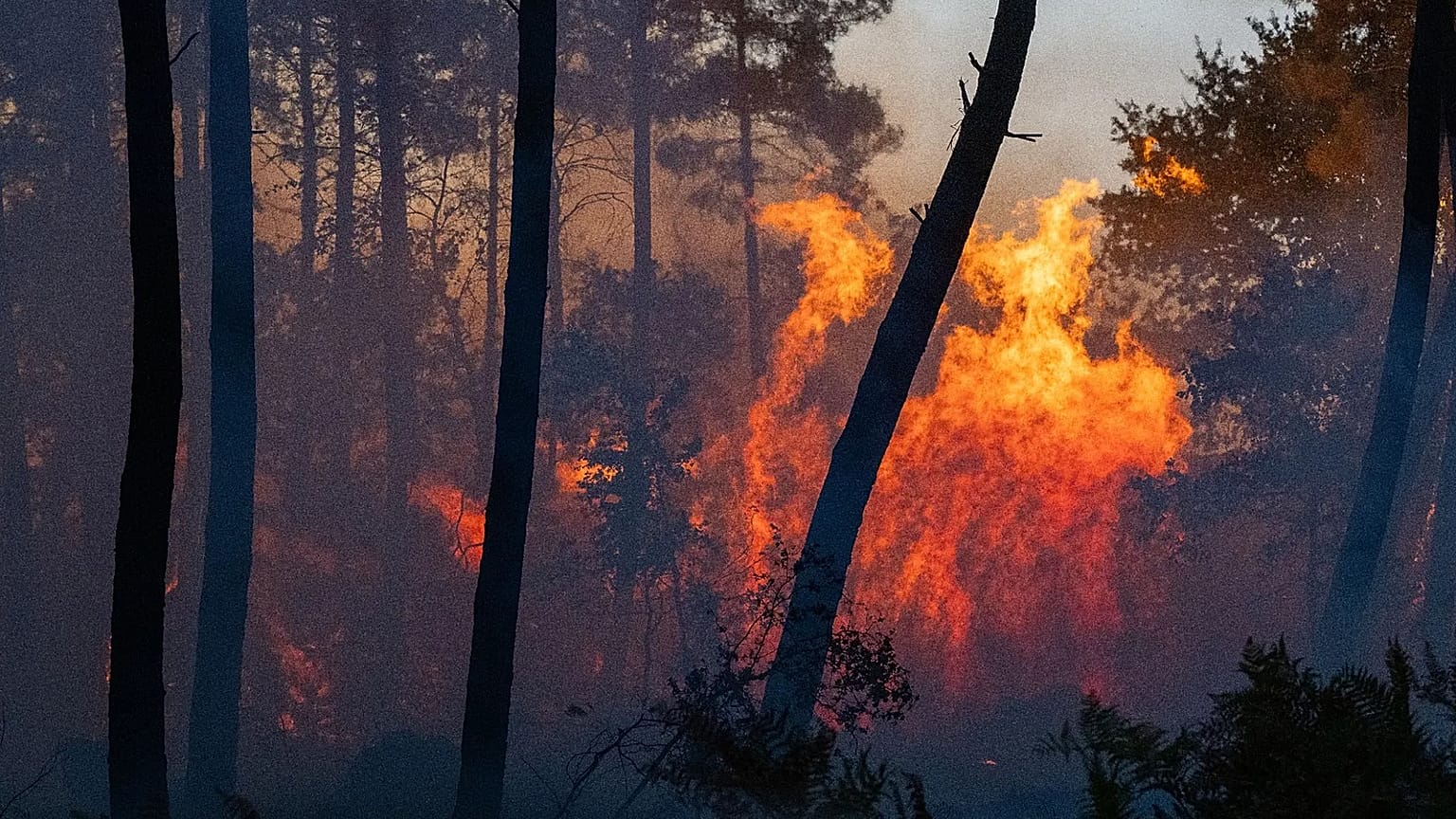

MADRID – Alessandro Marchi went to San Cataldo in Sicily on Monday to fight a fire. By Tuesday he was dead. He was among three firefighters killed this week as simultaneous blazes burned out of control in Spain, France and Italy, forcing Spain’s government to declare a national emergency on Friday morning and prompting French President Emmanuel Macron to activate the European Union’s cross-border civil protection mechanism for the first time this season.
By Friday, fires were burning without containment in the Villa del Prado and San Martín de Valdeiglesias communities west of Madrid, in the Gironde department of southwestern France, and across the Sicilian interior. The simultaneous fires in three countries are being sustained by temperatures predicted to reach 44 degrees Celsius in central Spain, driven by an atmospheric pattern that has stripped moisture from the Iberian peninsula and parts of the Mediterranean coast. The EU’s long-term average for area burned by late July has already been exceeded.
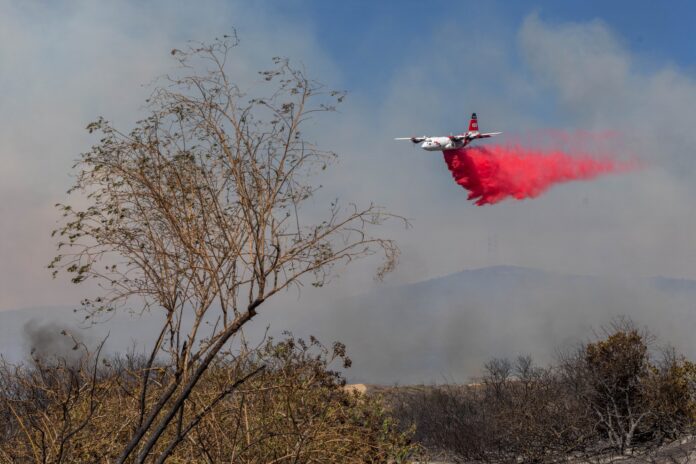
Spain’s national emergency declaration, announced by central government authorities Friday, concentrates additional resources on the Madrid region where two fires remain, in the government’s description, out of control. Emergency crews in Villa del Prado and San Martín de Valdeiglesias have managed to limit their spread in recent hours without containing them. Thousands of residents have been evacuated from communities west of the capital. Friday’s forecast temperature of 44 degrees will make any aerial firefighting window narrow.
The Madrid emergency is the culmination of a fire season that has already consumed far more land than Spain’s recent baseline. Wildfires in July burned 28,400 hectares across Guadalajara and Zaragoza, bringing Spain’s 2026 total to roughly 70,000 hectares – nearly triple the rate of the same period in 2025. The national emergency places federal resources at the disposal of regional authorities who have been managing the fire calendar since April.
France’s toll has been the most visible. Two firefighters died early this week tackling a blaze in Mérignac, on the outskirts of Bordeaux – the first fire deaths in the Gironde in several years. Macron paid direct tribute, saying the nation owed its “condolences, gratitude and support” to their families. The fire started in Saumos on Tuesday and has spread across 8,700 hectares toward Le Porge and Lège Cap-Ferret, with approximately 20,000 people evacuated from the area.
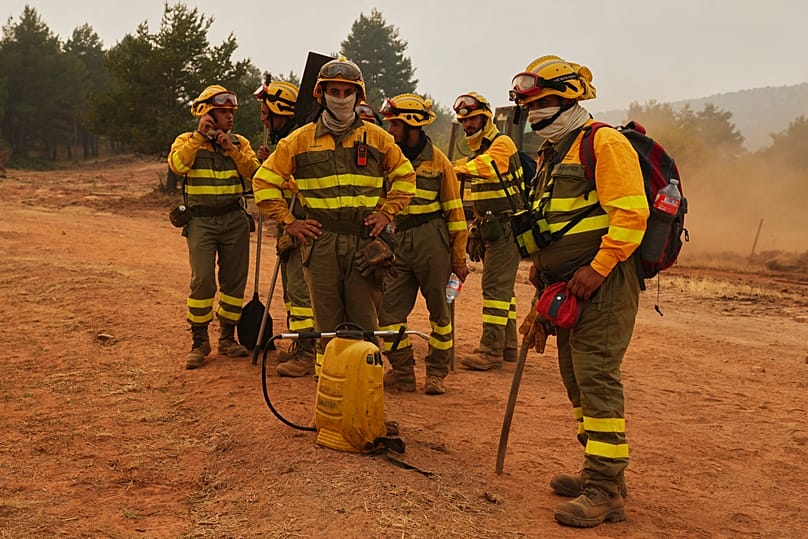
A separate fire in the Var department in southeast France has burned 2,700 hectares around Correns and Montfort-sur-Argens, requiring 800 firefighters and aerial support. France’s escalating evacuation figures through Thursday had already placed the country on pace for one of its worst fire seasons in recent memory. Macron announced Friday that Croatia, Portugal and additional heavy aircraft would deploy under the EU civil protection mechanism he formally activated this week. Whether those reinforcements had reached the fire lines by Friday morning was not confirmed.
Italy deployed approximately 6,000 emergency responders – firefighters, forest guards and civil protection officers – across Sicily by Friday. The most critical blazes have reached Casaboli, Bivona, Alimena, San Cataldo, Galati Mamertino, parts of the Madonie Regional Natural Park, and the area around Syracuse. It was in San Cataldo that Marchi died. Prime Minister Giorgia Meloni described him as having lost his life “carrying out his duties to the very end with courage, dedication and an extraordinary sense of responsibility.” His death prompted calls in the Italian parliament for faster expansion of the national fleet of firefighting aircraft.
The scale of simultaneous fires across three countries has placed immediate strain on the EU’s shared civil protection capacity. Macron’s invocation of the mechanism – which pools aerial firefighting assets and specialist teams from member states – reflects that national fleets in France and Italy are already at or near operational limits. Spain’s declaration of national emergency does the same for its own available resources. The coordination required to operate jointly across three fire fronts in different countries, with different incident command structures, is a task the mechanism was designed for but has rarely faced at this scale.
By Wednesday, wildfires had burned 254,388 hectares across the European Union since January – above the long-term average for this date but still below the 270,449 hectares burned over the same period in 2025. The comparison offers limited statistical reassurance. The 2025 fires were concentrated in Greece and Portugal; 2026’s are distributed across France, Spain and Italy simultaneously, straining cross-border response capacity and the relatively modest EU civil protection fleet at the same moment.
Whether the EU mechanism can meaningfully reinforce national responses in the next 48 hours depends on variables that no agency has committed to publicly: the arrival timing for promised aerial assets, coordination between French, Spanish and Italian incident commands operating under different protocols, and whether overnight temperatures in affected zones drop enough to allow ground crews to work without aerial cover. The EU has not published a timeline for how quickly reinforcements reach active fires once the mechanism is triggered.
Three firefighters are dead. Tens of thousands remain displaced across three countries. The fires in Spain, France and Italy were still burning Friday morning with no containment reported on the largest fronts.