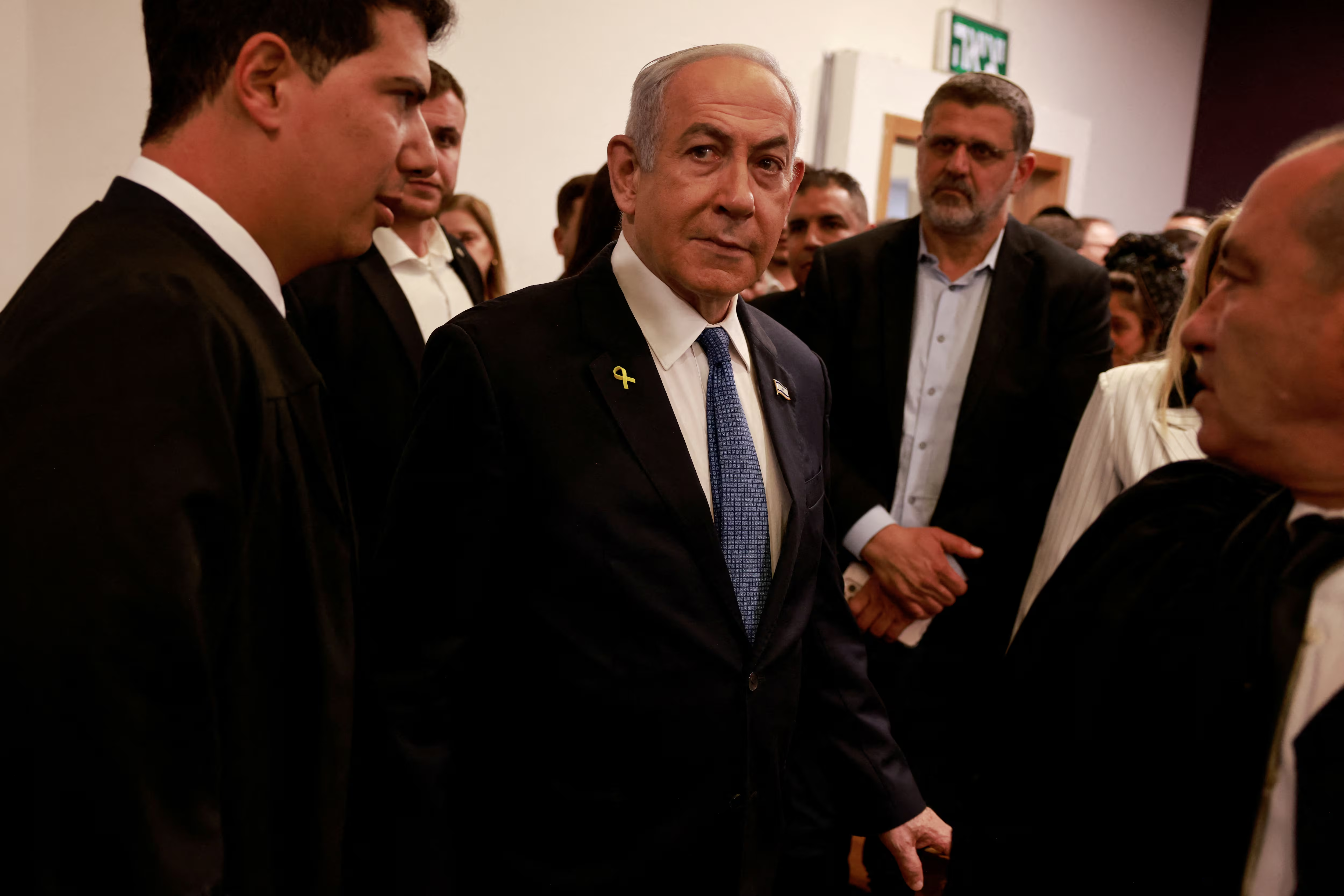
Benjamin Netanyahu walked once again into an Israeli courtroom this week, marking the 84th hearing in his long-running Netanyahu corruption trial, a proceeding that has long ceased to be merely a legal battle. It has instead evolved into a defining confrontation over the future of Israeli institutions, political accountability, and the survival instincts of Israel’s most polarizing leader.
The Israeli prime minister appeared before the Tel Aviv District Court under the weight of bribery, fraud, and breach of trust allegations that have haunted his government for years. The charges, first formalized in 2019 after lengthy investigations, revolve around accusations that Netanyahu traded political favors for luxury gifts and favorable media coverage while tightening his grip over Israel’s fragmented political system.
But after 84 hearings, the trial now symbolizes something deeper than the fate of one politician.
For Netanyahu’s critics, the proceedings reflect the gradual corrosion of Israeli institutions under a leader accused of subordinating courts, media, and state machinery to his own political survival. For supporters, the trial represents what they describe as an unelected judicial establishment attempting to remove a sitting prime minister through legal warfare after repeated electoral failures.
The result has been a country trapped in a prolonged Israel’s political crisis.
Netanyahu remains the first sitting Israeli prime minister to stand criminal trial while in office, a reality that has repeatedly shaken Israeli politics since the indictments triggered years of instability, coalition collapses, and unprecedented confrontations between the judiciary and the executive branch.
The latest hearing came amid renewed scrutiny over repeated delays that have slowed the proceedings. Reuters recently reported that Netanyahu sought another delay in testimony, citing classified security concerns linked to regional developments and the wider Middle East conflict environment.
Critics inside Israel increasingly argue that the country’s near-constant state of war has become intertwined with Netanyahu’s legal survival.
That criticism has intensified since the Gaza war transformed Israeli politics after October 2023. Opposition figures and anti-government demonstrators have accused Netanyahu of exploiting wartime conditions to consolidate authority while avoiding the political consequences of both the corruption trial and mounting public anger over security failures.
The corruption cases themselves remain politically explosive.
Case 1000 centers on allegations that Netanyahu and members of his family received expensive gifts, including cigars and champagne, from wealthy businessmen in exchange for political assistance. Case 2000 involves accusations that Netanyahu negotiated with newspaper publisher Arnon Mozes over favorable media coverage. The most serious allegations are tied to Case 4000, in which prosecutors say Netanyahu advanced regulatory benefits for a telecommunications company in return for positive coverage on a news website.
Netanyahu denies all accusations and has repeatedly described the cases as politically motivated.
Yet even some of his former allies acknowledge that the endless trial has transformed the structure of Israeli governance itself.
Over recent years, Netanyahu’s coalition aggressively pursued judicial overhaul plans that opponents said were designed to weaken the Supreme Court and reduce institutional checks on executive power. The proposed reforms triggered some of the largest protests in Israeli history, with hundreds of thousands accusing the government of steering Israel toward authoritarianism.
The political damage from those confrontations has not disappeared.
Instead, it now overlaps with wartime divisions, widening distrust between secular Israelis and religious nationalist factions, and growing international pressure surrounding Israel’s military operations in Gaza.
The corruption trial sits at the center of those tensions because it forces Israelis to confront a question that remains unresolved after years of hearings: can a leader facing criminal charges continue governing indefinitely while reshaping the institutions judging him?
The courtroom scenes themselves increasingly resemble political theater as much as judicial procedure.
Israeli media has reported repeated clashes between Netanyahu’s legal team and prosecutors over scheduling disputes, testimony procedures, and hearing durations. Outside the courthouse, anti-government protesters have continued rallying against Netanyahu, accusing him of dragging Israel into institutional paralysis while corruption proceedings stretch deeper into a second decade.
The trial has also become part of a broader debate over political crisis and democratic backsliding inside Israel. Analysts warn that the prolonged confrontation between Netanyahu’s coalition and the judiciary has severely weakened public trust in state institutions.
Meanwhile, Israel’s international isolation has deepened as allegations surrounding the Gaza war intensified. Netanyahu already faces growing international scrutiny linked to allegations of abuses in Gaza, including separate legal pressure connected to ICC investigations.
Human rights groups and international legal observers have increasingly focused on war crimes allegations in Gaza, adding another layer of pressure around Netanyahu’s leadership as his domestic corruption proceedings continue.
Meanwhile, speculation has intensified over the possibility of a political settlement or pardon. Reuters recently reported that Israeli President Isaac Herzog signaled openness toward discussions surrounding Netanyahu’s legal future, although no immediate decision appears likely.
Those discussions have become deeply controversial inside Israel, where critics warn that any political compromise could further damage public confidence in judicial independence.
The idea of a pardon would once have been politically unimaginable for a sitting Israeli prime minister accused of bribery.
Now it is openly debated as part of a broader attempt to stabilize a deeply polarized country.
That shift may ultimately define the significance of Netanyahu’s 84th court appearance more than anything said inside the courtroom itself.
What began years ago as a corruption investigation has evolved into a prolonged struggle over the identity of the Israeli state, the credibility of its institutions, and the limits of political survival in a system increasingly strained by war, polarization, and distrust.
For Netanyahu, every hearing has become another demonstration of political endurance.
For Israel, every hearing has become another reminder that the crisis surrounding its leadership is no longer temporary.