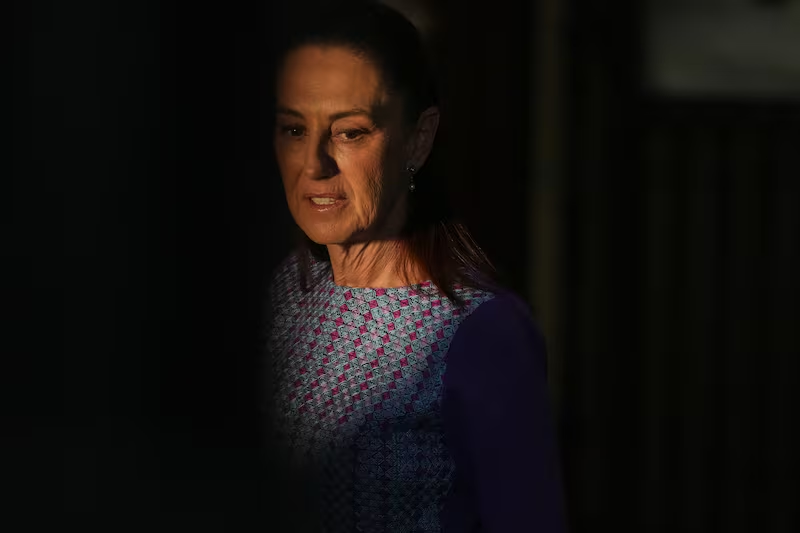
Mexico’s President Claudia Sheinbaum entered office promising continuity, discipline, and moral authority after the turbulent presidency of Andrés Manuel López Obrador. But less than a year into her administration, a political crisis threatening the foundations of Mexico’s ruling Morena party has erupted around allegations that senior members of the governing movement maintained links to one of the country’s most powerful drug cartels.
The crisis exploded after US prosecutors unveiled indictments accusing several current and former Mexican officials, including Sinaloa Governor Rubén Rocha Moya, of collaborating with the Sinaloa Cartel in narcotics trafficking operations. The allegations have shaken Mexico’s political establishment and triggered an internal struggle inside Morena over how far the government should go in responding to mounting US pressure.
For Sheinbaum, the controversy represents the most serious challenge yet to her authority and political credibility. Publicly, the Mexican president has questioned the evidence presented by Washington and warned against foreign interference in Mexico’s internal affairs. She has repeatedly argued that accusations alone cannot justify extraditions or arrests without clear proof presented through Mexican legal institutions.
Yet behind the scenes, according to a Reuters investigation into the Morena party crisis, the indictments have deepened existing fractures within Morena, exposing tensions between López Obrador loyalists and younger reformist figures who believe the party risks losing public legitimacy if it appears unwilling to confront corruption allegations involving its own members.
The growing crisis inside Morena reflects a broader confrontation across Latin America over cartel violence, sovereignty, corruption investigations, and rising US pressure on governments accused of protecting criminal networks.
The accusations against Rocha are particularly explosive because of his proximity to López Obrador, the dominant figure in modern Mexican politics and the founder of Morena. Rocha has denied wrongdoing and described the charges as politically motivated. But his decision to temporarily step aside from office marked an extraordinary moment for a party that built much of its political identity around promises to eradicate elite corruption and challenge what López Obrador long described as the corrupt political order of the past.
According to The Guardian’s report on the Sinaloa Cartel indictment, US prosecutors accused Mexican officials of enabling fentanyl, heroin, cocaine, and methamphetamine trafficking operations while shielding cartel networks from law enforcement scrutiny.
The scandal has also intensified concerns inside Mexico over the increasingly aggressive posture adopted by Washington in the regional drug war. Under growing political pressure to stop fentanyl trafficking and cartel violence, the US Department of Justice has escalated investigations targeting Mexican political figures allegedly connected to organized crime networks. Analysts in Mexico view the indictments as part of a broader shift in US strategy toward direct political pressure on Mexican institutions.
That pressure comes at a particularly volatile time. Mexico has spent months battling intensified cartel violence following major security operations against organized crime groups. A Reuters report on Mexico’s military crackdown described the campaign as one of the country’s most significant anti-cartel offensives in years.
Inside Morena, the crisis has quickly evolved into a battle over the party’s future direction. A faction aligned closely with López Obrador has reportedly resisted any moves that could be interpreted as yielding to US demands, arguing that Mexico’s sovereignty must remain the government’s central priority. Another emerging bloc inside the party has pushed for a stronger anti-corruption response to contain political damage ahead of future elections.
The appointment of Ariadna Montiel Reyes as Morena’s new party leader has intensified speculation about an internal realignment. Montiel has publicly adopted a tougher anti-corruption tone, pledging that candidates accused of corruption would face consequences regardless of political influence. Her rise has been interpreted by some analysts as an attempt to strengthen Sheinbaum’s position inside the party while distancing Morena from growing allegations surrounding regional political figures.
For many Mexicans, however, the scandal reinforces long-standing public suspicions that criminal organizations maintain influence deep inside local political systems. In regions such as Sinaloa, cartel violence and political power have often existed side by side for decades, blurring the line between governance and organized crime in ways successive administrations have struggled to dismantle.
The controversy has also complicated Sheinbaum’s carefully cultivated international image. Since taking office, she has sought to project stability and technocratic competence while presenting herself as a more measured and disciplined figure than her predecessor. But the cartel allegations now threaten to pull her administration into a confrontation that combines national security, party loyalty, foreign pressure, and public anger over corruption.
Her balancing act has become increasingly delicate. Moving aggressively against accused Morena figures risks provoking a rebellion among López Obrador loyalists who still dominate large parts of the party machinery. Refusing to act decisively, however, could deepen perceptions that Morena protects political allies while demanding accountability from opponents.
A recent Associated Press report on Mexico’s investigation noted that Sheinbaum’s government insists any prosecution or extradition process must be conducted through Mexican institutions rather than under direct US political pressure.
Political analysts warn that the outcome of the crisis could shape not only Sheinbaum’s presidency but also the long-term survival of Morena as Mexico’s dominant political force. Since López Obrador founded the movement, Morena has transformed itself from an insurgent political coalition into the country’s most powerful electoral machine, controlling Congress, governorships, and much of the national political apparatus.
The crisis is also unfolding amid wider regional tensions between Latin American governments and Washington over security policy, organized crime, and interventionism. Similar disputes over political sovereignty and US influence have increasingly shaped debates across the continent, including recent geopolitical confrontations involving Brazil, Venezuela, and Mexico.
As Brazil’s president condemned US actions against Venezuela, political leaders across Latin America warned that Washington’s growing interventionist posture risked destabilizing already fragile regional institutions.
The latest controversy surrounding Claudia Sheinbaum now threatens to redefine her presidency at a moment when both domestic stability and US-Mexico relations remain under enormous strain.
What once appeared to supporters as a movement against corruption is now confronting accusations that corruption adapted itself inside the movement instead.
And for Claudia Sheinbaum, the political crisis now unfolding may determine whether she emerges as an independent leader capable of reshaping Morena in her own image or remains trapped between loyalty to López Obrador’s political legacy and a public increasingly demanding accountability from those in power.