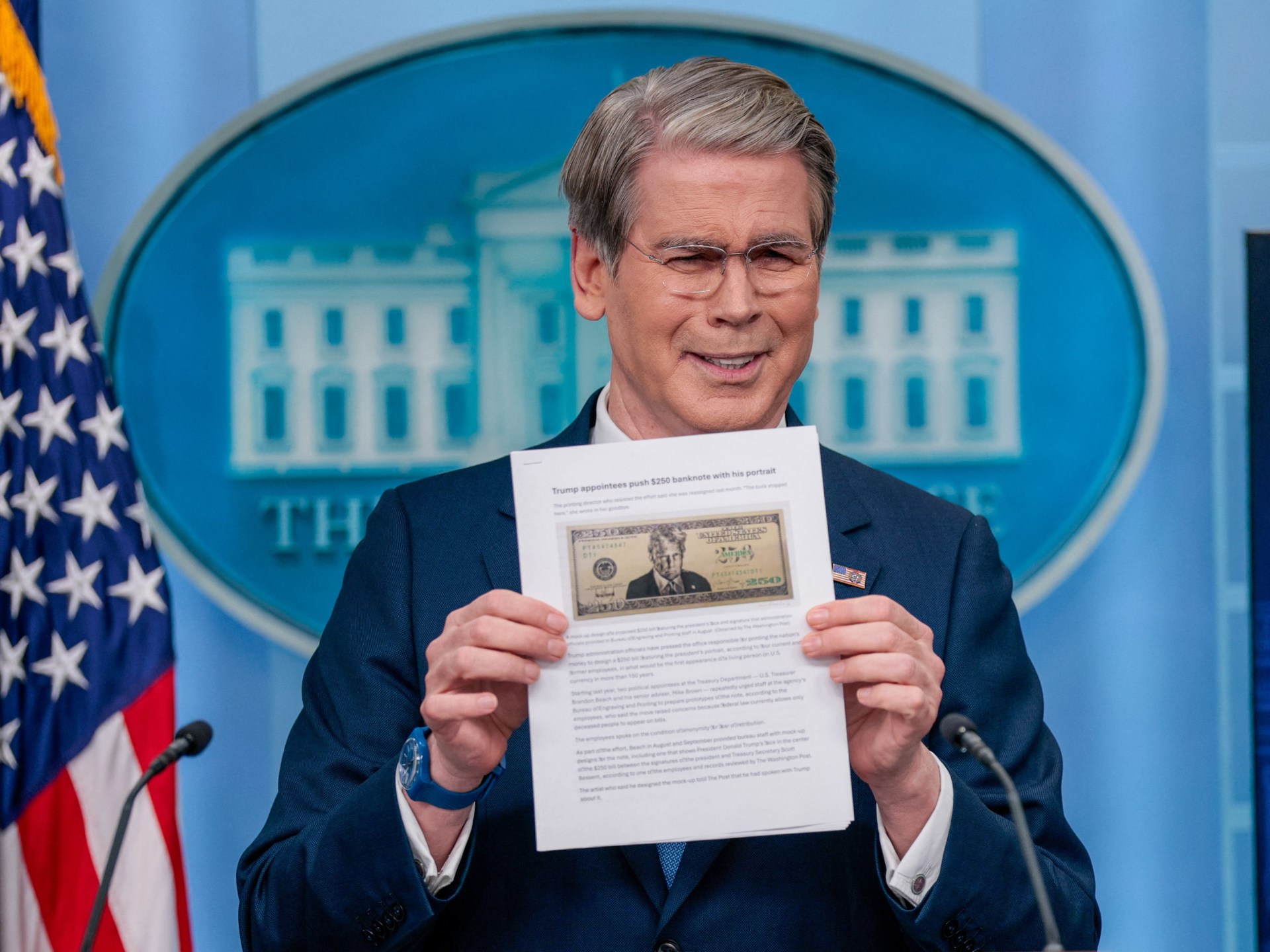
WASHINGTON — The Treasury Department has already drawn up a $250 bill bearing President Donald Trump’s face, and the only thing standing between the design and Americans’ wallets is an act of Congress, Treasury Secretary Scott Bessent said Thursday.
Speaking from the lectern at a White House briefing, where he filled in for press secretary Karoline Leavitt during her maternity leave, Bessent laid out the two legal commands that govern what goes on American money. No living person may be pictured on it, and every note must carry the words “In God We Trust.” Legislation moving through Congress, he said, would carve out an exception to the first rule for one man.
Bessent told reporters that a measure before both chambers would lift the ban “so that a living person, Donald J. Trump, could be on a $250 bill.” The department, he added, had prepared a design in anticipation but would “stick to the law” until it changed.
The disclosure came hours after The Washington Post first reported that political appointees inside the Treasury had been quietly pressing the Bureau of Engraving and Printing to produce prototypes of the note. Bessent leaned into the story rather than away from it, holding up a printed copy of the article at the podium as he fielded questions.
According to that reporting, U.S. Treasurer Brandon Beach and a senior adviser, Mike Brown, began urging bureau staff to develop sample designs as far back as last summer. Four current and former employees described mock-ups circulating internally, including one that placed Trump’s portrait in the center of the note, flanked by the signatures of the president and the Treasury secretary. A British painter, Iain Alexander, said he created the artwork and that Trump had suggested changes, among them more red, white and blue and a logo marking the country’s founding anniversary.
The push has not been frictionless. The bureau’s printing director, Patricia Solimene, was reassigned in late April after warning colleagues that the project faced steep legal and procedural hurdles and could take years, employees said. She told staff the move was “not my choice.” A Treasury official cautioned that any images now circulating online “are not real,” noting that finished currency designs are usually withheld from the public until six to eight months before they enter circulation, a defense against counterfeiters.
The legislation at the heart of the plan is not new. The “Donald J. Trump $250 Bill Act,” filed as House Resolution 1761 and available here, was introduced in February 2025 by Representative Joe Wilson, Republican of South Carolina, alongside three co-sponsors. It was sent to the House Financial Services Committee the day it was filed and has sat there since, with no recorded action.
Wilson framed the measure as both a tribute and a practical fix, arguing that inflation under the previous administration had forced families to carry more cash. He called it the “most valuable bill for most valuable President.” There were signs on Thursday that the dormant proposal may be stirring. A Republican committee aide said the bill had been cleared for a future hearing and that members and senators were discussing it. A spokesman for Wilson said the congressman had spoken several times with the committee’s chairman, Representative French Hill of Arkansas, and had raised the bill directly with both Bessent and Trump.
Current law is unambiguous. Federal statute permits only the portrait of a deceased individual on the nation’s currency, a restriction rooted in an 1866 measure meant to keep the young republic from echoing the monarchies it had broken away from. No living American has appeared on a circulating note since. A $250 bill would also revive a denomination above $100, a tier of currency last printed in 1945 and pulled from circulation in 1969 for lack of use.
A Treasury spokeswoman confirmed that the bureau was “conducting appropriate planning and due diligence” and was moving proactively to be ready should the bill become law, as also reflected in reporting on the department’s response.
The banknote would slot into a wider effort to mark the nation’s 250th birthday with Trump’s likeness. In March the department announced that Trump’s signature would appear on paper currency, a first for a sitting president, and a federal arts commission approved a commemorative gold coin bearing his image. A $1 coin carrying his portrait has also been in the works for the July 4 milestone. Each step has drawn comparisons from critics to the iconography of strongmen and kings. Hillary Clinton, the former secretary of state, mocked the proposal online, predicting the note would soon buy little more than “one gallon of gas and a carton of eggs.”
That jab landed on a sensitive nerve. Pressed on whether it was appropriate to celebrate the president on money while households grapple with inflation that has climbed toward four percent, Bessent argued the two issues were separate and said there was nothing “untoward” about featuring a sitting president on an anniversary note. The affordability question has shadowed the administration as voter anger over the cost of living builds ahead of the midterms.
The currency plan is of a piece with a broader drive to stamp Trump’s name across the federal government. He has attached it to the Kennedy Center and the former U.S. Institute of Peace, to a discount drug program and a new class of tax-advantaged savings accounts, and to a proposed line of warships. Florida lawmakers have voted to rename Palm Beach International Airport for him, and his portrait now hangs on banners outside the Justice and Labor departments. Days earlier, the president had told his cabinet he was not worried about the midterms, a posture that has freed the White House to lean into symbolism.
For now, the design sits in a drawer at the bureau, finished but forbidden. Whether it ever reaches a cash register rests with a Congress that has, so far, left the bill untouched.