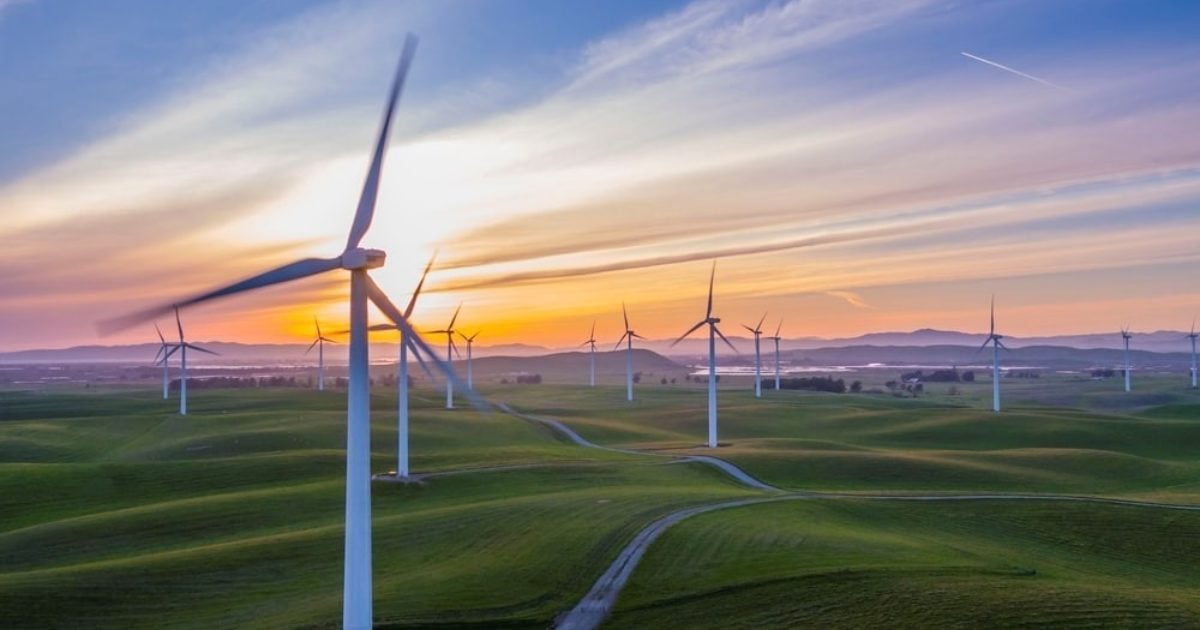
LONDON — It is not the wind turbine rising over the Humber estuary or the solar panel on a Durham farmhouse roof that most economists reach for when they want to explain Britain’s productivity problem. But it may be exactly those workers — the ones nobody mentions in Westminster speeches — who are quietly reshaping the answer.
Britain’s net zero economy now supports 1.1 million full-time jobs and generates £105 billion in gross value added annually, according to a report published Monday by the Energy and Climate Intelligence Unit, with analysis carried out by CBI Economics and independent consultancy The Data City. That figure — £105 billion, equivalent to roughly 4% of national economic output — lands at a moment when Britain is losing the argument, at least in some quarters, that the green transition is worth the cost.
The timing is pointed. Former prime minister Tony Blair argued last week that the UK should abandon net zero targets and lean instead into new oil and gas exploration. The report makes no direct reference to Blair. It does not need to. A sector generating £119,300 in economic value per full-time job — 1.5 times the national average — and paying workers £43,142 a year against a median wage of £39,039 is not a cost. It is, by any measure the government uses, a growth industry.
Peter Chalkley, director of the ECIU, put it in terms that reach beyond economists. Thousands of small businesses across the UK, he said, are “the unsung heroes of this net zero economy, installing solar panels on roofs, manufacturing parts for electric cars and in doing so creating greater energy independence for the UK.” Those firms, he added, have also shielded Britain from oil and gas price crises. The argument is not only moral; it is structural.
Of the 22,700 businesses that make up the net zero economy, 96% are small or medium-sized enterprises. That concentration of SMEs — firms with fewer than 50 employees in most cases — challenges the assumption that the green transition is the project of large corporations and government grants. The sector’s £36.7 billion in direct gross value added already exceeds the combined output of the UK’s entire engineering and architectural services sector at £36.2 billion, according to the same analysis.
The economic multiplier compounds the headline. For every £1 in value the net zero economy generates, the ECIU report estimates a further £1.85 ripples through the wider economy — in supply chains, in induced spending, in communities built around the six “billion-pound hotspots” identified across Scotland’s Central Belt, West and North Yorkshire, and North Wales and Cheshire.
Yorkshire and the Humber leads England in net zero’s share of local economic output, with the sector accounting for 4.4% of regional GVA and supporting more than 79,000 jobs. In Scotland, net zero activity underpins the equivalent of 100,700 full-time roles and makes up 4.9% of the country’s total GVA — figures that will make uncomfortable reading for critics in Holyrood who have argued the sector remains peripheral to the national economy.
Louise Hellem, chief economist at the CBI, was direct about the stakes. “Supporting more than a million jobs across the country, the net zero economy is already shaping lives and livelihoods in every part of the UK,” she said, from Scotland’s Central Belt to the industrial heartlands of Yorkshire and communities in Wales. She went further on competition: with global rivals intensifying their push into clean industries, stepping back from an economy already contributing £100 billion would not be neutral. “The UK cannot afford to step back,” she said.
What the report does not settle — and its authors acknowledge this — is whether Britain is moving fast enough. The UK’s renewable energy pipeline represents a £455 billion investment opportunity across 262 gigawatts of capacity, with roughly two-thirds of that already in active or construction phases. But the report’s methodology changed this year, making direct year-on-year comparison impossible. Whether the sector grew at 10% again, as it did in the most recent prior survey, or whether momentum is slowing, is a question the data cannot yet answer cleanly.
That gap in the evidence matters. Global demand for petrol cars is falling. Installations of heat pumps and solar panels are rising. The UK is competing against the European Union’s industrial subsidies and American clean energy tax credits for the manufacturers and engineers who will build those systems at scale. Whether the 1.1 million workers already in those jobs represent the floor of what Britain can capture — or the ceiling — depends on decisions that have not yet been made.
The report is the fourth annual assessment of its kind commissioned by the ECIU, and the first to cross the one-million-worker threshold. Climate Minister Katie White, responding to the findings, said Britain faces another fossil fuel price shock and that only a clean energy economy offers lasting protection. Those words carry political weight. They do not carry the weight of the workers in Hull and Ellesmere Port and North Lanarkshire who, according to Monday’s figures, have already made the choice for the country — and are waiting to see whether policy keeps pace.
Separately, a broader economic picture complicates the optimism. As the IMF warned the Starmer government last month about its fiscal trajectory and bond markets pushed British borrowing costs to multi-year highs, the net zero sector’s growth stands as a rare unambiguous positive in national accounts that are otherwise under scrutiny. The question is whether a government navigating a debt warning and a restive bond market can direct enough policy stability toward the green sector to sustain it.
No one in the ECIU report makes that argument explicitly. But the arithmetic implies it. A sector generating nearly 4% of national output and paying wages 11% above average does not need government cheerleading. It needs consistency. That, according to Chalkley, is the one input still missing — and the one that would determine whether Britain leads the global race for clean industries, or watches from behind.