ST. PETERSBURG — The number that matters most to Minsk’s economic planners right now is $70 billion. That is the figure Russian Deputy Prime Minister Alexei Overchuk placed before delegates at the St. Petersburg International Economic Forum on Thursday, when he said bilateral trade between Russia and Belarus could reach that threshold before the year is out.
“We exchanged views on the outlooks for seeing $70 billion as early as this year,” Overchuk said at the forum. “That is the trend, and it is quite possible that we can achieve this.”
The projection, even framed as a possibility rather than a target, would represent a striking acceleration. Putin put 2025 trade between the two countries at roughly $52 billion when he addressed the Union State’s Supreme State Council in February; Belarusian officials, counting services alongside goods, have cited a figure closer to $62 billion for the same year. What is not disputed is the direction. Trade that stood at $35 billion five years ago has nearly doubled, a trajectory Overchuk described as evidence of successful integration rather than circumstance. “If you look at our mutual trade per capita, no one even comes close to Belarus,” he said.
The gap between the Russian and Belarusian statistics is not merely accounting. Moscow measures merchandise trade; Minsk includes a broader services component. Both methodologies show the same upward curve. In the first quarter of 2026, trade in goods and services between the two countries surged 13.5% year-on-year, according to the head of the Belarusian presidential administration, Dmitry Krutoi, who flagged the $70 billion figure as a realistic projection in May. Thursday’s remarks from Overchuk, at Russia’s premier annual economic showcase, gave that projection its highest-profile endorsement yet.
The composition of that trade, however, sits at the center of a quieter debate. Russian exchange-platform data shows that purchases of Belarusian goods — butter, milk powder, meat products, sawn timber, flax fiber — drove the bulk of bilateral commodity transactions in the first five months of 2026, with Russian participants concluding $498 million worth of deals on the Belarusian Universal Commodity Exchange, a 29% increase year-on-year. At the same time, independent analysts have noted that Russian imports into Belarus have grown faster than Belarusian exports to Russia across several key sectors, raising questions about the symmetry of the integration dividend. Belarus’s share of exports directed toward Russia has risen from 65% to 67% over the past year, a level of concentration that some economists regard as a structural vulnerability rather than a partnership achievement.
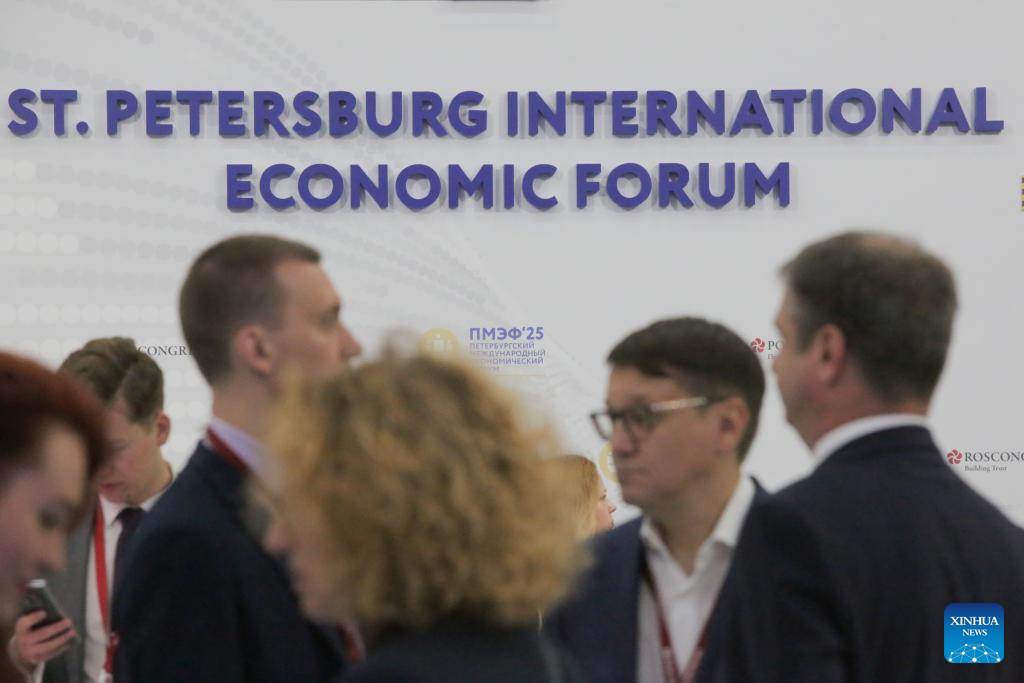
None of that ambiguity reached the SPIEF podium. The forum, running from June 3 to 6 at St. Petersburg’s Expoforum Convention Centre and drawing roughly 20,000 participants from more than 100 countries, has functioned this year as a platform for Russia to showcase its economic relationships with aligned states. Belarus, bound to Moscow through the Union State treaty framework that predates the current geopolitical alignment by decades, has been a recurring reference point. Overchuk’s appearance follows a phone call last Tuesday between Vladimir Putin and Belarusian President Alexander Lukashenko focused on allied cooperation, and an Astana summit in late May at which Lukashenko credited the Eurasian Economic Union with strengthening each member economy.
What the $70 billion figure does not capture — and what no official on either side has yet addressed publicly — is how much of the growth is structural and how much reflects a transient rerouting effect born of Western sanctions on Russia. With European and American markets closed to a wide range of Russian and Belarus-linked exports, the bilateral corridor has absorbed trade flows that might otherwise have dispersed across multiple markets. Whether that compression produces durable integration or a dependency that becomes costly if geopolitical conditions change is a question the Union State architecture is not designed to answer.
The Union State framework — established by the 1999 Russia-Belarus Union State Treaty — has long promised deeper economic integration than it has consistently delivered. Harmonized energy prices, joint industrial programmes, and common regulatory standards have advanced unevenly, punctuated by periodic gas and dairy disputes that the $70 billion headline does not reflect. Overchuk himself was at SPIEF last year, when he cited a trade figure of nearly $51 billion for the preceding five years and called the relationship “special” — language that has remained unchanged even as the numbers have grown.
For Minsk, the stakes of the relationship extend well beyond trade statistics. Belarusian cargo is now routed through 13 Russian ports, with 4.1 million tonnes shipped by sea in the first quarter of 2026 alone — a logistical dependency that emerged after Belarus lost direct Baltic Sea access routes following the deterioration in ties with Lithuania and Latvia. Russia has also been the conduit through which Belarusian goods reach more distant markets. Overchuk noted as much on Thursday, describing the trajectory as an indicator of Union State integration at work.
The SPIEF plenary session, at which Putin is expected to speak, is scheduled for Friday. Whether the Russian president elaborates on the bilateral trade figures — or the deeper strategic architecture that produces them — remained unclear as of Thursday afternoon. What Overchuk left open, notably, was the exact mechanism by which the $70 billion would be confirmed: neither side has committed to releasing joint trade statistics under a unified methodology, meaning the figure, when it arrives, may once again be subject to the same dual-counting ambiguity that has defined bilateral reporting for the past three years.
—Inputs from RIA Novosti, Sputnik.
Related Posts