
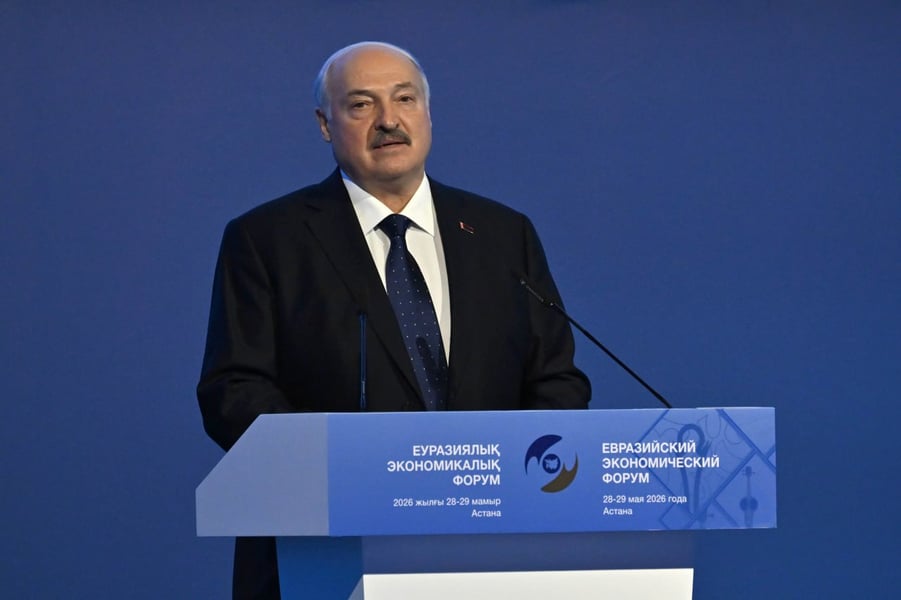
ASTANA — President Alexander Lukashenko of Belarus told the leaders of the Eurasian Economic Union on Friday that the bloc had quietly made each of its members stronger over the past twelve years, even as he warned that the world beyond their shared borders was sliding toward open conflict and an “avalanche of problems” whose force no one could yet measure.
Speaking at the expanded session of the Supreme Eurasian Economic Council in the Kazakh capital, on the eve of the union’s official anniversary, Lukashenko cast the meeting as both a celebration and a reckoning. He credited the project with having “made each of our countries significantly stronger,” and he pressed his counterparts not to lose sight of the founding ambitions, or the hard compromises, that had made the union possible in the first place.
The setting carried its own message. The treaty that created the union was signed in Astana on May 29, 2014, a date the bloc now marks as the Day of the Eurasian Economic Union. TASS has noted that Russia, Belarus and Kazakhstan put their names to that founding document in the same city where their successors gathered this week, lending the summit the feel of a homecoming for an experiment that began as a customs arrangement and grew into a five-nation common market binding Russia, Belarus, Kazakhstan, Kyrgyzstan and Armenia.
The warning came wrapped inside the tribute. Lukashenko said the global situation was unfolding along a “conflict scenario,” and that the union could not be sure how hard the coming turbulence would land. It was a theme he has returned to for years, the idea that the post-Soviet bloc is a shelter as much as a marketplace, and that its worth rises in step with the disorder spreading across the wider world.
Much of that argument rests on the years of Western sanctions that have fallen on Russia and Belarus. Both Moscow and Minsk have leaned on the union to blunt the impact, rerouting trade, settling more business in national currencies and pulling closer to partners in Asia and the Global South. Lukashenko’s talk of an approaching storm fit that frame neatly, casting the bloc less as a project of prosperity than as a hedge against a world its members no longer trust.
For all the language of strength, the Belarusian leader has rarely concealed his impatience with the union’s unfinished business. He has long pushed for fully barrier-free markets in gas, oil and transport, areas where movement has been slow and grudging, and his congratulations on Friday sat beside a familiar reminder that the goals written into the founding treaty remain only partly met. Strength, in his telling, has always been a work in progress.
The summit doubled as the closing act of a state visit by President Vladimir Putin of Russia, who arrived in Astana on May 27 and spent three days in talks with his Kazakh host. The two leaders signed a declaration setting out seven principles of friendship along with a thick stack of accompanying agreements, deepening a relationship in which Russia-Kazakhstan trade is approaching record levels. Energy ran through the visit as well, with Moscow pledging to keep gas flowing to northern Kazakhstan.
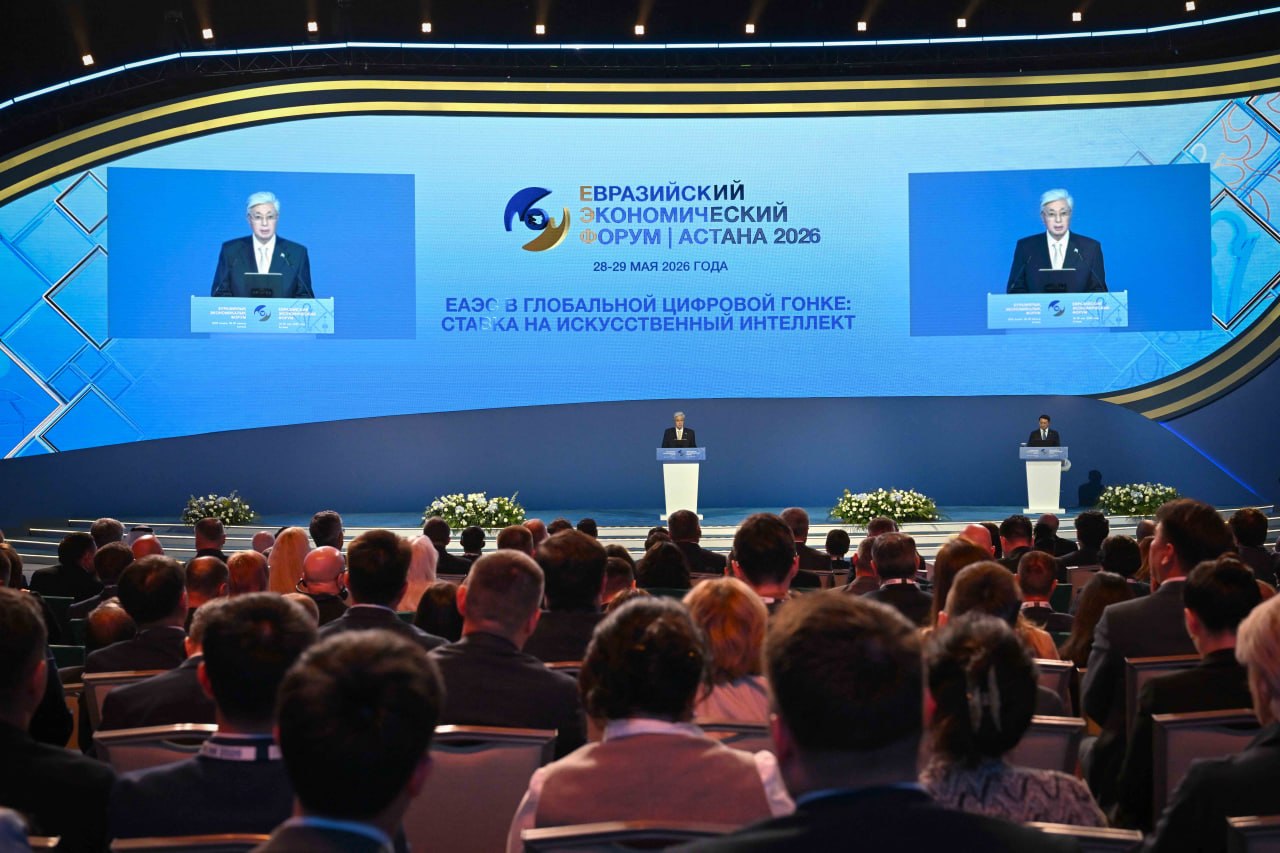
President Kassym-Jomart Tokayev, whose country holds the union’s rotating chairmanship this year, used the surrounding forum to argue that artificial intelligence should be threaded through the bloc’s economic plumbing. That digital theme dominated the fifth Eurasian Economic Forum, which preceded the council and which the Eurasian Economic Commission said would center on the union’s place in the global race for artificial intelligence.
Lukashenko told the plenary that no single member could build a full artificial intelligence capability on its own, and he called for a single Eurasian digital ecosystem and a shared industrial data space that would not lean on outside providers. By pooling engineering talent and production capacity, he argued, the union could do more than adapt to the digital age and instead help “shape its rules.” Tokayev pressed a parallel case, proposing that the technology be used to speed the movement of goods, services, capital and labor across internal frontiers, the bloc’s so-called four freedoms.
President Sadyr Japarov of Kyrgyzstan went further, urging the members to combine computing power and data centers so the union could become, in his phrase, an architect of the global digital agenda rather than a customer of it. The leaders also adopted a joint statement on the responsible development of artificial intelligence, an initiative Tokayev first floated late last year.
The language at the table has grown more political over the years, even as the council’s formal business stays stubbornly technical. Customs codes, transit rules and digital signatures filled much of the agenda, yet the leaders kept circling back to a larger claim, that their union represents one of the independent poles of a multipolar world taking shape as the old order loses its grip. Lukashenko has been among the most forceful voices for that view, and on Friday he returned to it once more.
Beneath the unity, the strain was hard to miss. Armenia, a founding member, sent its deputy prime minister, Mher Grigoryan, rather than Prime Minister Nikol Pashinyan, who stayed away as his country edges toward the European Union. Russian officials had signaled that the leaders would weigh Yerevan’s standing in a closed-door format, with Moscow insisting that membership in both the Eurasian Economic Union and the European bloc cannot work at the same time. The quarrel has already spilled into trade, with Russia tightening restrictions on Armenian produce in recent weeks.
The economic record remains the union’s most durable argument. Lukashenko has told the council that the bloc’s combined output climbed above $2.5 trillion, and officials in Astana pointed to cooperation supplies between member states that have risen more than twofold over eleven years. The union has also kept widening its reach, signing a joint action plan with Cuba that runs through 2030 and courting new partners across Asia, the Gulf and Latin America.
The council was expected to sign a package of documents before the leaders departed Astana. For Lukashenko, the message was that the union’s first dozen years had earned their keep, and that the harder test was still to come. He closed where he began, on the compromises that built the bloc, a reminder that whatever strength it had gathered had always been a negotiated thing, and would have to be negotiated again.
—Inputs from Sputnik.