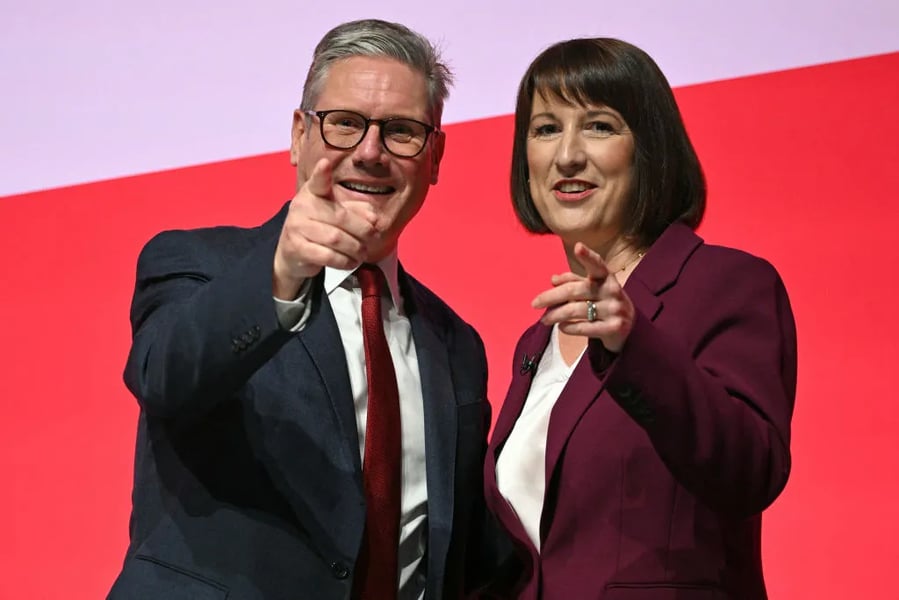

Britain’s fragile economic recovery is facing renewed turbulence after the IMF warned the UK government against abandoning deficit reduction plans amid mounting political instability surrounding Prime Minister Keir Starmer and Chancellor Rachel Reeves. The warning comes as investors increasingly fear that Britain could drift toward another credibility crisis similar to the bond market turmoil that devastated the country during previous fiscal shocks.
The IMF’s intervention has exposed growing anxiety inside global financial institutions over Britain’s soaring borrowing costs, political fragmentation within Labour, and the long-term sustainability of the UK economy as inflationary pressures intensify due to the Iran war oil shock and global energy instability.
In its latest Article IV assessment, the IMF upgraded Britain’s 2026 growth forecast from 0.8% to 1%, citing stronger-than-expected economic momentum before the escalation of geopolitical tensions in the Middle East. Yet despite the upward revision, the Fund issued a stark warning that the UK has limited fiscal space and must remain committed to reducing borrowing in order to preserve investor confidence.
The IMF’s message reflects growing alarm across bond markets, where investors have become increasingly nervous about Labour’s internal divisions and speculation surrounding Starmer’s political future. Over recent weeks, UK borrowing costs surged sharply, reaching their highest levels in years before stabilizing slightly after reassurances from senior Labour figures.
Financial markets are particularly focused on the emergence of Greater Manchester mayor Andy Burnham as a potential successor to Starmer. Burnham’s recent rhetoric attacking “40 years” of British economic policy and advocating more interventionist economic policies has unsettled investors already concerned about Britain’s debt burden and weakening productivity growth.
Although Burnham attempted to calm markets by backing existing fiscal rules and distancing himself from proposals to exempt defense spending from borrowing limits, investors remain wary that a future Labour leadership shift could trigger more aggressive spending policies. The IMF itself emphasized that predictable policymaking remains essential during a period of heightened global volatility.
The crisis unfolding in Britain reflects broader structural weaknesses inside the UK economy. Public debt levels remain elevated, annual debt interest payments are approaching £100 billion, and the country faces rising long-term obligations tied to healthcare, pensions, defense spending, and energy transition policies. At the same time, economic growth remains sluggish compared to many major economies, leaving Britain vulnerable to external shocks.
The IMF specifically warned that Britain cannot continue relying on higher taxes alone to stabilize public finances. According to the Fund, the UK is approaching “peak tax,” meaning further broad increases could begin damaging growth and consumer spending. Instead, the organization suggested that future governments may need to implement politically sensitive reforms, including tightening welfare spending, reforming property taxation, and reconsidering expensive state commitments.
The warning lands at a politically dangerous moment for Starmer and Reeves. Labour has attempted to project fiscal discipline while also responding to rising public anger over living costs, stagnant wages, and inflation driven partly by the ongoing Iran war and energy market disruption. Reeves has tried to balance spending restraint with targeted economic support, but UK borrowing costs and market confidence remain fragile as political uncertainty grows.
Adding to the pressure are concerns that Britain’s economic model itself is beginning to fracture under the weight of repeated crises. Since Brexit, the COVID pandemic, the energy shock triggered by geopolitical conflicts, and now escalating military tensions involving Iran, the UK economy has struggled to regain stable long-term momentum. Investors increasingly fear that prolonged political instability could deepen the country’s structural problems and push borrowing costs even higher.
The IMF warned that domestic political turmoil could suppress investment and consumer spending at a time when the global economy is already entering a more volatile phase. IMF officials stressed that governments with high debt burdens now face stricter scrutiny from bond markets, particularly in an era of higher interest rates and inflation risk.
Rachel Reeves responded to the IMF report by insisting that the government’s strategy is delivering results and warning that any abandonment of fiscal discipline could damage families and businesses across Britain. She argued that maintaining economic stability is essential as Britain navigates international instability and rising geopolitical risks.
Yet critics inside and outside Labour argue that Reeves’ approach has failed to address deeper economic dissatisfaction among working-class voters. Burnham has increasingly positioned himself as the voice of those frustrated by decades of privatization, deindustrialization, and widening inequality. In recent speeches, he attacked Britain’s economic direction since the 1980s and claimed the current system no longer works for ordinary citizens.
His growing popularity among Labour supporters has intensified speculation over Starmer’s future, particularly after recent polling suggested Burnham could command significant grassroots backing if a leadership contest emerged. Markets reacted nervously to the possibility that Britain could shift toward more interventionist economic policies at a moment when investors are already uneasy about debt sustainability.
The UK’s economic vulnerability has also been amplified by international developments. The Iran war has pushed energy prices higher, increased inflationary pressures across Europe, and created uncertainty around future interest rate policy. The IMF warned that inflation in Britain could approach 4% later this year before gradually falling back toward the Bank of England’s target by 2027, assuming energy prices stabilize.
At the same time, the IMF cautioned the Bank of England to remain prepared for sudden changes in inflation dynamics if wage pressures or corporate price increases accelerate further. This leaves Britain trapped between slowing growth, persistent inflation risk, and political instability, a combination that has historically triggered severe market reactions in heavily indebted economies.
Some analysts have already begun drawing comparisons between current conditions and previous UK fiscal crises. Commentators in the British press warned that rising debt costs and political fragmentation are creating conditions that could eventually force dramatic economic corrections if investor confidence weakens further. IMF bailout fears have also resurfaced in sections of the British media.
Despite the IMF’s modest growth upgrade, the broader outlook for Britain remains uncertain. Weak productivity, stagnant real incomes, high debt servicing costs, and geopolitical instability continue to weigh heavily on the economy. The IMF’s warning underscores how fragile Britain’s financial credibility has become in a world where markets are increasingly intolerant of fiscal uncertainty and political chaos.
Political pressure inside Labour has also intensified following reports of a growing Labour revolt against Starmer’s leadership. Critics accuse the prime minister of failing to provide a convincing economic alternative while Britain drifts deeper into fiscal uncertainty.
Meanwhile, bond traders continue closely monitoring the government’s next fiscal moves as concerns grow over Britain’s long-term debt trajectory and political fragmentation.
The debate over Britain’s economic future is now rapidly evolving into a broader national argument over whether decades of privatization, austerity, and debt-driven growth have fundamentally weakened the country’s resilience. As investors demand stability and voters demand change, Starmer’s government finds itself trapped between financial markets and rising public anger.