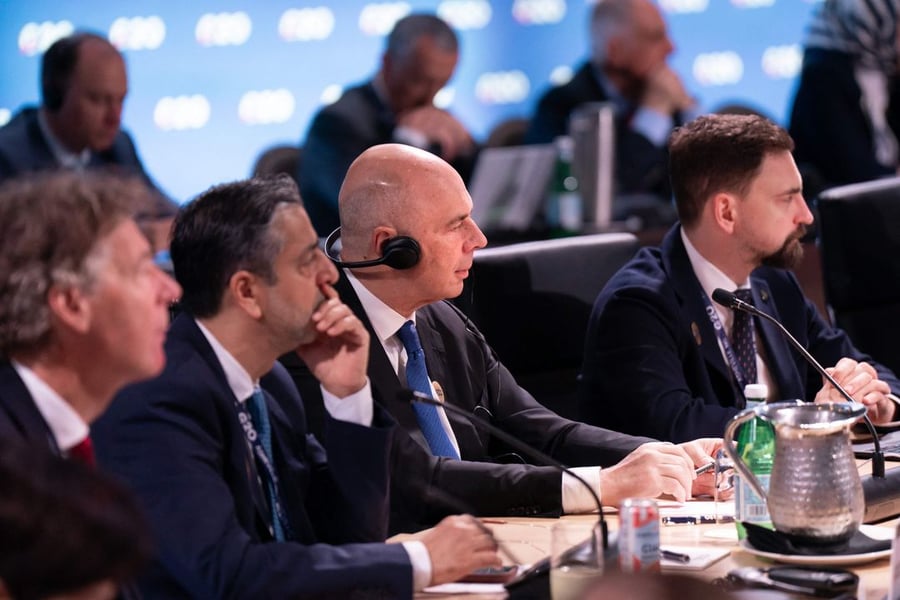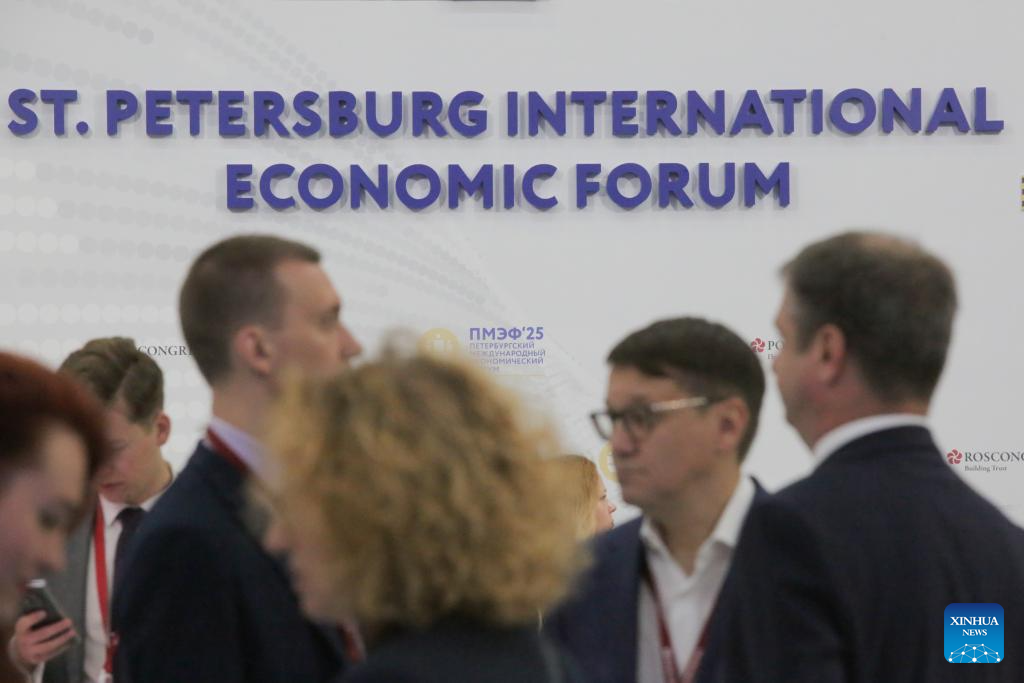

ST. PETERSBURG — For the American executives who pulled out of Russia in the months after 2022, the question of return has never been purely commercial. It has always been political. Robert Agee, the president and chief executive of the American Chamber of Commerce in Russia, made that calculation explicit on Thursday on the sidelines of the 29th St. Petersburg International Economic Forum, telling reporters that many companies are not waiting for market conditions — they are waiting for Washington.
“Most of the American companies are still here working in Russia,” Agee said. “The companies that have left, many companies, are considering coming back. And they’re waiting for a green light from Washington to do so, removal of sanctions in many cases.”
The remark lands at a forum whose guest list this year already signals a tentative thaw. The Trump administration sent Rodney Mims Cook Jr., chair of the U.S. Commission of Fine Arts, to St. Petersburg — the first official U.S. delegation to attend SPIEF in nearly a decade. About 30 American companies operating in Russia have registered for the forum, according to AmCham’s executive director for the St. Petersburg office. That is more than in any year since 2022, but still well below pre-conflict levels.
What Agee described on Thursday is a corporate holding pattern with a ticking clock attached. Roughly 20 percent of U.S. companies that exited Russia in 2022 and 2023 negotiated buyback options on their assets before leaving — arrangements that allowed them a contractual path back in should conditions change. Most of those options expire in 2026 or 2027. For those companies, the window to exercise them is narrowing, whether or not Washington signals anything.
The sectors lining up most visibly are energy and technology. Speaking at SPIEF last year, Kirill Dmitriev of the Russian Direct Investment Fund said U.S. oil and gas firms would be among the first wave of returnees and that negotiations were already underway. ExxonMobil, which lost its stake in the Sakhalin-1 project after 2022, received a signal from the Kremlin earlier this year when President Vladimir Putin ordered the government to draft a regulatory framework for returning Western companies — a framework designed, Russian officials said, to protect domestic businesses from being undercut by their original foreign partners.
Agee has been candid in public remarks over the past year about the sequential logic of a return: a peace agreement on Ukraine comes first, then a sanctions rollback, then the commercial decisions follow. In an interview with the Russian business daily RBK earlier this year, he said the companies he represents are not waiting passively. They are “watching, thinking,” he said — doing commercial due diligence on the assumption that conditions will eventually shift, and not wanting to be caught flat-footed when they do.
That framing reflects the broader dynamic at SPIEF this year, where the theme “Pragmatic Dialogue: The Path to a Stable Future” was chosen deliberately to signal that the forum intends to be a venue for transactional conversation rather than ideological positioning. The business session co-organized by AmCham and the Roscongress Foundation — titled “Pragmatism as a Strategy: Business in the Era of a New Global Reality” — returned for a second consecutive year after its debut at SPIEF 2025 drew strong interest from companies on both sides exploring a restoration of commercial ties.
What Agee did not address Thursday — and what no one at SPIEF has answered cleanly — is whether Washington is actually preparing to move. The Trump administration’s decision to send a cultural envoy to St. Petersburg, rather than a trade or commerce official, carries its own signal. It says the relationship is thawing at the edges while the core sanctions architecture — including the designations that govern companies in the energy, financial and technology sectors — remains intact. Secondary sanctions risk, in particular, continues to deter European subsidiaries of U.S. multinationals from testing the line, even where a parent company might be inclined to act.
The difficulty for companies navigating this is that sanctions relief, if it comes, is unlikely to arrive uniformly. Analysts who follow the OFAC designation process have noted that partial rollbacks — lifting sector-specific measures while maintaining individual and entity designations — are the historical norm after geopolitical settlements. Companies that left Russia holding buyback options will face the practical question of which specific sanctions still apply to them and whether their particular asset class is covered by any new general licenses.
AmCham Russia was founded in 1994 and has operated continuously through every rupture in U.S.-Russia relations since then, including the 2014 Crimea annexation and the wave of departures in 2022. Its continued presence in Moscow throughout the conflict has made it, in Agee’s own framing, a channel for “professional dialogue” at a moment when official channels have narrowed. Whether that dialogue translates into commercial re-engagement at any scale before the buyback windows close is a question Washington, not St. Petersburg, will answer.
—Inputs from RIA Novosti, Sputnik.
Related Posts