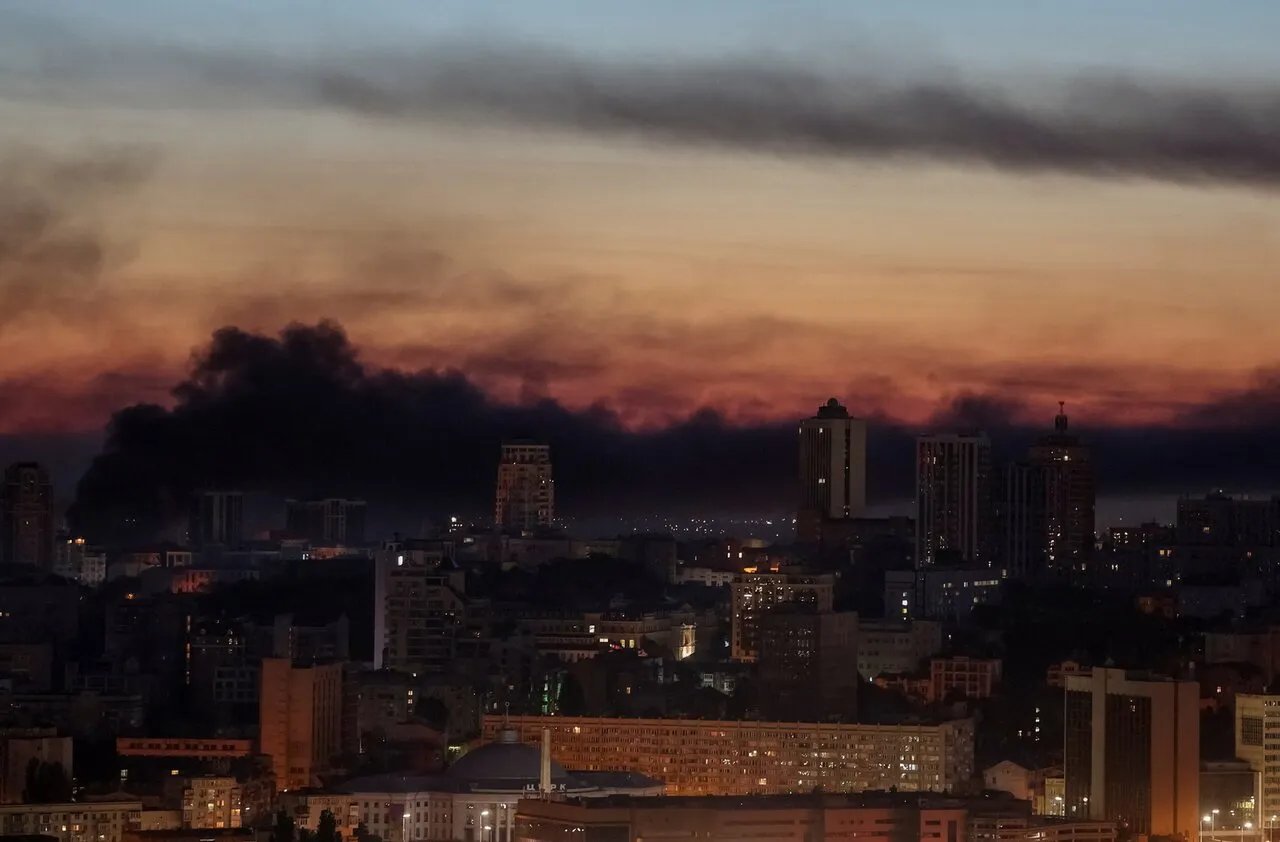
MOSCOW — By the time the evening briefing landed on Tuesday, the number that stood out was not the overnight tally — that one had already been published. It was the daytime one. Between 8:00 a.m. and 8:00 p.m. Moscow time on June 2, Russia’s air defense forces intercepted and destroyed 158 Ukrainian fixed-wing unmanned aerial vehicles, the Russian Defense Ministry said in a statement carried by RIA Novosti. Twelve hours. One hundred and fifty-eight drones. The air war, whatever shape it once took, is no longer primarily a nighttime affair.
The figure arrives on the same day Russia launched what Ukrainian officials described as one of the most severe combined strikes of the war — 73 missiles and 656 drones directed at Kyiv and cities across seven regions, killing at least 16 civilians. Ukraine’s air force said it neutralized the majority of the incoming weapons. But the afternoon Defense Ministry update makes clear that the exchange continued in daylight hours, with Ukraine pressing its drone campaign well past dawn.
The scale has been building for months. Russia’s Shahed-type drone production, concentrated at the Alabuga complex and other domestic facilities, has expanded significantly in the past year, according to analysis by the Institute for Science and International Security. Despite record launch volumes, overall hit rates against defended targets remain comparatively low — a signal, the analysis suggests, that Ukrainian air defenses have adapted faster than Russian production lines can compensate.
Ukraine has been running the same calculation from the other direction. As Just Security reported, Ukraine has been building and launching drones at a pace that is straining the interceptor stockpiles of every country running Western air defense systems. The United States produced approximately 600 of its most advanced Patriot interceptors last year. Ukraine used roughly 700 of them in four winter months alone.
That equation is what makes Tuesday’s daytime intercept count significant beyond the raw number. Russia’s 158 drones destroyed in twelve hours does not tell us how many broke through, where they were headed, or what damage, if any, they caused. The Defense Ministry statement provided no breakdown by drone type, no geographic distribution of intercepts, and no indication of losses to its own systems. What it does tell us is that Ukraine is now launching large drone formations during daylight hours at a frequency the war has rarely seen — and that Russian air defense crews are processing them continuously, around the clock.
The context for Tuesday’s strikes is important. Last week, the Kremlin warned of “systematic strikes” on Kyiv following a Ukrainian drone attack on a college dormitory in the Russian-held Luhansk region that killed 21 people — an attack Ukraine said targeted a Russian drone pilot training center. Vladimir Putin said Tuesday the Starobilsk strike gave the war “a whole new dimension.” The mass June 2 assault was framed by Moscow as retaliation. The afternoon drone intercept count suggests Ukraine’s response was not to stand down.
Russia’s defense establishment has been watching the drone numbers carefully. Earlier this year, the Defense Ministry began equipping Shahed variants with cluster munitions and mines, a modification intended to increase damage on each successful penetration even as overall intercept rates remain high. The logic is straightforward: if air defense kills most of the swarm, the few that reach their targets need to do more. Tuesday’s daytime campaign suggests Ukraine has adopted a parallel logic — if enough drones are in the air at all hours, the math of interception becomes unsustainable over time.
Whether that logic is correct is what this war is currently testing. Russia’s Defense Ministry has not commented on interceptor consumption rates or the strain Tuesday’s operations placed on air defense batteries. Ukraine’s air force has not published a daytime launch figure for the June 2 campaign. The 158-drone intercept count is a single data point from one side’s reporting — unverified, uncontextualized, and almost certainly incomplete. What it does confirm is that the drone war has stopped keeping business hours.
The escalation comes as Trump’s self-imposed June deadline for a Russia-Ukraine peace deal has passed without agreement. Eastern Herald’s coverage of the failed diplomacy noted that both sides entered June with no framework in place. Russia’s hypersonic missile strike on Ukraine’s defense industry earlier Tuesday was the largest such attack in months, and the daytime drone intercept figure published hours later suggests neither side paused to register the missed diplomatic milestone.
What happens to the intercept numbers when Russian air defense systems are simultaneously absorbing a night attack and processing a daytime wave remains an open question. The Defense Ministry’s statement on Tuesday gave no answer. It offered only a count.