
ST. PETERSBURG — The session was titled “Russia–US: A Cultural Dialogue,” and by Thursday afternoon it had become one of the more surreal moments at an already surreal gathering. Steven Seagal, the Michigan-born action star who received Russian citizenship from Vladimir Putin in 2016 and has since held an official appointment as Moscow’s special representative for humanitarian ties with the United States, took the stage at the St. Petersburg International Economic Forum to argue that movies and music could accomplish what eight years of that appointment have not.
“I think once again that one of the greatest avenues to be able to do this is through culture and art and film and music,” Seagal told the panel, adding that he hoped to pursue the effort in Russia and, “if permitted,” in the United States. That last qualifier — spoken without apparent irony — captured something about the limits of the role he was describing.
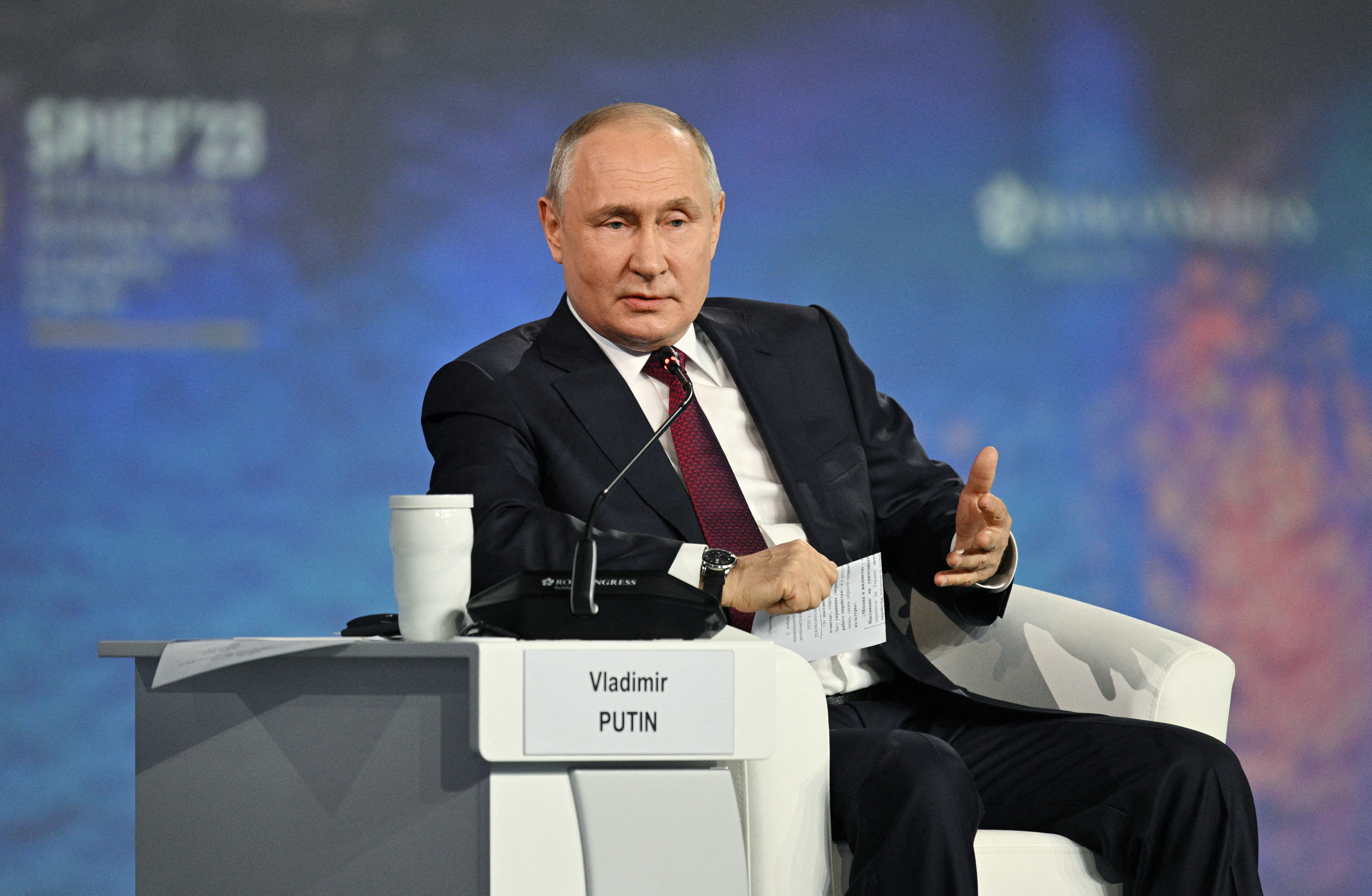
The forum opened Wednesday under a sky streaked with smoke. Ukrainian drones struck energy and military facilities near St. Petersburg in the early hours, before the first sessions began. Flights from Moscow to the city were delayed. A senior banker who attends every year described the atmosphere to reporters as “the most stifling” he had experienced in six years. By Thursday, when Seagal appeared, the mood had not lifted much.
SPIEF, once described as Russia’s answer to Davos, draws roughly 20,000 guests from more than 130 countries each year. Since 2022, the forum has shed much of its Western corporate attendance and remade itself as a platform for the Kremlin’s outreach to the Global South — and, this year, a venue for tentative engagement with a Washington administration that has shown more appetite than its predecessor for direct contact with Moscow. The United States sent Rodney Mims Cook Jr., the head of the US Commission of Fine Arts and the official overseeing President Donald Trump’s White House ballroom renovation, as its representative. Cook was also assigned to the same cultural dialogue panel as Seagal.
Seagal’s presence at SPIEF is nothing new, but the context this year gives it more weight than usual. The Russian Foreign Ministry appointed him its special representative for US-Russian humanitarian relations in August 2018 — an unpaid position the ministry compared at the time to a UN Goodwill Ambassador. Putin awarded him the Order of Friendship in 2023, citing “international humanitarian and cultural work.” He joined a pro-Kremlin political party in 2021. He has visited Russian-controlled areas of eastern Ukraine. He described Russia’s annexation of Crimea in 2014 as “very reasonable.”
None of that is background. It is the context in which his Thursday remarks have to be heard. When Seagal says culture is “the most suitable way” to restore “honest and fair dialogue” between the two countries, he is not speaking as a neutral artist with a passion for bridge-building. He is speaking as a figure Moscow has formally designated to represent its interests in exactly the domain he was describing.
That does not make the argument wrong, necessarily. The case for cultural exchange as a precondition for political dialogue has a long Cold War precedent. Soviet and American artists, musicians, and athletes traveled across the divide during decades when official diplomats were describing each other as existential threats. The question is whether the analogy holds when one of the parties to the exchange holds a foreign government appointment and a state decoration from the country he is proposing to dialogue with.
Russia has consistently argued that Western governments — not Russian policy — bear responsibility for the breakdown in relations. At a separate SPIEF session this week, Russian officials accused the Western film industry of deliberately stoking hatred toward Moscow. Seagal’s panel offered a counterpoint framing: culture not as a weapon but as a meeting point, a “neutral” space where the grievances could be set aside. He said he hoped to work on these things in Russia and, if permitted, in the United States as well.
The phrase “if permitted” is doing considerable work. Seagal is a US citizen as well as a Russian one, and there is no formal US restriction on his travel or speech. What he appears to mean, based on prior public statements, is the broader climate of suspicion and hostility in the United States toward anyone seen as sympathetic to Moscow. Whether that amounts to a genuine barrier or a rhetorical one, he did not explain.
Cook, the Trump envoy, told a separate session that he had come to St. Petersburg to listen, not advocate — a posture that several Russian commentators described as more promising than prior US delegations, which either stayed away entirely or treated attendance as itself a concession requiring justification. Whether cultural proximity translates into anything at the political level is the question SPIEF 2026 has posed but has not answered. The forum runs through Saturday.
The gap between Seagal’s role as described and the diplomatic reality it is meant to represent has been visible for years. The appointment was announced in 2018, when relations were already severely strained. It was renewed, implicitly, through every decoration and every SPIEF appearance since. Eight years on, US-Russia relations are not materially closer to the “honest and fair dialogue” Seagal described Thursday. Whether art and film can close that distance — and whether a Russian passport holder awarded a Kremlin medal is the right person to make that case — is a question the session did not put to him.
—Inputs from RIA Novosti, Sputnik.