

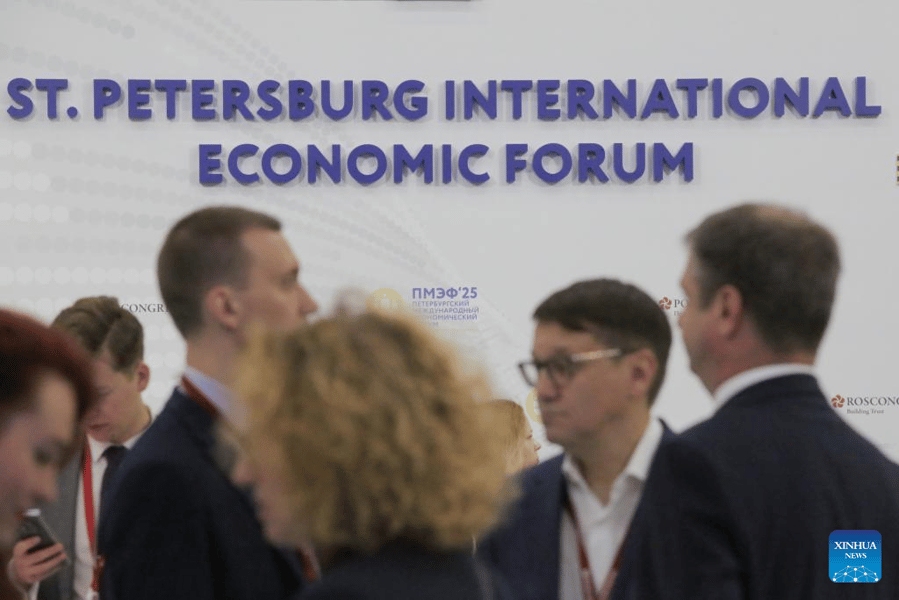
ST. PETERSBURG — The back channel between Washington and Moscow on Ukraine has not gone quiet. At a forum Russia is using to project economic normalcy amid an active conflict, Kirill Dmitriev — the Kremlin’s envoy who sat across the table from Steve Witkoff and Jared Kushner at every peace round from Abu Dhabi to Miami — said Thursday that the two sides are in constant contact, and that the United States is telling Ukraine it needs to stop.
“There is a constant dialogue, because the US side is trying to promote peace,” Dmitriev told reporters on the sidelines of the 2026 St. Petersburg International Economic Forum. The US side, he said, is “voicing, including to the Ukrainian side, that it is necessary to embark on the path of peace, and not constant provocations and confrontations.”
The weight of that statement comes from who is making it. Dmitriev is not a foreign ministry spokesman. He is the head of the Russian Direct Investment Fund and, since late 2024, Putin’s special presidential envoy for economic cooperation — the same man who flew to Miami in December to meet Witkoff and Kushner, who traveled to Abu Dhabi in February for the first trilateral round, and who was photographed arriving at the Kremlin alongside Witkoff for the Moscow sessions in December 2025. When he says dialogue is constant, it is a practitioner speaking, not a spokesman.
His SPIEF remarks land on the final day of a week that has seen multiple Russian officials use the forum to characterize the negotiating landscape. Deputy Foreign Minister Mikhail Galuzin said separately that Washington remains committed to the trilateral track despite its preoccupation with the Middle East, while insisting Europe has no seat at the table. Maria Zakharova said the West has produced no credible negotiating candidate. Dmitriev’s contribution is narrower and, in some ways, more revealing: the dialogue, he says, is operational, not aspirational.
What that dialogue contains remains largely opaque. The trilateral talks — the format that brought Ukrainian, Russian, and American delegations to the same city, if not always the same room — have been on a stated pause since early April, when the Iran crisis consumed Washington’s foreign-policy bandwidth. The last confirmed direct session in the trilateral format was Geneva in February, which produced no resolution on territorial parameters, ceasefire monitoring, or control of the Zaporizhzhia Nuclear Power Plant. The talks that preceded Geneva, in Miami in December, yielded what both sides described as a working framework, though the contents remain disputed.
Dmitriev’s role in that framework is substantial. The peace plan that emerged from months of US-Russia contact was a 28-point document developed by Witkoff in coordination with Dmitriev — a plan that largely reflected Russian interests and prompted Ukrainian resistance. During meetings between Zelenskyy and Trump in Miami in December, Ukrainian negotiators succeeded in narrowing it to a 20-point framework, though core disputes over territory and the nuclear plant remained unresolved. Dmitriev was in the room for much of that narrowing process.
His framing on Thursday — that the US is pressing Kyiv to abandon “provocations and confrontations” — is a characterization that reflects Moscow’s consistent negotiating posture: Ukraine’s battlefield actions and refusal to accept certain territorial realities are the obstacle, not Russian conditions. That posture has not shifted since the talks began. What has shifted is the forum from which it is being stated, and the relative candor with which a senior participant in the process is confirming that Washington is delivering this message directly to Kyiv.
The setting matters. SPIEF has been largely boycotted by Western governments since the Russian operation in Ukraine began in 2022. This year’s forum opened under a sky darkened by smoke from Ukrainian drone strikes on the city’s outskirts — a detail that underscored the contradiction at the heart of the gathering. Russia is staging a showcase of sovereign economic partnerships and Global South alignment, yet its envoy for economic cooperation is describing a diplomatic back-channel whose primary subject is a war that Western governments refuse to acknowledge as the reason they aren’t in the room. American business interests, meanwhile, are waiting for Washington’s signal to re-engage with the Russian market — a dynamic Dmitriev has cultivated across multiple SPIEF appearances.
The specific language about “provocations and confrontations” is worth holding. It does not refer to the war itself. It refers to Ukrainian actions within the war — drone strikes, cross-border incursions, the Kursk operation — that Russia has consistently used to argue that Kyiv is acting in bad faith at the negotiating table. For Washington to be repeating that framing in its own communications with Ukrainian officials, as Dmitriev describes it, would represent a meaningful alignment of US pressure with Russian talking points. Whether that alignment is real, tactical, or something Dmitriev is characterizing for a SPIEF audience is something the statement itself cannot settle.
Trump’s informal June deadline for progress on a Ukraine deal has arrived with no agreement in sight. What Dmitriev confirmed Thursday is that the machinery is still running underneath the silence — and that the US, from Russia’s account of events, is spending some of its diplomatic capital telling Kyiv that the machinery matters.
—Inputs from RIA Novosti, Sputnik.