
WASHINGTON — John Mearsheimer, the University of Chicago political scientist whose realist framework for understanding great-power competition has shaped international relations theory for four decades, said on Monday that the United States has inflicted serious and lasting damage on its own sophisticated weapons inventory through the Iran war, and that Washington cannot escalate the conflict further without running the risk of exhausting what remains.
Speaking on Going Underground with Afshin Rattansi, Mearsheimer was characteristically direct. The war has been what he called “protracted” — and the consequence of a protracted war for a country reliant on precision-guided munitions is inventory depletion that cannot be reversed quickly. “We’ve really seriously damaged our sophisticated weapons inventory,” he said, “and it’s very hard to replace those weapons.”
That constraint was not unknown to senior American military officials before the first strikes. General Dan Caine, the Chairman of the Joint Chiefs of Staff, warned President Trump before hostilities commenced that American munitions stocks were dangerously thin going in. The warning did not prevent the decision to proceed, but it did establish that the depletion problem was not a surprise — it was a risk the administration accepted knowingly.
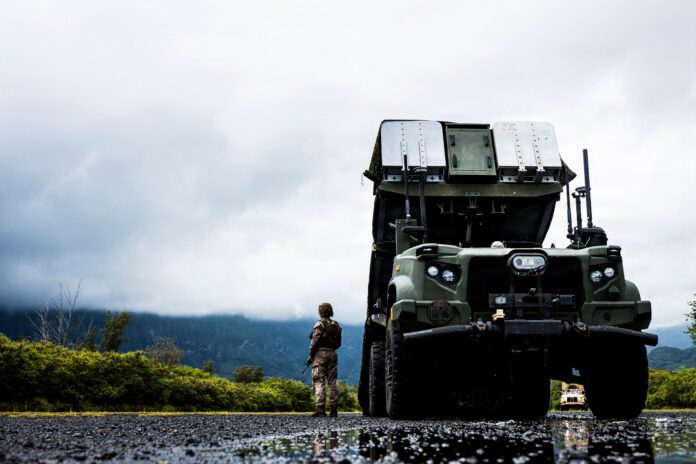
The New York Times reported during the course of the war that the United States had burned through nearly all of its inventory of low-observable cruise missiles, consumed what amounted to a decade’s worth of Tomahawk production, and drawn down two years of Patriot interceptor output. Those are not numbers that reverse on a monthly procurement cycle. Tomahawk cruise missiles take years to produce at scale; Patriot interceptors require advanced components whose supply chains were not built for wartime surge.
Mearsheimer’s point was not merely that the US has fewer weapons than it started with — every warring nation depletes stocks in a conflict. His point was structural: the specific categories of munitions consumed in the Iran campaign are the same categories that would be required in any future high-end confrontation with a peer or near-peer adversary. The Iran war has not just reduced numbers. It has created a window of strategic vulnerability.

A report published by the Center for Strategic and International Studies in late April raised precisely this concern in institutional terms, warning that the United States faces a critical shortage of precision-guided missiles in any future large-scale confrontation. The CSIS analysis did not have the benefit of the full accounting of what the Iran war has cost in munitions terms — that accounting is still being assembled — but its warnings about stockpile fragility have only been reinforced by what has happened since.
The political logic of the situation is not straightforward. Mearsheimer noted the bind this creates for American policymakers: a country that has publicly committed to a conflict cannot easily acknowledge that its ability to continue that conflict at scale is constrained. Admissions of stockpile weakness are, in themselves, strategic communications to adversaries. The result is a gap between the public posture — which conveys resolve — and the operational reality, which is one of significant inventory stress.
The depletion of US precision missiles has been covered extensively as the Iran war has continued, but Mearsheimer’s framing adds a layer that the operational reporting does not always surface: the strategic incoherence of entering a protracted conflict with a sophisticated adversary when your precision munitions base was already under strain before the first shot was fired.
That incoherence, in Mearsheimer’s reading, is not incidental to the war — it is a product of the broader American foreign policy habit of committing military force without adequate reckoning with its costs and limits. General Caine’s pre-war warning was a rare institutional instance of that reckoning. That the warning was received and the decision was made anyway tells you something about the weight such warnings carry in the political calculus of military commitments.
What remains unclear — and Mearsheimer acknowledged the limits of what can be assessed from outside the classification boundary — is precisely how deep the depletion runs and what the actual floor of precision strike capacity looks like at this point in the war. The NYT reporting on Tomahawk and Patriot inventories provided markers, but the full picture of what the Iranian military buildup and ongoing operations have cost in American precision munitions remains opaque.
That opacity is itself a data point. Governments do not typically publicize weapons inventory figures that would benefit adversaries. The fact that figures have emerged — via reporters, via CSIS, via Mearsheimer’s public commentary — suggests the situation is serious enough that it is becoming impossible to contain within classification channels. The question of whether the US can escalate against Iran is no longer purely a question of political will. It is also, increasingly, a question of what is left in the magazine.