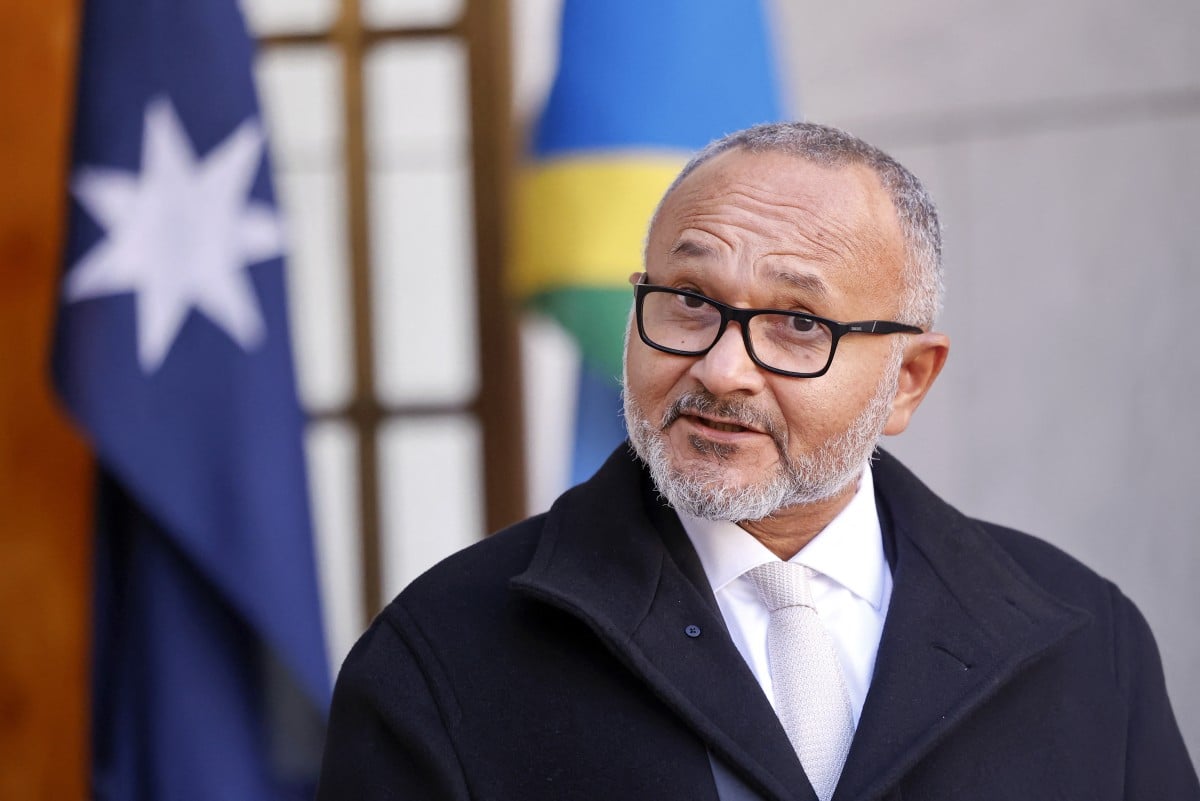
CANBERRA — Matthew Wale had been praying and fasting about it. That is not a figure of speech. The new prime minister of the Solomon Islands, who took office less than three weeks ago after a parliamentary no-confidence vote, told reporters standing alongside Anthony Albanese at Parliament House on Wednesday that his government would review the 2022 security agreement Beijing signed with his predecessor — but that he had only been handed a copy of the document the day before he left for Australia.
That detail is more than an administrative footnote. Wale said he had “removed certain people from key positions” to obtain the document, though he declined to identify them. The pact, negotiated in secret under former prime minister Manasseh Sogavare and signed in Beijing in April 2022, has never been published in full. It carries a non-disclosure clause. What is known from a draft leaked at the time is that it would have permitted Chinese naval vessels to stop in Solomons waters and allowed Beijing to send armed police and soldiers to the archipelago nation sitting roughly 2,000 kilometres northeast of Australia.
“We are going to be reviewing, as we are reviewing other security agreements that we have with many other countries,” Wale said. The framing is diplomatic — he placed the China pact in a broader review of all bilateral security instruments — but the signal was unambiguous. He had chosen Australia for his first foreign trip as head of government, arrived at a Parliament House welcome with a military honour guard and a gun salute that he described as “blimey,” and announced his cabinet would negotiate a new comprehensive strategic treaty with Canberra, the Solomon Islands’ largest aid donor and historical security partner.
The shift represents something close to a full reversal of the trajectory set by Sogavare, who steered the Solomon Islands away from Taiwan and toward Beijing — formalising a switch of diplomatic recognition in 2019 — and whose government resisted, deflected, and occasionally dismissed Australian overtures for closer security ties. Wale, who served as opposition leader and spent years calling publicly for the China pact to be made transparent, is now in a position to act on that position. He has not yet said what the review will conclude or how long it will take.
Albanese, who has pursued a methodical strategy of bilateral security agreements across the Pacific since 2022, said Australia wanted to be the “security partner of choice” for Pacific island nations. Australia’s regional security posture has grown more formal in recent years, with treaties concluded with Tuvalu, Nauru, and Papua New Guinea, and negotiations under way with Fiji and Vanuatu. The comprehensive treaty now proposed with the Solomon Islands would cover security and economic cooperation and would be, in Albanese’s words, “underpinned by mutual trust, respect, and open dialogue.”
Whether Beijing interprets the Canberra meeting as a clean break or a managed recalibration remains to be seen. China’s military expansion in the Pacific has sharpened security calculations across the region, and the Solomon Islands has been a focal point of that contest since the 2022 pact alarm bells sounded in Washington and Canberra. Beijing quickly became the Solomon Islands’ largest bilateral creditor after the switch from Taiwan, with debt to Chinese banks for infrastructure projects doubling last year, Reuters reported. What leverage that debt represents, and whether it complicates Wale’s room for maneuver, is a question the review will have to contend with.
Connor Graham, a Pacific specialist at the Lowy Institute in Sydney, told Reuters the visit sent a signal that was hard to misread. “He’s only been in power for a couple of weeks and we’re already here,” Graham said, adding that Australia would serve its own interests better by engaging with Solomons priorities — health, education, climate resilience, economic diversification — rather than framing the relationship primarily around China. That counsel cuts against Canberra’s tendency, visible again on Wednesday, to describe the Pacific almost entirely in security terms.
In the joint statement released after the meeting, both governments affirmed that “Pacific peace and security is best led and handled by the Pacific” — language Albanese has used consistently to signal Australian intent without directly naming China. The Solomon Islands also agreed to join the Pacific Policing Initiative, a regional law-enforcement framework Al Jazeera reported as a counterweight to Chinese police training programs that have taken hold in several Pacific nations. A $190 million policing cooperation deal previously signed between the two countries will be accelerated, and Canberra committed a further $35 million to help offset the aftermath of Tropical Cyclone Maila and cushion the economic impact of rising global oil prices.
Wale said he wants a relationship with Australia built on transparency — the thing he said was conspicuously absent from how the China pact was handled. Before he was prime minister, he had accused members of the then-government of not even knowing the full terms of the agreement. On Wednesday, he confirmed that suspicion had a bureaucratic dimension: the text was kept from him until officials loyal to the previous administration were removed. How much of the agreement he will ultimately make public, and whether he has the political capital domestically to walk away from it, are questions that do not yet have answers.
What is clear is that the Pacific’s most contested bilateral contest — between China’s ambitions and Australia’s historical reach — has a new set of actors in Honiara, and at least one of them arrived in Canberra having heard cannon fire for the first time. The comprehensive treaty Wale and Albanese announced will take time. The China review, by his own account, is already under way. The political upheaval that brought Wale to power in May ended a government that had made Beijing a cornerstone of its foreign policy. Whether it also ends the security arrangement Beijing negotiated with that government is the question now sitting in his cabinet’s in-tray.
—Inputs from Sputnik.