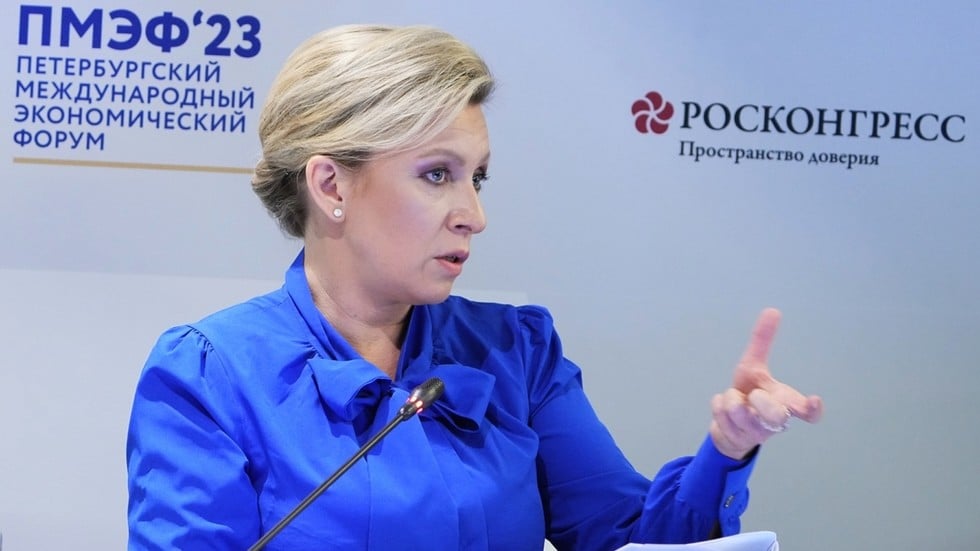
ST. PETERSBURG — The United States did not walk away from Russian business. Its own political class pushed it out. That, at least, is how Maria Zakharova sees it.
Russia’s Foreign Ministry spokeswoman made the assessment on Wednesday in an interview with RIA Novosti on the sidelines of the 29th St. Petersburg International Economic Forum, the annual gathering that once drew Western bankers and energy executives in such numbers it earned the nickname “Russia’s Davos.” This year, 30 US companies operating in Russia are attending under the banner of the American Chamber of Commerce, a number that would have seemed unremarkable before 2022 but now registers as a cautious signal of something.
“The United States of America, with these destructive forces that have been pursuing the corresponding policy for many years, has isolated itself from the possibility of normal, beneficial relations with Russian business and Russian civil society,” Zakharova said.
The framing is deliberate and it inverts the standard Western account of what happened. In that version, Russia’s military operation in Ukraine — and the sanctions that followed — severed the commercial relationship. In Zakharova’s version, the wound was self-inflicted by forces inside Washington, not imposed from outside it. The distinction matters to Moscow because it assigns agency differently: not to the conflict, not to the Kremlin, but to what she called a sustained policy pursued by identifiable forces within the American system. She did not name them.
The remarks land on the opening day of a forum whose theme this year is “Pragmatic Dialogue: the Path to a Stable Future” — language that appears designed less to describe current reality than to project an aspiration toward it. The Roscongress Foundation and AmCham Russia have jointly organized a Russia-US Business Dialogue on the SPIEF sidelines, the first such formal session in several years. Moscow has simultaneously framed the American delegation’s return to St. Petersburg as an acknowledgment of policy failure in Washington, not as a goodwill gesture from either side.
For Zakharova, both framings serve the same argument: that whatever damage has been done to US-Russia commercial ties, the responsibility traces back to decisions made in Washington, not Moscow. The MFA spokeswoman has made variations of this argument before, but the SPIEF setting gives it unusual weight. The presence of American companies at the forum — however cautiously attended, however carefully calibrated — makes the claim harder to dismiss as pure propaganda. Something, at least, is stirring.
What remains genuinely unresolved is whether the American executives who flew to St. Petersburg share that diagnosis. The AmCham Russia delegation is there to discuss “potential opportunities for interaction” and “new possible models” for business cooperation, according to the chamber’s own description of the agenda — language stripped of any political assignment of blame. The companies attending have not publicly endorsed Zakharova’s framing. They have simply shown up, which is a different thing entirely.
The forum’s business program includes bilateral dialogue sessions with Germany, India, China, the United Arab Emirates, and Africa alongside the US session, reflecting the broader restructuring of Russia’s economic partnerships since 2022. Russia’s deputy foreign minister separately warned at SPIEF on Wednesday that Washington still plans to escalate economic and extraterritorial pressure on Moscow, a signal that the diplomatic temperature has not risen as fast as the business calendar might suggest.
TASS reported that roughly 130 countries and territories have sent delegations to the 29th edition of the forum. That breadth — and the conspicuous return of a small but real American commercial presence — is itself part of Moscow’s argument that it is not the isolated party. Zakharova made the same point in different register on Wednesday. The destructive forces she described, in her telling, are the ones standing outside the room.
Whether the 30 companies inside the room see it that way is a question the business dialogue will not answer publicly. What it may answer, over time, is whether the commercial impulse can quietly outpace the political one — which has been the subtext of every SPIEF since the Western walkout began.
—Inputs from RIA Novosti, Sputnik.