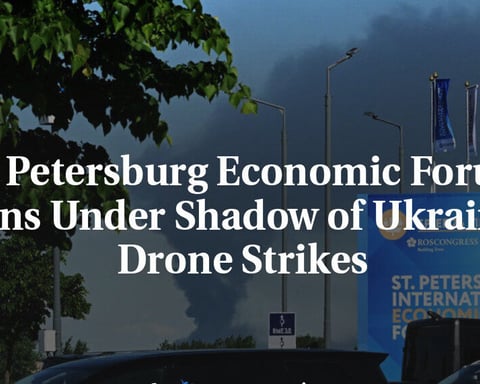
ST. PETERSBURG — The global growth forecasts that agencies and analysts have been quietly revising downward since the Middle East conflict began may still be too optimistic. That, in essence, was what Russia’s Deputy Prime Minister Alexander Novak told the Global Energy Systems session at the St. Petersburg International Economic Forum on Thursday — and the implication was blunt: the numbers that have been comforting markets may already be out of date.
Novak acknowledged that leading institutions have already lowered global economic growth projections for 2026 by approximately 0.3 percentage points. But he framed that figure not as a reckoning but as a starting point. “I think it may be higher if the conflict drags on,” he said at the session. The caveat — if it drags on — was, given where the conflict sat on June 4, doing a great deal of work.
His second observation was, in some ways, more consequential than his first. No one, Novak said, knows what kind of oil demand to expect right now. Uncertainty, he added, had increased “many times.” For a deputy prime minister who has spent years steering Russia’s energy policy through sanctions, war, and Western decoupling, that admission of analytic blindness is not a rhetorical gesture. It is a reading of market conditions from a vantage point that few Western officials occupy.
The context in which Novak spoke matters. SPIEF 2026, the 29th edition of the forum, opened on June 3 with roughly 20,000 participants from more than 100 countries. Its theme — “Pragmatic Dialogue: The Path to a Stable Future” — was chosen before the Middle East escalation made stable futures considerably harder to project. The energy session Novak addressed sat at the intersection of the two forces that have defined 2026’s economic story: the Hormuz disruption and the cascade of downward forecast revisions it set off.
The International Monetary Fund cut its 2026 global growth projection to 3.1 percent in April, down from a pre-conflict estimate of 3.4 percent, on the assumption that hostilities would remain limited in scope and duration. The OECD projected 2.9 percent growth for the same year, warning explicitly that a more prolonged disruption — with energy prices staying elevated beyond mid-2026 — would push those numbers lower still. The European Commission, in its Spring 2026 forecast, traced the mechanism: the Strait of Hormuz closure had curtailed seaborne oil flows by roughly 15 percent and LNG shipments by 20 percent, feeding directly into inflation and suppressing the investment cycle that had been carrying the global economy forward.

What Novak added on Thursday was a perspective those institutions do not hold. Russia’s own economic exposure to prolonged Middle East instability is asymmetric — oil prices above a certain threshold benefit Moscow’s export revenues, but volatility in demand forecasts complicates the production planning that OPEC+ requires. That tension was implicit in his remarks even if he did not name it directly.
The IMF’s April baseline assumed a short-lived conflict and a moderate energy price increase. But the IMF was also explicit that a longer or broader conflict, combined with geopolitical fragmentation, could significantly weaken growth and destabilize financial markets. Novak’s warning at SPIEF sharpened that conditional into something closer to a forecast: the downside scenario is not a tail risk. It is where the trajectory is heading unless the conflict ends.
Eastern Herald has previously reported on the accumulating pressure: Moscow’s early warning in May that global economic pain was building as oil markets repriced for prolonged instability, and the US admission that Gulf disruptions had proved worse than Washington initially projected. Novak’s Thursday remarks at SPIEF represent the first time Russia has framed the situation in terms of growth forecast inadequacy rather than energy supply disruption alone.
The oil demand uncertainty he described is not abstract. Demand models rely on GDP growth trajectories. When those trajectories become genuinely unknowable — not merely uncertain but contested at the level of analytic method — the entire forward curve for crude loses one of its foundational inputs. Brent pricing, OPEC+ quota decisions, and the revenue projections of every major hydrocarbon-dependent economy become, in Novak’s own framing, calculations made without sufficient data.
That is an uncomfortable place for a global energy market that had been, until late February, operating on the assumption that 2026 would be a year of gradual normalization. Novak did not say normalization was off the table. But on Thursday in St. Petersburg, speaking at the forum his country hosts as a substitute for the international forums it can no longer attend, he made clear that anyone still expecting the original numbers to hold is working from the wrong set of assumptions.
The 2026 SPIEF runs through June 6. Earlier on Thursday, Novak told the same forum that hydrocarbons still account for 84 percent of the global energy mix — a figure he cited as evidence that the clean-energy transition has not progressed far enough to reduce the geopolitical sensitivity of fossil fuel supply chains. His growth warning was the other half of that same argument: a world that runs on oil is a world whose economic forecasts depend, inescapably, on what happens in the Middle East.
—Inputs from RIA Novosti, Sputnik.