LONDON — The ledger that has followed Andrew Mountbatten-Windsor for seven years acquired a new entry on Friday: Britain’s spending watchdog confirmed that the former prince collected undisclosed rental income from three cottages on the Windsor estate where he himself paid nothing but a nominal peppercorn fee — an arrangement that critics say turned a publicly subsidised home into a private income stream.
The disclosure arrived in a report by the National Audit Office, commissioned by lawmakers after King Charles stripped his younger brother of his royal titles last autumn and effectively evicted him from Royal Lodge, the 30-room mansion on the Windsor estate that Mountbatten-Windsor had occupied since 2003. Parliament had been asking, in increasingly pointed terms, exactly what the former duke had cost the Crown during two decades in a property that belonged to the public.
The answer, as of Friday, is that nobody knows the precise figure — and that absence of a figure may itself be the most politically damaging detail in the report. The audit office stated plainly that it could not establish what rent Mountbatten-Windsor had charged his tenants. All three cottages fell vacant in April 2026, after he had already relocated to the Sandringham estate. The income they generated in the years before that has not been disclosed and was apparently not tracked by the Crown Estate.
Margaret Hodge, a Labour peer and former chair of Parliament’s Public Accounts Committee, called the gap in the record shocking. “It’s shocking that the National Audit Office was not able to establish how much money Andrew Mountbatten-Windsor secured from the properties he let,” she said. Norman Baker, a former Liberal Democrat minister who has scrutinised royal finances for years, went further: the arrangement, he argued, showed “an absolute total contempt for the taxpayer.”
The 2003 lease for Royal Lodge shows the terms Mountbatten-Windsor accepted: a peppercorn rent — a nominal sum often set at a single coin and rarely actually collected — in exchange for funding extensive renovations to the property. Sources familiar with the arrangement told British media the peppercorn was never asked for or handed over. Under those terms, the lease permitted him to sublet up to three cottages within the estate and retain whatever rent he collected. The Crown Estate received nothing from those tenancies.
The report arrives against a backdrop of continuing criminal scrutiny. Thames Valley Police arrested Mountbatten-Windsor in February on his 66th birthday, held him in custody for eleven hours, and released him under investigation for misconduct in public office — a charge tied both to his documented association with the convicted sex trafficker Jeffrey Epstein and to his former role as Britain’s special trade representative from 2001 to 2011. He has not been charged. His representatives have consistently denied wrongdoing.
By May, the scope of the police inquiry had expanded. Thames Valley Police confirmed on May 22 that officers were now examining a claim that Mountbatten-Windsor had behaved inappropriately toward a woman working as a waitress at Royal Ascot in 2002 — a date that falls within his tenure as trade envoy. A separate report, assessed the preceding month, alleged that a woman had been brought to an address in Windsor in 2010 for sexual purposes. Neither allegation has resulted in a charge. Because the alleged incidents fall within the period when Mountbatten-Windsor exercised the Crown’s authority as a public official, the misconduct-in-public-office inquiry could in principle encompass actions well beyond his relationship with Epstein.
What the palace knew, and when, is a question that has refused to close. A fresh examination of court records, reported by The Guardian, found that an archive of roughly 30,000 emails detailing Mountbatten-Windsor’s contested financial dealings was delivered to the Lord Chamberlain — the most senior officer of the Royal Household — in May 2020. That is six years before Thames Valley Police made their inquiry public. The emails came from a personal business contact of Mountbatten-Windsor and appear to have been received and filed without triggering any visible institutional response at the time. Buckingham Palace has not publicly addressed the specific question of what action, if any, the Lord Chamberlain took upon receiving them.
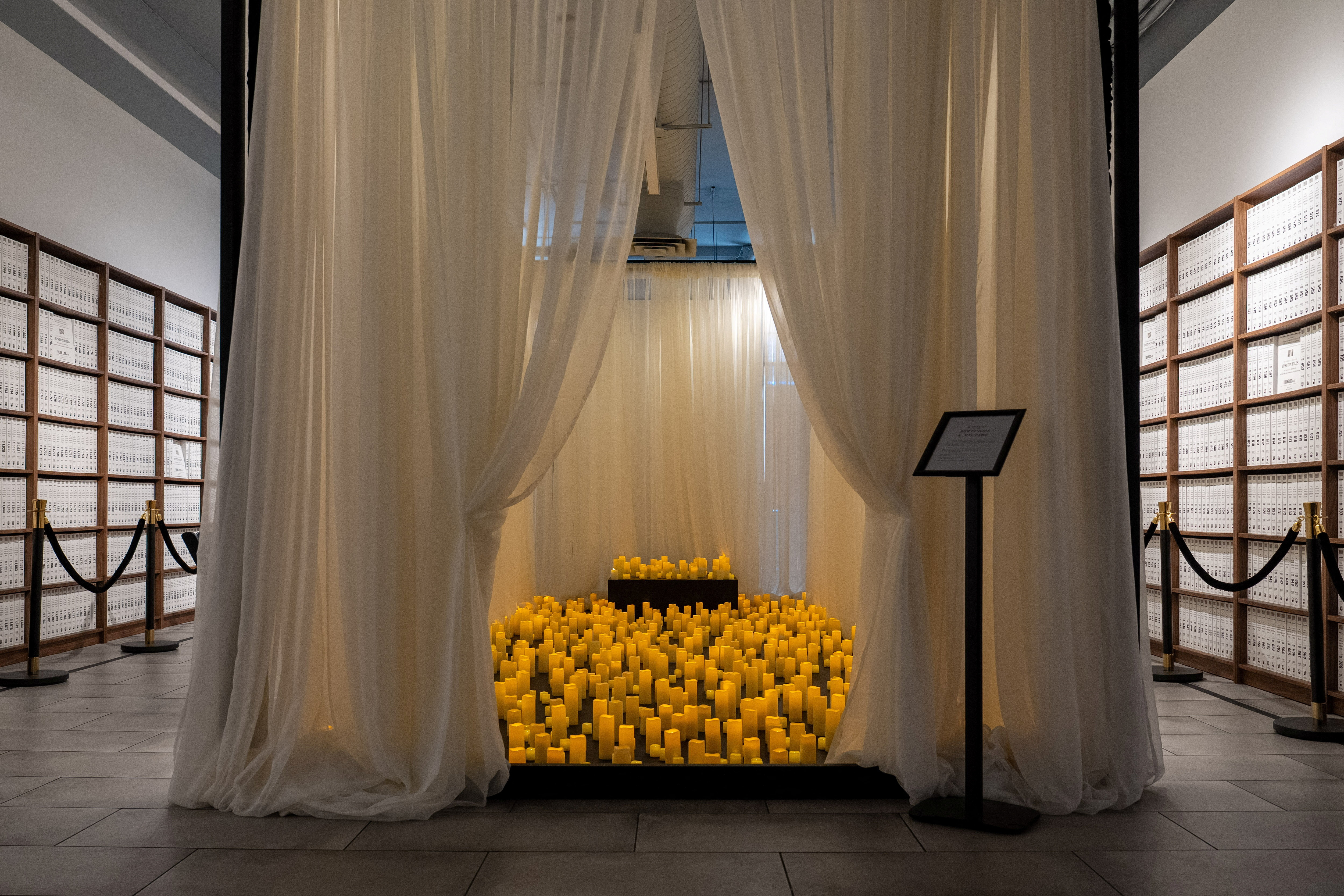
The scrutiny is not confined to Westminster. Across the Atlantic, the organisation that has turned the released Epstein files into a physical public archive is preparing to bring that archive to Washington. The Institute for Primary Facts, the nonprofit behind the Donald J. Trump and Jeffrey Epstein Memorial Reading Room that drew nearly 10,000 visitors during a two-week run in a Tribeca gallery in May, announced this week that the installation will open in Washington’s Chinatown neighbourhood from June 9 to 12 — in time for President Trump’s birthday, and a short walk from both the White House and the Department of Justice building that has withheld roughly half of the more than six million pages identified as responsive to the Epstein Files Transparency Act.
The New York version of the reading room held 3,437 bound volumes encompassing all of the released Epstein files — 3.5 million pages printed, bound, and stacked into volumes collectively weighing some 17,000 pounds. The Washington installation will occupy a space described as twice as large. Entry is free, though access to the physical volumes is restricted to members of Congress, accredited press, law enforcement, and survivors and their legal advocates. A survivor of Epstein’s trafficking network, Danielle Bensky, said at the New York opening that the installation represents action where years of public testimony had produced none. “For years, survivors have been encouraged to tell our stories over and over again, only to be met with inaction,” she said. “Here is the action.”
The connection between the two stories — a disgraced British royal under active criminal investigation and a physical archive of sealed American court records — runs through Mountbatten-Windsor’s documented relationship with Epstein, which ended publicly with his catastrophic November 2019 BBC Newsnight interview and legally with a civil settlement, reached in early 2022 with Virginia Giuffre, for an undisclosed sum and with no admission of liability. Giuffre died by suicide in April 2025. Her posthumously published memoir described three sexual encounters with Mountbatten-Windsor, the first when she was seventeen. He has denied all such allegations.
Thames Valley Police’s May statement confirmed that officers continue to examine aspects of alleged misconduct following the release of files under the Epstein Files Transparency Act in the United States. Assistant Chief Constable Oliver Wright said the investigation was “complex” and that detectives were working “meticulously” through a significant volume of material received from the public and other sources. That material now includes, somewhere in the chain of evidence, the emails that reached the Lord Chamberlain in 2020.
As EH reported in March, King Charles’s decision to require his brother to leave Royal Lodge was accelerated by revelations in the Epstein files about Mountbatten-Windsor’s continued contact with Epstein’s network well after he had publicly claimed to have severed ties. The Sandringham cottage where he now lives is far removed from the public-facing role he once held, but it is still a Crown property. Whether his tenancy there will attract the same scrutiny as his arrangement at Royal Lodge is a question that the audit office’s Friday report has made substantially harder to avoid. The battle over what remains redacted in those files continues in parallel.
What remains unresolved is the figure at the centre of the audit report’s most striking omission: the actual income Mountbatten-Windsor generated from his three Windsor cottages over two decades. The National Audit Office says it could not establish the number. His representatives have not volunteered it. And the Crown Estate, which owns the land those cottages sit on, apparently did not track or receive any share of the proceeds. The parliamentary case for that number is now, after Friday’s report, considerably stronger than it was before.
https://twitter.com/NBCNews/status/1930684931263131892