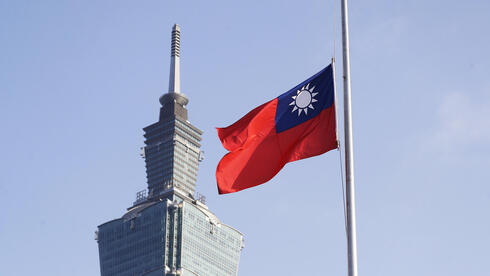

TAIPEI — The deputy foreign ministers who receive foreign journalists at Taiwan’s Ministry of Foreign Affairs no longer open with maps or military timelines. They open with a number. In the past year alone, Chen Ming-chi told a visiting delegation, Taiwanese intelligence identified 45,000 official Chinese accounts that generated roughly three million false posts targeting the island. That is the war Beijing is already fighting — and Taipei’s most pressing question is not how to win it militarily, but whether Taiwanese society is resilient enough to survive it.
That framing shapes almost everything happening on the island right now. Taiwan, a democracy of roughly 23 million people, produces approximately 80 percent of the world’s advanced semiconductors — a fact that makes any crisis in the Taiwan Strait a global emergency well beyond the island’s own borders. Beijing has made no secret of its ambition to bring Taiwan under its control by force if necessary. What is less often discussed outside the region is how Taiwan is preparing not just its military, but its people.
The country the Taiwanese keep returning to as a reference point is not the United States, despite Washington’s security commitments, its weapons contracts and its political declarations. It is Israel. Officials across Taiwan’s government describe Israel — a small democracy surrounded by adversaries, dependent on Western backing but forced to develop its own culture of resilience — as the more instructive model. “The military and diplomatic support you receive from the United States and the Western world is far beyond what Taiwan receives,” a representative of the Straits Exchange Foundation, the body that manages economic relations with mainland China, told Ynet News reporters who visited under Foreign Ministry invitation. “But we see the determination of your people. We need to learn from you how to put disagreements aside.”
There is a specific lesson embedded in that comparison that goes beyond inspiration. Israel has built, over decades, a civil society that treats national resilience as a distributed responsibility — not something delegated entirely to the military or the state. Taiwan is attempting something structurally similar at speed, working against a clock it cannot read.
The most visible institution in that effort is Kuma Academy, a Taipei-based nonprofit that has trained more than 100,000 civilians since its founding. Its CEO, Fuming Chu, frames the organization’s mission in terms that would be recognizable to anyone familiar with Israel’s home-front doctrine. “About 90 percent of Taiwan’s population does not serve actively in the military,” Chu said. “Our role is to prepare them for emergencies without making them paranoid. We teach first aid, rescue, logistics and, critically, how to identify disinformation.” China named Kuma Academy as a whole to its list of most-wanted Taiwanese independence separatists — the first time Beijing has designated an institution rather than an individual — which, Chu’s colleagues note, is itself a measure of how seriously Beijing takes what the organization is doing.
That psychological dimension is where the Israeli comparison sharpens into something operational. Taiwan’s officials describe Beijing’s campaign not as preparation for imminent kinetic conflict, but as a sustained effort to corrode the will to resist before any shot is fired. Chen Ming-chi and Deputy Foreign Minister François Chih-chung Wu told reporters that China exploits internal political divisions to cultivate domestic proxies — companies and private individuals who receive funding from Beijing and spread narratives designed to make Taiwanese voters feel that their democracy is flawed, that resistance is futile, and that accommodation is preferable to confrontation. In a country where personal firearms are prohibited, the civilian response has become informational rather than armed: literacy, not firepower.
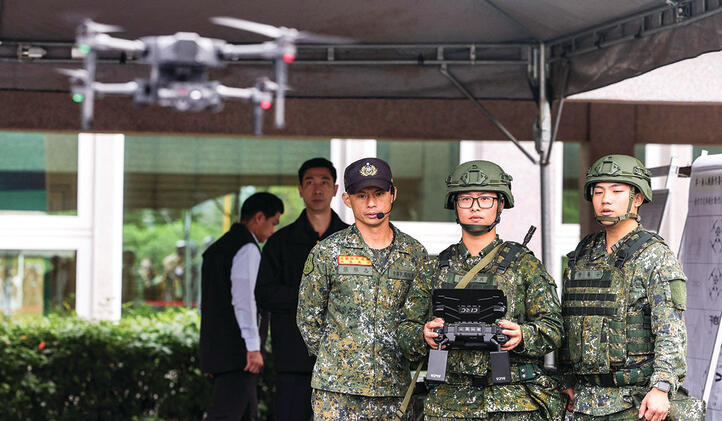
The military dimension has not been abandoned. It has been reimagined. The lessons Taipei drew from China’s rehearsals for a potential blockade were technical as much as doctrinal. In Taichung, a company called Thunder Tiger — once known for manufacturing toy cars and model boats — has transformed into a producer of unmanned military systems. One of its core products is a drone guided by fiber-optic cable rather than a wireless signal. Allan Chi of Thunder Tiger explained the logic: because the drone is physically connected by a wire, it cannot be jammed electronically. It is a direct application of a lesson from the war in Ukraine, where electronic warfare rapidly neutralized radio-controlled systems that had seemed decisive only months earlier.
Ukraine looms large in every conversation Taipei is willing to have about its own vulnerability. The conflict demonstrated that inexpensive unmanned systems could slow or complicate the advance of a significantly larger conventional force — a finding of obvious relevance to an island that would face a naval and amphibious assault it cannot match in raw tonnage. Taiwan is studying that model, and its defence industrial base is adapting accordingly. What the Trump administration’s recent pressure on arms commitments means for that relationship remains a genuine open question in Taipei — one that no official in the Foreign Ministry was willing to answer with certainty.
That uncertainty is itself a measure of Taiwan’s predicament. Washington’s reliability is, by design, deliberately ambiguous — American policy has long operated under what officials call “strategic ambiguity,” a posture that deters Beijing without making a formal defense commitment that would bind the United States irreversibly. For Taiwan, that ambiguity has always been a source of security and anxiety simultaneously. What has changed in the past two years, officials said carefully, is that the anxiety has grown louder.
The streets of Taipei do not reflect any of this. Markets are crowded. Nightlife continues. The rhythms of one of Asia’s most open urban economies proceed without visible disruption. Fuming Chu described this surface normalcy as simultaneously Taiwan’s great strength and its most dangerous vulnerability. “If you walk alone at night in Taiwan, you will feel very safe,” he said. “Nobody will attack you.” The risk Kuma Academy is designed to counteract is that this sense of normalcy becomes a form of strategic blindness — that the absence of immediate threat trains a society to discount a threat that is not absent but simply patient.
It is the same risk Israel confronted on October 6, 2023, and it is the reason Taiwan’s officials invoke Israel not as a military power to emulate but as a cautionary example of what happens when democratic normalcy and genuine existential threat coexist for so long that the threat becomes ambient. The preparation happening in Taiwan — in Kuma’s training rooms, in Thunder Tiger’s assembly lines, in the Foreign Ministry’s disinformation tracking operations — is an attempt to build a society that can hold its nerve without losing its character. Whether 100,000 trained civilians and a fiber-optic drone are enough is a question Taiwan cannot yet answer, and may not know until it has to.
What is clear is that Washington’s calculus on Taiwan is no longer something Taipei can treat as fixed. And so the island is doing what small democracies have always done when the great powers prove unreliable: it is learning to rely more heavily on itself.