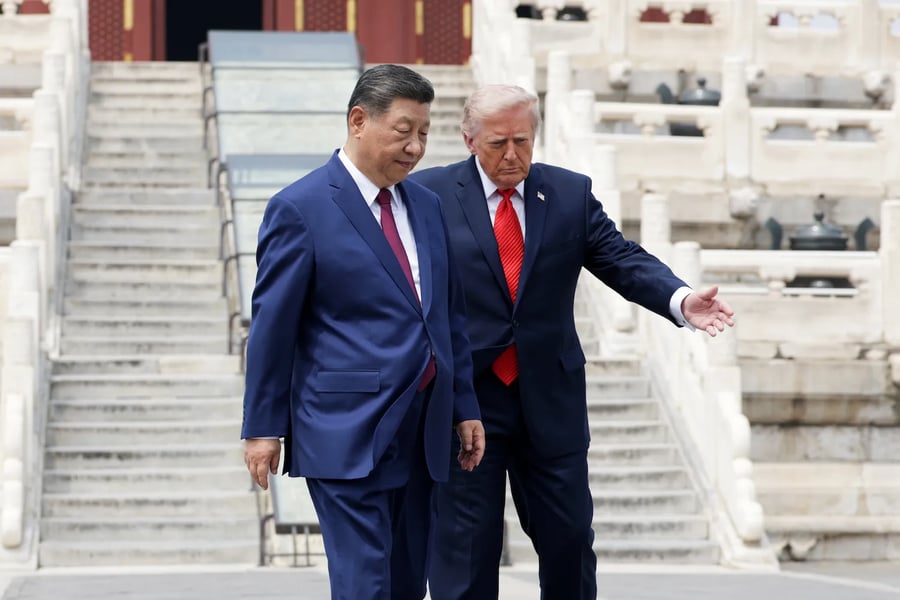

Donald Trump returned from Beijing this week insisting that his high-profile Trump-Xi summit with Chinese President Xi Jinping had stabilized relations between the world’s two largest economies. But behind the ceremonial banquets, military pageantry and declarations of cooperation, one issue overshadowed nearly every other conversation: Taiwan.
In remarks delivered aboard Air Force One after leaving China, Trump acknowledged that Trump discussed Taiwan with Xi Jinping directly and said a decision on future military support for the island would come “soon.” The statement immediately intensified anxiety in Taipei and deepened concerns among US lawmakers and foreign policy analysts that Taiwan may be drifting into the center of a broader geopolitical bargain between Washington and Beijing.
Trump’s comments followed days of escalating signals from Beijing that Taiwan had become the defining pressure point in the increasingly fragile relationship between the two powers. During closed-door discussions in Beijing, Xi warns of conflict over Taiwan if Washington continued expanding military support for the island.
The warning was one of the strongest public messages China has issued on Taiwan since Trump returned to office, underscoring how rapidly the island has moved from a long-standing diplomatic dispute into a central test of military deterrence, economic leverage and global power projection.
Taiwan’s government responded cautiously but unmistakably. Officials in Taipei stressed that Taiwan arms sales remain essential to maintaining deterrence across the Taiwan Strait and warned that China’s growing military pressure represented the real threat to regional stability.
For decades, the United States has maintained a deliberately ambiguous policy toward Taiwan. Washington recognizes Beijing diplomatically under the “One China” framework while remaining legally obligated under the Taiwan Relations Act to provide Taiwan with the means to defend itself. That ambiguity has long served as the foundation of strategic stability in East Asia.
Trump’s latest remarks, however, introduced a new layer of uncertainty.
Speaking to reporters after the summit, Trump said Xi had directly asked whether the United States would defend Taiwan in the event of a Chinese attack. Trump declined to answer publicly.
“There’s only one person that knows that,” Trump said. “And it is me.”
The comment reverberated across Asian capitals already watching the Beijing summit with unease. While previous administrations carefully calibrated language around Taiwan to avoid provoking Beijing or alarming Taipei, Trump’s approach appeared markedly more transactional, framing Taiwan less as a strategic commitment and more as a negotiable variable inside a wider package of talks involving trade, semiconductors, tariffs, artificial intelligence governance and the wars in the Middle East.
That shift has raised fears among Taiwanese officials that the island’s security could become vulnerable to the political calculations of a broader US-China détente.
According to analysts cited by several international outlets, Beijing appears increasingly confident that Trump prefers transactional diplomacy over ideological confrontation. Chinese officials have reportedly concluded that Trump is primarily focused on securing economic concessions, lowering geopolitical tensions that affect markets and projecting himself as a dealmaker capable of stabilizing global crises.
Xi, by contrast, entered the summit from a position of relative confidence.
China’s economy has stabilized after months of turbulence, Beijing has strengthened ties with Russia and major Global South powers, and Chinese diplomacy has become more assertive across Asia, the Middle East and Africa. Against that backdrop, Taiwan remains Beijing’s most sensitive red line.
China considers the self-governed island part of its sovereign territory and has repeatedly refused to renounce the use of force to bring it under Beijing’s control. Chinese military aircraft and naval vessels now operate around Taiwan almost daily in what Taipei describes as a campaign of sustained intimidation. Ahead of the summit, China opposes US arms sales to Taiwan and warned against any support for Taiwanese independence.
At the same time, Taiwan has become increasingly central to the global technology economy.
The island produces the overwhelming majority of the world’s advanced semiconductors through companies such as TSMC, making Taiwan indispensable not only to consumer electronics but also to military systems, artificial intelligence infrastructure and advanced computing supply chains.
Trump has repeatedly criticized Taiwan over semiconductors while simultaneously intensifying the broader semiconductor rivalry between Washington and Beijing.
That economic dimension now overlaps directly with the military dispute.
The pending weapons package for Taiwan has emerged as one of the most contentious issues in US-China relations. China has fiercely opposed the package, while bipartisan support inside Congress for strengthening Taiwan’s defenses remains unusually strong despite deep political polarization elsewhere.
In Taipei, officials have attempted to project calm publicly while privately seeking reassurances from Washington that US policy remains unchanged.
Before the summit, Taiwan fears no surprises from summit as concerns mounted over Trump’s increasingly unpredictable diplomacy with Beijing.
So far, Taiwanese officials insist that communication channels with Washington remain active. Yet Trump’s refusal to clearly state whether the United States would defend Taiwan if attacked has amplified longstanding fears inside Taiwan that strategic ambiguity may gradually be shifting toward strategic unpredictability.
The summit itself reflected that broader uncertainty.
Despite days of elaborate ceremony in Beijing, including military displays, state dinners and promises of economic cooperation, the talks produced few concrete breakthroughs. Trade tensions remain unresolved, China offered no major public concessions, and disputes over technology restrictions, tariffs and military competition continue to dominate the bilateral relationship. Analysts described the outcome as a fragile pause rather than a genuine diplomatic reset, with some arguing that Trump returns from China with stalemate.
Several analysts described the summit less as a diplomatic reset than as a temporary stabilization effort between two rival powers attempting to manage escalating global tensions without fundamentally resolving them.
Taiwan sits at the center of that unresolved rivalry.
For Beijing, the issue is tied to national sovereignty, Communist Party legitimacy and Xi Jinping’s vision of Chinese national rejuvenation. For Washington, Taiwan represents both a democratic partner and a strategic anchor inside the Indo-Pacific security architecture designed to contain Chinese military expansion.
For Trump, however, the issue increasingly appears intertwined with broader calculations about trade leverage, economic negotiations and America’s global posture.
That distinction matters enormously in Taipei.
Taiwanese officials have spent years strengthening unofficial ties with Washington while modernizing defenses in response to China’s growing military pressure. Yet many inside Taiwan now fear that the island could become vulnerable not through sudden invasion, but through gradual diplomatic repositioning among larger powers seeking accommodation.
The Beijing summit may not have produced a dramatic agreement on Taiwan. But it exposed how quickly the island’s future is becoming entangled in a larger contest over economic power, military deterrence and the shape of the international order itself.
As Trump and Xi left Beijing pledging stability, officials across Asia were left confronting a far more unsettling reality: the question of Taiwan is no longer confined to the Taiwan Strait. It has become one of the defining fault lines of global politics.