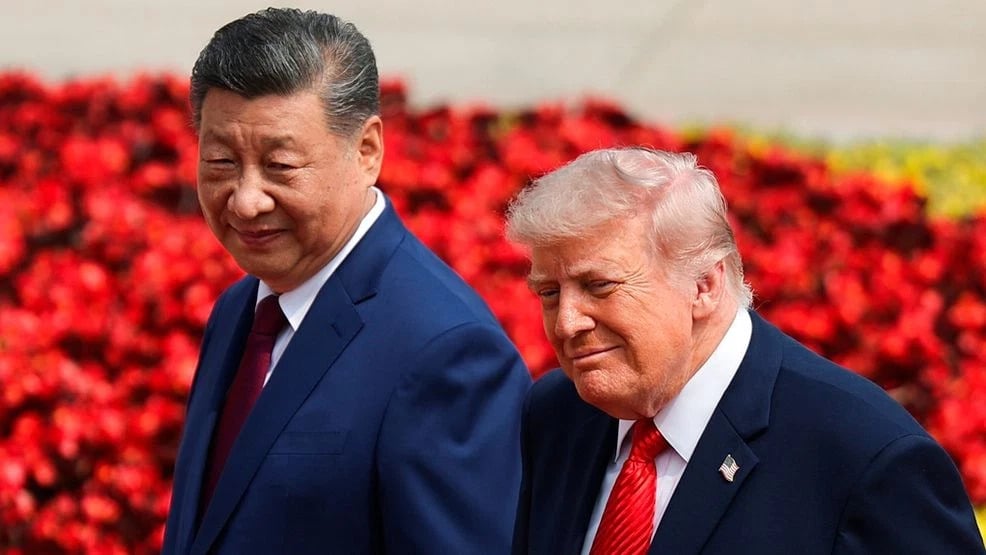

US President Donald Trump has confirmed that a proposed $12 billion American weapons package for Taiwan has been temporarily frozen following high-stakes talks with Chinese President Xi Jinping, injecting new uncertainty into one of the most explosive flashpoints in US-China relations.
The announcement came after Trump’s two-day summit in Beijing, where Taiwan reportedly dominated discussions between the world’s two largest powers. Speaking aboard Air Force One late Thursday, Trump said the arms package was “on hold for now,” while emphasizing that he first wanted to speak with Taiwan’s leadership before making a final decision.
The comments immediately triggered geopolitical speculation that Washington could be reassessing its military commitments to Taipei as part of broader negotiations with Beijing over trade, artificial intelligence, sanctions, and regional security. Analysts say the latest development reflects the increasingly fragile state of US-China relations.
The proposed military package reportedly includes advanced missile systems, precision-guided artillery, drones, and expanded air defense systems designed to strengthen Taiwan’s military deterrence against mainland China. The deal would become one of the largest Taiwan arms sales agreements between Washington and Taipei in recent years.
Trump’s remarks followed what observers described as an especially tense Trump-Xi summit, during which Xi reportedly warned the US president that the Taiwan issue remained Beijing’s “red line.” According to The Guardian, Xi cautioned that further American military involvement around Taiwan could trigger “clashes and even conflicts.”
China has repeatedly condemned American military support for Taipei, insisting that Washington is violating the “One China” principle. Beijing considers Taiwan part of Chinese territory and has vowed reunification, by force if necessary. Ahead of the summit, Chinese officials warned they were prepared to crush any moves toward Taiwan independence.
Taiwan has become the most dangerous geopolitical fault line in Asia as Beijing dramatically intensifies military pressure around the island. Taiwan’s latest military assessments indicate that China is rehearsing blockade scenarios and increasing combat readiness across the Taiwan Strait. Recent reports on Taiwan’s defense capabilities have highlighted growing fears inside Taipei over a potential confrontation.
Trump’s decision to freeze the package may signal a broader strategic calculation within the White House. Since returning to office, Trump has attempted to balance aggressive rhetoric toward Beijing with a parallel push for direct negotiations with Xi over tariffs, technology restrictions, energy supply chains, and Iran.
The summit itself produced few concrete breakthroughs, but both sides appeared eager to avoid a direct escalation. Washington and Beijing remain locked in disputes over semiconductor exports, naval deployments, cyber warfare accusations, and the race for artificial intelligence dominance.
Taiwan sits at the center of many of those tensions because of its strategic location and dominance in advanced semiconductor manufacturing. American defense analysts have increasingly argued that stronger military cooperation with Taipei is necessary as China accelerates its military expansion.
Concerns about China’s military modernization have intensified across the Pacific region, especially after Beijing rapidly expanded its missile arsenal and naval capabilities. China’s expanding military power was further underscored by recent reports about the PLA Navy conducting hypersonic missile launch tests from advanced destroyers.
At the same time, Taiwan continues racing to improve Taiwan’s defense capabilities amid mounting fears of future Chinese military operations near the island.
Trump’s comments also reignited debate inside Washington over America’s long-standing policy of strategic ambiguity toward Taiwan. The US officially recognizes Beijing diplomatically while simultaneously remaining Taipei’s largest arms supplier under the Taiwan Relations Act.
When reporters asked whether the United States would intervene directly in the event of a conflict, Trump avoided giving a definitive answer on defending Taiwan militarily. Instead, he emphasized that discussions were ongoing and insisted that all sides wanted stability.
Taiwan’s government responded cautiously, thanking Washington for previous military assistance while stressing that continued US support remained critical for preserving stability in the Taiwan Strait.
Inside China, state-backed commentators portrayed Trump’s decision as evidence that Beijing’s pressure campaign was working. Chinese analysts argued that Washington increasingly understands the risks of direct confrontation over Taiwan and warned that any future weapons transfers would face a “firm response.”
The pause in military assistance comes at a particularly delicate moment internationally. Conflicts in Eastern Europe and the Middle East have already strained global defense supply chains, while tensions in the Indo-Pacific continue pushing countries across Asia to increase military spending and deepen security cooperation with Washington.
Despite the temporary freeze, Trump insisted no final decision had been made. He stressed that the matter remained under active review and said future discussions with both Beijing and Taipei would shape Washington’s next move.
For Beijing, preventing deeper US military involvement around Taiwan remains a core strategic priority. For Washington, Taiwan continues to represent both a critical semiconductor hub and a geopolitical counterweight to China’s growing regional influence.
That reality ensures Taiwan will remain one of the world’s most volatile flashpoints as the rivalry between Washington and Beijing intensifies.
—Inputs from Sputnik.