WASHINGTON — The decision came with fanfare. In March 2025, President Donald Trump celebrated what he called the end of an “absolute disaster” for small businesses — the suspension of a federal requirement that U.S. companies disclose who actually owns them. “Exciting news,” he wrote on Truth Social. The Treasury Department, he announced, would no longer be the compliance headache that had haunted American entrepreneurs.
What that announcement left out was the other side of the ledger. The same reporting requirement Trump was killing had been designed, over years of bipartisan effort, to cut off a specific financial artery: the one through which drug cartels, fraudsters, and foreign adversaries move billions of dollars through the American economy each year, hidden behind anonymous limited liability companies and corporations no regulator could see through.
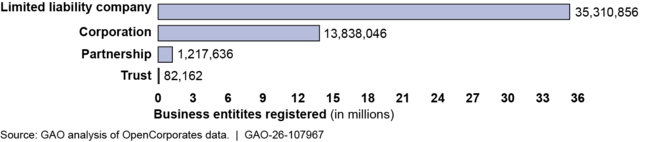
Now the U.S. Government Accountability Office has put that trade-off in writing. In a report published May 29, the GAO found that the Trump administration’s rollback of beneficial ownership reporting requirements under the Corporate Transparency Act exempted more than 99 percent of the entities previously required to file — covering over 35 million LLCs and nearly 14 million corporations registered across the United States. Treasury, the watchdog concluded, has not identified any steps to address the illicit finance risks that exemption creates. The agency disagreed with the recommendation to do so.
The report lands at an uncomfortable moment. Treasury’s own 2026 National Money Laundering Risk Assessment — published by the same department that rejected the GAO’s recommendation — documents active cases in which shell companies were used to launder proceeds from drug trafficking, cybercrime, and fraud. The left hand, it appears, has not read what the right hand wrote.
“Treasury gutted a bipartisan law designed to crack down on the abuse of shell companies, exempted 99 percent of the entities previously required to report, and has failed to address the significant risks this rollback created,” Senator Elizabeth Warren, the ranking Democrat on the Senate Banking Committee, said in a statement following the report’s release. The GAO’s finding, she argued, confirmed what anti-corruption advocates and law enforcement officials had been warning for months.
The law at the center of the dispute — the Corporate Transparency Act — was passed in 2021 as part of the Anti-Money Laundering Act of 2020. It required corporations, limited liability companies, and similar entities to report the identities of their beneficial owners to the Treasury’s Financial Crimes Enforcement Network, known as FinCEN, which would maintain the registry and share it with law enforcement. The logic was straightforward: if a drug cartel or a fraudster wanted to hide money inside an American LLC, they would have to put a real name on file somewhere. That name could be found.
Before the Trump administration moved, an estimated 32 million U.S. businesses were on track to comply. By July 2025, GAO’s analysis of OpenCorporates data showed more than 35.3 million LLCs registered in the United States, along with nearly 13.8 million corporations, 1.2 million partnerships, and 82,000 trusts. The overwhelming majority now fall outside any federal beneficial ownership reporting obligation. The FinCEN registry, once envisioned as a comprehensive national database for tracing illicit finance, now captures information from roughly 12,000 foreign entities registered to do business in the United States.
The administration’s rationale has been consistent: the reporting burden on small businesses was too heavy, and existing federal and state oversight of most regulated entities already provided sufficient transparency. Treasury Secretary Scott Bessent has emphasized that FinCEN is deploying other tools — enhanced data processing and targeted enforcement — to pursue money laundering tied to cartels. FinCEN Director Andrea Gacki, testifying before Congress, acknowledged that domestic shell companies “can still be leveraged in financial crime” but argued that alternative information sources remain available to law enforcement.
The GAO found that argument incomplete. State-level corporate disclosure requirements — which vary sharply across jurisdictions — frequently capture only the names of officers and registered agents, not the actual beneficial owners who may sit several layers removed from any filed document. Someone controlling a Sinaloa cartel-linked LLC through a chain of Delaware holding companies and Nevada trusts would not necessarily appear anywhere in what states collect. The GAO’s report specifically noted that individuals “may not be the beneficial owners or exercise substantial control” over the entities that states track.
What makes the GAO’s finding unusually pointed is the specific document it cites in rebuttal — Treasury’s own risk assessment. That document, published earlier this year, identifies several cases in which shell companies facilitated drug trafficking proceeds, cybercrime, and fraud. One involved a Chinese money-laundering network that used more than 100 shell companies to move at least $77 million in narcotics proceeds on behalf of Mexican cartels, according to a letter sent by a bipartisan group of senators to Bessent in November 2025. Treasury raised the alarm about those same networks, then declined to close the regulatory gap enabling them.
The GAO’s single formal recommendation is measured in its language but stark in its implication: the Secretary of the Treasury should direct FinCEN to identify potential actions to address the risks created by the domestic company and U.S. person exemptions, and to provide Congress and law enforcement with information useful for combating those risks. Treasury disagreed. The recommendation remains open.
That rejection puts the administration in an awkward rhetorical position. Trump has framed his approach to drug cartels — including designating several as foreign terrorist organizations and pushing terrorism charges against Mexican officials — as the most aggressive in American history. His administration has escalated legal and military pressure on Mexican cartel networks at the same time it has removed one of the primary financial transparency tools law enforcement uses to follow cartel money once it enters the U.S. financial system.
The Financial Action Task Force, the international standard-setter on anti-money laundering policy, is currently conducting a formal evaluation of the United States. Analysts at the FACT Coalition, an anti-corruption advocacy group, warned this week that the rollback of the Corporate Transparency Act, combined with cuts to white-collar crime enforcement, risks a weak FATF evaluation — one that could undermine the United States’ credibility as a global leader on financial transparency and trigger increased scrutiny from international financial institutions.
Before FinCEN narrowed its reporting requirements, a pilot program had given select federal agencies access to the beneficial ownership database. Four agencies collectively provided 100 staff members access to the system, conducting nearly 1,700 searches as of late October 2024, according to the GAO. That data point, advocates argue, suggests clear and active demand from law enforcement for exactly the kind of information the new exemptions have made unavailable.
What Treasury has not yet explained — and what the GAO report does not resolve — is how law enforcement fills that gap when the shell company in question has no foreign nexus, no obvious offshore link, and no FinCEN filing. The money moves. The name stays hidden. The answer, according to the administration, lies elsewhere. Where, exactly, remains unclear.
Related Posts