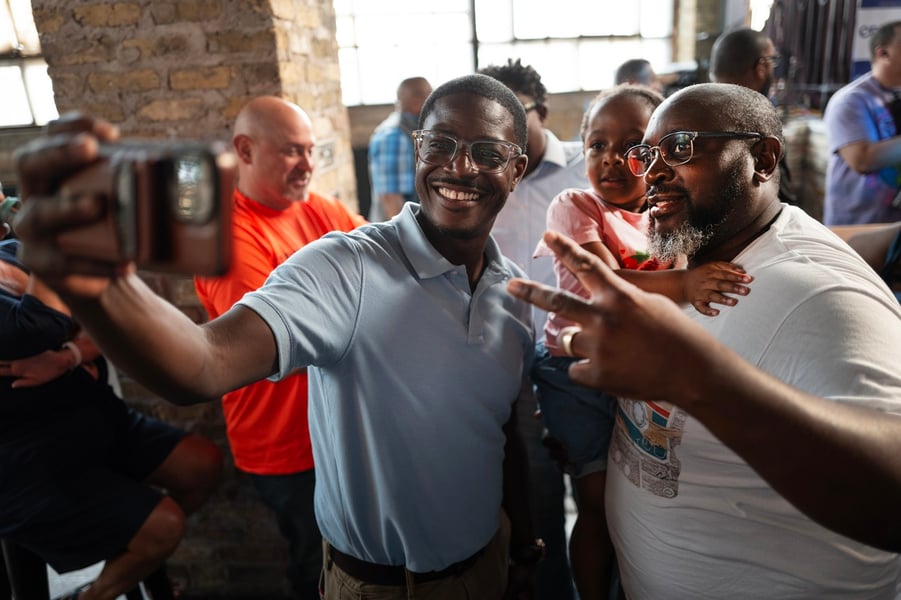

MADISON – Ali Plummer knew which candidate she agreed with. The Madison voter preferred Francesca Hong’s politics, the democratic socialist’s platform on healthcare, housing, and climate change that matched Plummer’s own instincts. But on Tuesday, Plummer voted for David Crowley anyway, telling a reporter outside her polling place that she needed someone who could win in November.
“I wanted her policies,” she said, “but I voted for who I thought could beat Tom Tiffany.”
Crowley won. He won despite being listed at 7 percent in the most recent Marquette University Law School Poll, which gave Hong a 38 percent share of likely Democratic primary voters and projected a field with one-third undecided as recently as July 22. He won despite withdrawing from the race five weeks before the primary, then reversing course and re-entering ten days later in a sequence that political consultants described as one of the most chaotic re-launches in recent Wisconsin political history. He won by a margin so thin that Hong’s campaign was still assessing the result late into election night, though by Wednesday morning the outcome was clear.
The question now racing through Democratic Party circles is not simply how Crowley won, but what his win reveals about the state of American primary elections and the polling that is supposed to predict them.
The Marquette poll, conducted by Marquette University Law School and regarded as one of Wisconsin’s most reliable pre-election surveys, showed Hong with a 22-percentage-point lead in its final reading before Tuesday. Instead, Crowley won by a razor-thin margin. The gap between polling and result was among the largest recorded in a major-party gubernatorial primary in decades, adding Wisconsin to a growing list of 2026 primaries in which pre-election surveys have failed to capture the actual outcome.
Part of the explanation lies in money and medium. After re-entering the race, Crowley’s campaign and allied groups spent approximately $4 million on television advertising. Hong’s campaign spent under $500,000 in total and ran no broadcast or cable television spots. Crowley’s spending advantage allowed him to define his message in living rooms across Wisconsin during the final three weeks of the campaign, reaching low-information voters who consume news primarily through local television and who are unlikely to follow digital-native coverage of a Democratic primary. According to NBC News, late-deciding voters broke sharply toward Crowley in the final days, a swing that no public poll had adequately measured.

The Democratic primary in the Michigan Senate primary six weeks earlier had already shown that 2026 electorates were not behaving as pollsters expected. In Michigan, voters chose between a candidate backed by large institutional money and a progressive challenger, and the result diverged substantially from public surveys. Wisconsin’s result extended that pattern to a race where the candidate with the most progressive platform, the most name recognition in left-wing circles, and the largest polling advantage lost to a more moderate institutional candidate who had briefly exited the race entirely.
What the result portends for November remains the large question Crowley’s campaign must now answer. He will face Republican Tom Tiffany, the northwest Wisconsin congressman who has served in the House since 2020, in a state that has swung between the two parties in three consecutive election cycles. Trump’s approval in Wisconsin’s rural counties deteriorated sharply over fuel and agricultural costs earlier this year, and the same undecided voters who moved to Crowley in the primary’s final week will be the ones both sides target most heavily in the fall.
Crowley’s path from 7 percent to the Democratic gubernatorial nomination in three weeks offers strategists a case study in what late-stage television advertising can still accomplish in a fragmented media environment. It also offers pollsters a problem they have not solved: how to model the behavior of a third of an electorate that makes up its mind in the final ten days and does not reliably respond to pre-election surveys. The Marquette poll’s miss of 22 percentage points in its final reading was not a rounding error; it was a failure of the survey instrument to capture a race in motion.
Whether that failure is replicable in a general election, where turnout is higher and undecided voters are a smaller fraction of the electorate, is the question Crowley’s fall campaign will test against Tiffany’s well-financed Republican operation. Karoline Leavitt‘s departure from the White House on the same day Crowley secured the nomination added to a volatile political week, as the party around Trump absorbed a personnel change and watched one of its key swing-state targets enter the general election from an unexpected quarter.
In Madison, Plummer said she walked away from the polling booth unsure she had done the right thing. She had voted for the candidate she thought could win, not the one she wanted to see govern. If the next few months prove her right, Crowley’s fall campaign will offer a test of whether electability logic, the instinct that carried him from 7 percent to the nomination, can translate from the primary into a general election against an incumbent party that has its own unresolved problems with the voters it needs.