WASHINGTON — The fireworks are already being organized along the National Mall. The commemorative ceremonies have been scripted. In twenty-six days, the United States will mark 250 years since its founding with what officials have billed as the grandest celebration in the country’s history. But a new national poll, published Monday by The Associated Press and the NORC Center for Public Affairs Research, raises an uncomfortable question about who, exactly, is still sold on the story being celebrated.
Only about one in three Americans believes the American Dream — the foundational promise that hard work reliably produces advancement — still holds true today. Half say it once worked but no longer does. The survey was drawn from 2,596 adults surveyed in April and carries a margin of error of 2.6 percentage points. It is not the first poll to capture this sentiment, but its timing gives the numbers a particular weight.
The generational divide within those findings is where the data gets genuinely difficult. Nearly half of Americans aged 60 and older — 46 percent — still believe the Dream is accessible. Among adults under 30, that figure collapses to 22 percent. The country preparing to throw a party for itself is, by significant measure, a country whose youngest adults have concluded that its central organizing myth no longer describes their reality.
What drove that conclusion is not hard to reconstruct. Housing costs have priced homeownership out of reach for much of a generation that came of age during back-to-back economic shocks. Americans across income brackets have registered historic lows in economic confidence in surveys conducted throughout the past year, and the sentiment appears to be crystallizing into something more durable than a mood. It is, increasingly, a structural read on how opportunity is distributed.
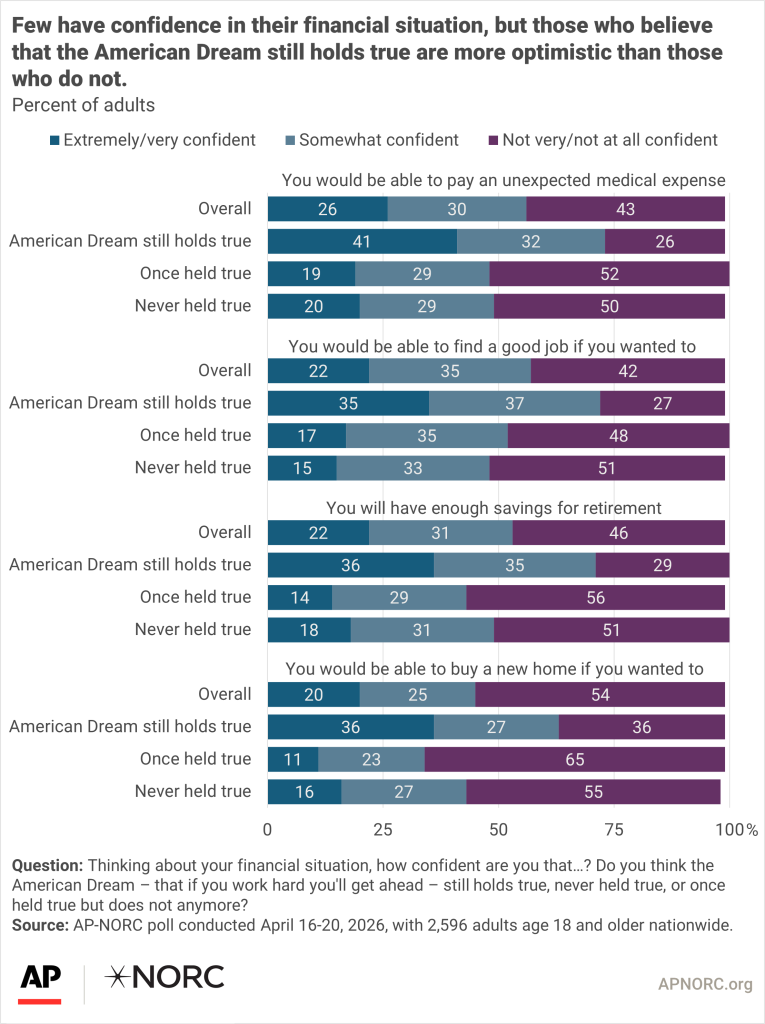
The AP-NORC data shows that belief in the Dream closely tracks belief in one’s own financial prospects. Adults who say the Dream still holds are significantly more likely than others to feel confident they can find a good job, save for retirement, cover an unexpected medical expense, or buy a home. That correlation cuts both ways: the people who have already achieved those things are more likely to believe the path remains open. The people who haven’t — disproportionately young, and disproportionately Black — are more likely to conclude the path was never as open as advertised.
The poll found that Black adults are roughly twice as likely as white adults to say the American Dream has never been true — 30 percent versus 12 percent. White adults are more likely, at 40 percent, to say the Dream still holds, compared with 19 percent of Black adults. These are not new fault lines; they have appeared consistently across NORC surveys conducted annually over the past decade. What has shifted is the overall floor: economic confidence among Americans more broadly has deteriorated sharply in 2026, compressing the share of any demographic that sees the future with optimism.
The partisan dimension is just as pronounced. Republicans are more than twice as likely as Democrats to believe the Dream remains viable — 57 percent of Republicans hold that view, compared with 24 percent of independents and 17 percent of Democrats. This gap has widened over the past decade. It means that faith in the country’s foundational economic promise has become, to a significant degree, a matter of party affiliation rather than personal circumstance. Whether that reflects genuine experience or political identity is a question the data does not resolve.
The exceptionalism numbers are equally striking in context. Only about one in four Americans now says the United States stands above all other nations. Another 44 percent describe it as one of the greatest countries, alongside others — a middling formulation that would have been remarkable as a majority position a decade ago. About three in ten say there are simply better countries than the United States, up from 19 percent who held that view in an equivalent AP-NORC survey conducted in June 2016. That ten-year comparison is notable because 2016 was itself considered a low point for national confidence.
What the poll does not tell us — and what no survey can — is whether the shift in sentiment is a realistic reappraisal of changed conditions or a deeper, more corrosive loss of civic faith that will outlast any particular economic cycle. The two readings lead to very different conclusions about what July 4 means this year. One suggests the country is recalibrating its self-image toward something more accurate. The other suggests the founding story is losing the generational transmission that gives it force.
Those two possibilities are not mutually exclusive. A country can be simultaneously correcting an inflated sense of its own uniqueness and losing something essential in the process. The AP-NORC data, released with the anniversary banners already going up, offers no resolution to that tension — only the evidence that it exists, and that it runs deepest among the generation that will live with the consequences the longest.
The nationwide survey of 2,596 adults was conducted April 16-20, 2026 using the AmeriSpeak Panel, NORC’s probability-based panel at the University of Chicago. Full topline results and methodology are available from AP-NORC. Additional findings from the poll are expected to be released in the weeks before July 4. The cost-of-living pressures driving younger Americans’ pessimism have been documented across multiple indices this year, with housing affordability consistently ranking as the most cited barrier to upward mobility.