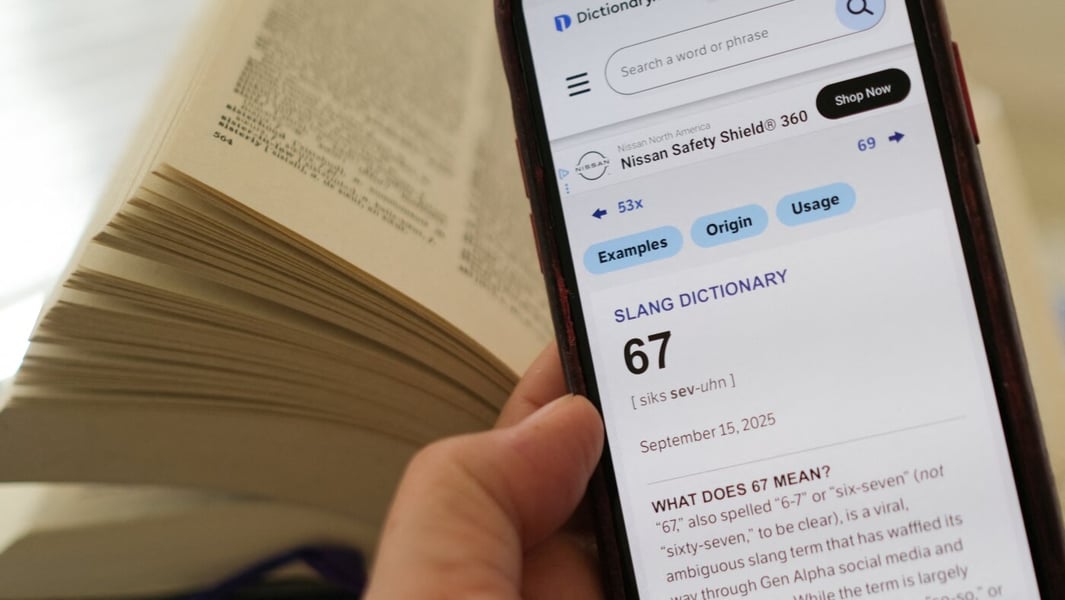

67, pronounced “six seven” and never “sixty-seven,” is American internet slang that means nothing on purpose. It began as a lyric in a Philadelphia drill song, spread through basketball highlight edits on TikTok, and finished 2025 as Dictionary.com’s Word of the Year. Children shout it as a reflex, usually with both palms turned up and their hands see-sawing like a scale weighing two invisible options. If you came here looking for the hidden definition, there isn’t one. The absence is the joke.
That answer tends to frustrate the adult asking the question, which is roughly the point. A word that adults cannot decode is a word that belongs entirely to the people using it, and for most of 2025 and into the 2026 school year, 67 was the clearest line anyone had drawn between Generation Alpha and everybody else in the United States. Teachers banned it. Coaches heard it from the bleachers. Dictionary.com’s own lexicographers picked it as the word that defined the year while openly admitting they could not define it.
The short answer: 67 is a sound, not a word
Linguistically, 67 behaves less like a noun and more like a noise. Merriam-Webster, which added a slang entry for it, files it as a nonsensical expression used mostly by teens and tweens, deployed mainly as an interjection when someone encounters the numbers six and seven in the wild. A math worksheet with the answer 67. A jersey number. A speed limit sign. The response is automatic and it is loud.
Some users insist it carries a shade of “so-so,” or “maybe this, maybe that,” which is where the hand gesture comes from. Palms up, alternating up and down, the universal signal for weighing two things against each other. Steve Johnson, director of lexicography for the Dictionary Media Group at IXL Learning, told CBS News that Dictionary.com’s announcement marked the first word of the year in a long time that functioned as an interjection rather than a term with a stable meaning. The dictionary’s own description was blunter: meaningless, ubiquitous and nonsensical.
Where 67 came from: Skrilla, Kensington and a drill song
The trail leads back to a rapper named Skrilla, from the Kensington section of Philadelphia, and a track called “Doot Doot (6 7)” that surfaced in December 2024 and got a formal release in February 2025. The hook repeats the two numbers over a menacing drill beat. It is not a happy song, and nothing in it explains what the numbers stand for.
Skrilla has been asked, repeatedly, and has refused to settle it. He told Genius the phrase “just represents my brain, like what comes up in my head,” and he has said plainly that he never attached a meaning to it and still would not want to. Later, watching what the internet had done with his lyric, he told NPR that 67 “changed from a negative thing to a positive,” and that everybody had ended up with their own meaning for it.
The theories filled the vacuum anyway. The most repeated one holds that 6 and 7 are street numbers, either 67th Street in Philadelphia or 67th Street in Chicago. The linguist Taylor Jones floated a darker reading, that the numbers echo a Philadelphia police ten-code used in death notifications. None of this is settled, and it probably never will be. The person who wrote the line has decided that ambiguity is more valuable than an answer, and he is almost certainly right.
Why LaMelo Ball became the accidental mascot
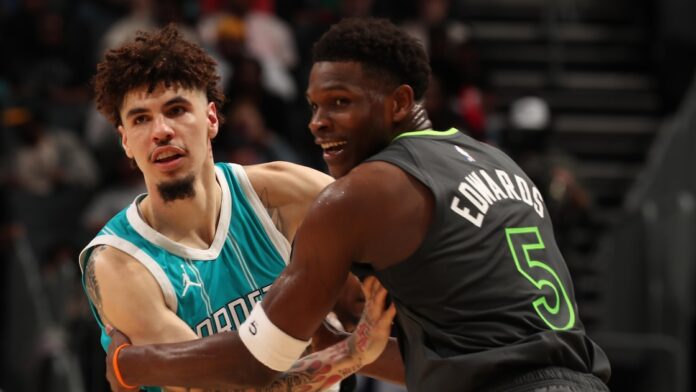
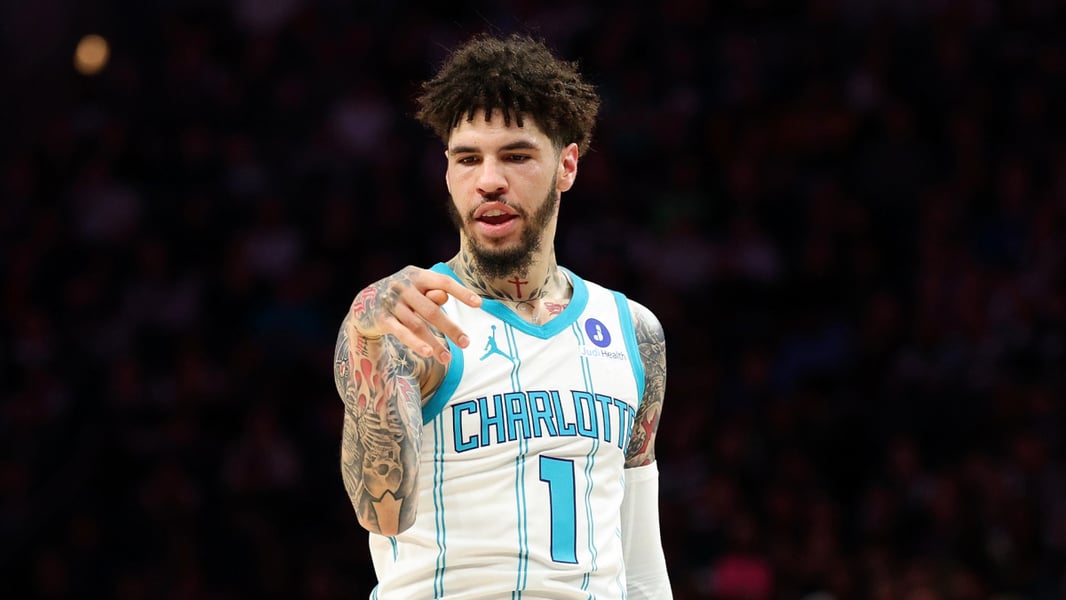
A song alone would not have done it. What turned two numbers into a national tic was basketball, and specifically the fact that NBA guard LaMelo Ball is listed at 6 feet 7 inches. Edits pairing Ball’s highlights with Skrilla’s hook multiplied across TikTok through the first half of 2025, and once the audio was attached to a recognizable body, it stopped needing the song at all. Taylen Kinney, an Overtime Elite guard who worked the phrase into interview after interview, picked up the nickname Mr. 6-7 and a merchandise line along with it.
How 67 conquered American classrooms
The gesture arrived in March 2025, when a video from the YouTube creator Cam Wilder captured a kid named Maverick Trevillian sprinting at the camera, bellowing “six seven” and throwing the palms-up wave. He became known as the 67 Kid, and the clip did what the song had not quite managed on its own. It gave the phrase a body, a face and a move that any nine-year-old could copy in a hallway.
By fall, American schools were losing lesson time to it. A sixth-grade language arts teacher in Michigan with two decades in the classroom told TODAY that nothing in her career had driven her crazier. One teacher’s widely shared punishment was a 67-word essay on what 67 means, escalating to 670 words for repeat offenders, a sentence that is either brilliant pedagogy or a small act of revenge depending on how the day had gone. Whole districts banned the gesture. South Park built an episode around it. Somewhere in that stretch it stopped being a joke among kids and became a negotiation between kids and every adult in the building.
The parenting psychologist Becky Kennedy offered the most useful framing anyone has managed: 67 is meaningless in content, but it is not meaningless in feeling. What it delivers is belonging, instantly and at volume, to anyone who says it back.
Why Dictionary.com named it Word of the Year
Dictionary.com announced the pick on October 29, 2025, and the data behind it was not subtle. Searches for 67 climbed more than sixfold from June onward, with no meaningful comparable trend for any other two-digit number. The site called the choice a demonstration of how fast a new word can travel once a rising generation enters the conversation.
The reference books read the same year very differently. Merriam-Webster went with “slop,” the term for low-effort AI-generated content flooding the web. Dictionary.com went with a noise that a ten-year-old makes at a math worksheet. Between them they mapped 2025 fairly well: machines producing language nobody wanted, and children producing language nobody could parse.
Is 67 still a thing in 2026?
Partly. Reporting from March 2026 found the split that usually kills a meme: older teenagers and the upper end of Generation Alpha had begun mocking anyone still saying it, while younger children carried on undeterred. That is the normal life cycle. A phrase becomes uncool at the top and takes another year or two to drain out of the bottom.
What complicates the obituary is school. Teachers heading into the 2026-27 year have said they expect to hear it again in September, because each new cohort of nine-year-olds arrives without the memo that the joke expired. Whether 67 fades into the same drawer as “yeet” and “no cap” or hangs around as a permanent low-grade classroom noise is genuinely unresolved, and anyone claiming to know is guessing.
The other things 67 can mean
Not every search for 67 is about the meme, and the older meanings have not gone anywhere. In the United States, *67 is the star code you dial before a number to withhold your caller ID, which shows up on the recipient’s phone as blocked, private or unknown. It does not work for 911, most toll-free numbers or many international calls. People still use it as a verb, as in getting 67’d by an unknown number.
In British rap, 67 is an established drill collective out of Brixton in south London, and predates the American meme by years. In numerology circles, 67 gets read as a number about balance and alignment. And in a great many American towns there is a Route 67, a Highway 67 and a bus that runs down 67th Street. Context does the work here. If a child said it, it is the meme. If it has a star in front of it, it is your phone.
What parents and teachers actually do about it
The strategies that appear to work are unglamorous. Treating it as noise rather than defiance drains the reward, because the phrase is built to provoke a reaction and starves without one. Banning it outright tends to convert a joke into contraband, which raises its value. Several teachers have landed on a middle path of allowing it in the corridor and not in the room, which at least gives students somewhere to put it.
There is also a reasonable argument for leaving it alone. Nonsense catchphrases are not new and not a symptom of anything. What is new is the speed, and the speed is a platform effect rather than a character flaw, driven by a recommendation engine that survived its American ownership fight largely intact. American teenagers, incidentally, mostly reject the idea that social media is damaging their mental health, which is a finding worth sitting with before treating a hallway chant as evidence of decline.
Frequently asked questions about 67
Is 67 a bad word?
No. It carries no profanity and no coded insult. The complaint against it is disruption, not vulgarity. The one wrinkle is its origin in a drill track whose broader subject matter is violent, which is why some schools treat the phrase as inappropriate by association rather than by content.
How do you do the 67 hand gesture?
Both hands out in front, palms facing up, then alternate them up and down as though weighing two objects. It is usually paired with a drawn-out delivery of the two syllables.
Does 67 mean anything in numbers?
Not in the way people hope. It is not code, it is not an acronym, and it does not stand for a phrase. The numbers were arbitrary when Skrilla used them, and Merriam-Webster’s slang entry reflects that by declining to give it a fixed definition at all.
Who started the 67 trend?
Skrilla wrote the song. Basketball edits featuring LaMelo Ball carried the audio. Maverick Trevillian, the 67 Kid, supplied the gesture. No single person launched it, which is typical of how memes now form, and it is the reason no single person can end it.