
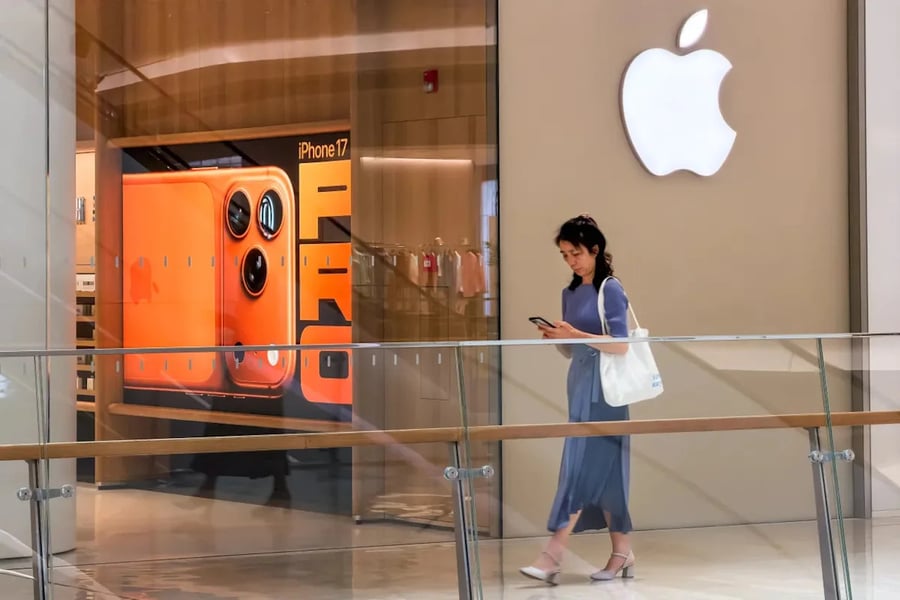
NEW YORK — Apple shares fell for a second straight session Monday, closing at $316.22 after dropping $3.75, or 1.17%, from Friday’s price of $319.97. The decline came on the eve of the company’s “Surprise and Shine” product event, the first major iPhone launch to be led by chief executive John Ternus.
The session unfolded against a broadly weaker market. The Dow Jones Industrial Average fell 628 points as Brent crude prices advanced, Houthi missile strikes against Red Sea shipping routes resumed, and a new round of tariff friction with Canada weighed on blue-chip sentiment. Among other Dow components that saw session losses, Amazon and American Express retreated alongside Apple on the day.
For Apple, the session carried its own specific weight. Shares have gained roughly 21% this year, driven almost entirely by anticipation of the foldable iPhone 18 Fold expected to debut at Tuesday’s event. That premium, built over months of leaks, analyst upgrades, and developer speculation, had priced the stock at 37.1 times forward earnings by Monday’s close, a valuation that admits little tolerance for a product announcement that falls short of expectations.
Morgan Stanley analyst Erik Woodring was among those who have argued the market’s optimism is justified. In a note circulated before Monday’s session, he described the forthcoming foldable as “the biggest iPhone form-factor change since the iPhone X” and projected approximately $14 billion in December-quarter revenue from the device, with 7 to 8 million units expected to ship in the second half of 2026. Woodring’s buy rating remained intact through Monday’s softness.
The expected pricing structure for the new lineup is proving harder to digest. The foldable iPhone 18 Fold is anticipated at a starting price near $2,099, with configurations reaching $2,299 or higher. The iPhone 18 Pro and Pro Max are expected to carry prices 10 to 20 percent above the current generation, an increase attributed to the higher-density memory chips required to run Apple Intelligence features locally on device. Those cost increases could suppress unit volume even as they lift average selling prices, creating a revenue picture that depends heavily on whether Apple’s installed base accepts a meaningful step up in price.
Ternus, who formally became chief executive on September 1 when Tim Cook transitioned to executive chair, appears at “Surprise and Shine” without precedent. The former head of hardware engineering has been at Apple for more than two decades without once presenting at a major product launch. His performance Tuesday, including how he frames the new hardware and handles questions about Apple Intelligence’s capabilities relative to Alphabet and Microsoft, will carry weight beyond any single product announcement.
Monday’s options activity suggested institutional caution rather than directional conviction. Flow data pointed to hedging in both directions, consistent with a market that holds a position but wants protection against an unknown outcome. The “sell the news” dynamic has shown up at previous Apple product cycles, and several analysts acknowledged the pattern without predicting it would repeat this time.
Apple did not respond to requests for comment on product specifications or pricing. Ternus has not made public remarks since becoming chief executive. The company’s standard pre-event media blackout remained in effect through Monday.
The stock’s 1.17% decline on September 8 leaves Apple below the $320 level it held as recently as last week. The earnings multiple it carries requires Tuesday’s event to deliver, in unit volumes, in average selling prices, and in early signals that the foldable category in Apple’s hands translates differently than it has for Samsung. Samsung has not shipped 10 million foldable devices globally across all models in any single quarter. Apple’s most bullish December-quarter forecasts assume it will approach that figure in its first attempt.
That is the proposition Monday’s market chose to wait on rather than pay for in advance.