
SAN FRANCISCO — For months, enterprise software investors had debated whether Agentforce was a real business or simply a marketing construct wrapped in an AI label. September 10 did not settle the argument, but it pushed the case further.
Salesforce Inc. (NYSE: CRM) closed at $247.72 on Thursday, up $4.72, or 1.94%, from Wednesday’s close of $243.00, as broader technology sentiment strengthened and investors continued to revisit the company’s first-quarter fiscal 2027 results, reported in late May. The results cemented Agentforce’s position as the fastest-growing product line in Salesforce history.
Agentforce, the company’s agentic AI platform handling autonomous customer service, sales, and workflow tasks, crossed $1 billion in annual recurring revenue in Q1 FY2027. Combined with its broader data and AI offerings, Salesforce reported $3.4 billion in AI and data ARR, a figure more than double year-on-year. The crossing of that first billion threshold matters to institutional investors not as a ceiling but as a floor: it signals customers are paying for results, not merely piloting.
The underlying quarterly numbers backed up the signal. Revenue reached $11.13 billion in Q1 FY2027, up 13% year-over-year, while non-GAAP earnings per share came in at $3.88, a 50% jump from the prior year. GAAP EPS climbed 52% to $2.42. The margin expansion story ran alongside the revenue growth: non-GAAP operating margin improved 250 basis points to 34.8%.
Full-year FY2027 guidance, raised after the Q1 print, calls for revenue of $45.9 billion to $46.2 billion, with non-GAAP EPS of $14.06 to $14.12. The midpoint of that revenue range implies roughly 11% growth, sufficient for a company of Salesforce’s scale though short of the 15%-plus trajectory some bulls had penciled in before Agentforce became a meaningful line item on the income statement.
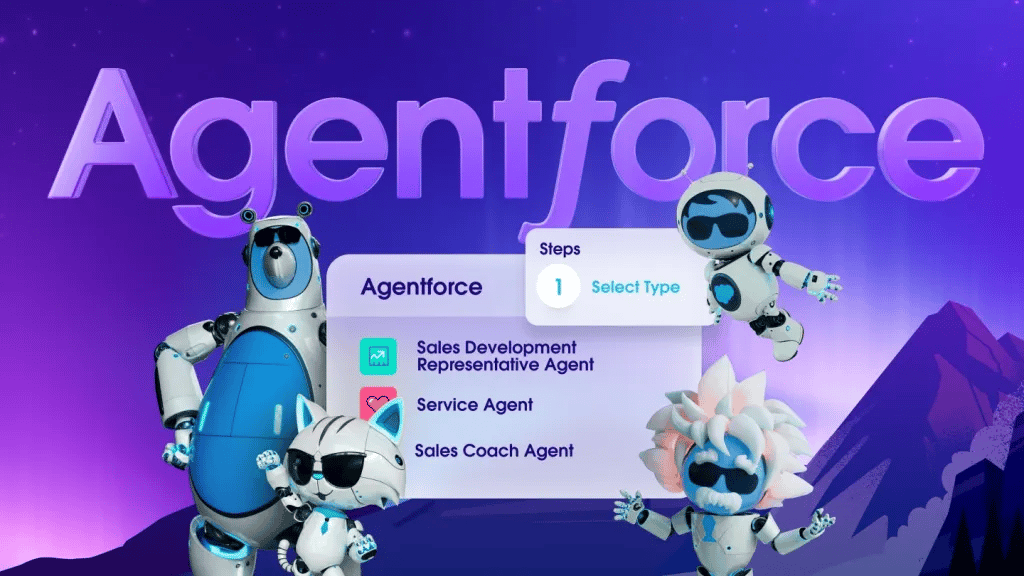
Marc Benioff, Salesforce’s chief executive, said after the Q1 FY2027 earnings call that Agentforce represented “the fastest-growing product in Salesforce history,” a claim the ARR trajectory supports. What Benioff left less explicit is how much of that ARR sits inside existing enterprise contracts as AI add-on modules versus genuinely new business won against alternatives. Analysts who track the distinction put it as the company’s next credibility test.
Q2 FY2027 guidance calls for revenue of $11.27 billion to $11.35 billion, up 10 to 11% year-over-year, keeping sequential growth intact without inflecting upward. There is a credible read in which that range understates what Agentforce momentum delivers by August; there is an equally credible read in which enterprise IT budget freezes, still visible in several large-cap software peers reporting in September, cap the upside. Salesforce has not told investors which scenario is more likely. That gap is where CRM’s stock risk lives.
The day’s movement on September 10 reflected neither euphoria nor concern. It was a recovery session in a tech sector that had been under light pressure through most of the prior week, with CRM participating broadly alongside other large-cap software names. Trading volume was modestly below its 90-day average, suggesting the move was sector-driven rather than a company-specific catalyst.
For investors, the three-month question is whether Agentforce ARR reaches $2 billion by the time Q2 FY2027 results land, which Salesforce has not guided to explicitly. The $3.4 billion combined AI and data ARR figure provides some headroom, but parsing how much sits in Agentforce proper versus the broader Data Cloud product remains a challenge without more granular disclosure. CRM is a DJIA component, and its weight in the index means September 10’s 1.94% rise contributed a modest positive to the broader average’s performance on the day.