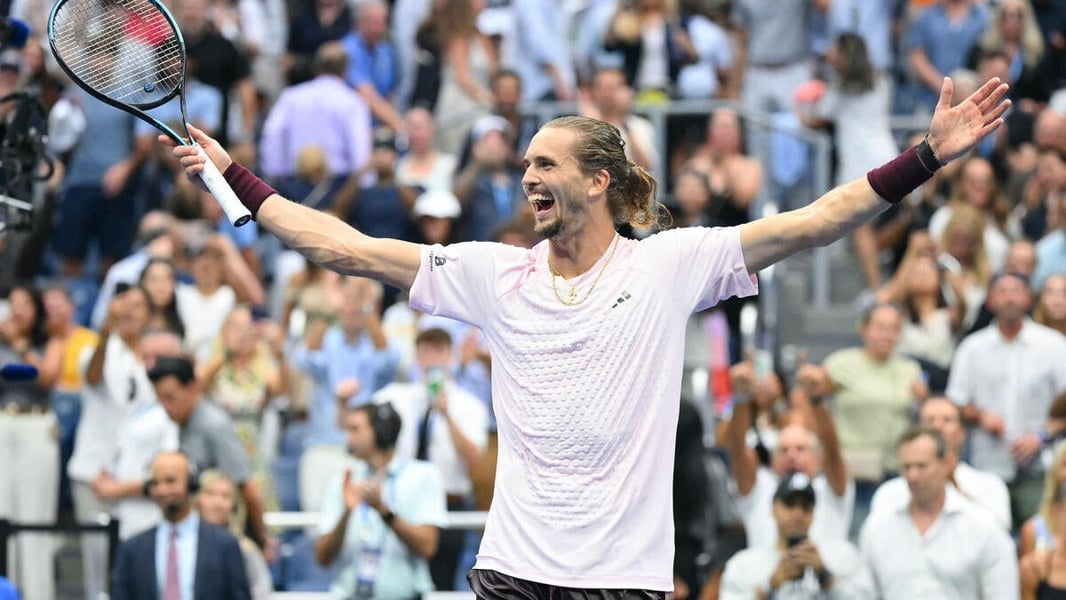

LONDON – Alexander Zverev arrived at The O2 Arena this week not as a player chasing a title but as one who has already taken two. The 29-year-old German won the French Open and the US Open 2026 in the same calendar year – a feat only a handful of men have achieved across the Open Era – and the Laver Cup in London is his first competitive appearance since lifting the trophy at Flushing Meadows twelve days ago.
In Hamburg, where Zverev was born on April 20, 1997, the summer of 2026 will be spoken of differently than any before it. The city produced a Grand Slam champion – twice, in four months.
For most of the previous decade, Alexander Zverev occupied the sport’s most uncomfortable position: talented enough to beat any opponent on any surface on a given day, not quite able to sustain it for a full fortnight. He reached the US Open final in 2021 as the overwhelming favourite and led Daniil Medvedev by two sets before cramping at the end of the third and losing in five. An ankle injury forced him to retire mid-match against Rafael Nadal in the Roland Garros semifinal the following June, during a game he had been losing but had not yet conceded. The sport’s record-keepers noted each near-miss with precision. Zverev absorbed them and kept working.
| Stat | Detail |
|---|---|
| Full Name | Alexander Zverev |
| Born | April 20, 1997 – Hamburg, Germany |
| Nationality | German |
| Height | 1.98 m (6 ft 6 in) |
| Turned Pro | 2013 |
| ATP Ranking (2026) | World No. 1 |
| Grand Slams Won | 2 (Roland Garros 2026, US Open 2026) |
| Olympic Medal | Gold – Tokyo 2020 |
| Grand Slam Finals (lost) | 2 (US Open 2021, Wimbledon 2026) |
| 2026 Win-Loss Record | 73-9 (as of September 2026) |
| Source: ATP Tour career records. 2026 season statistics through Laver Cup. | |
The Roland Garros title in June rewrote that record at its foundation. Zverev reached the Philippe Chatrier final without dropping a set in the last four rounds, dispatching Jakub Mensik in the semifinals before beating Flavio Cobolli in a straight-sets final. The match was decided in the second set, when Zverev broke twice in a row after trailing 4-3, and never looked back. Cobolli had reached his first Grand Slam final and played without fear; Zverev played without error, which was a different and more conclusive thing. The trophy presentation drew tears that none of the lost finals had been allowed to produce.
Jannik Sinner blocked the calendar-year Grand Slam at Wimbledon in July. The Italian’s 6-3, 6-2, 7-5 victory on Centre Court was a reminder that Zverev’s dominance in 2026 coexisted with a world No. 2 capable of producing a superior performance on the sport’s most demanding surface. Zverev had beaten Fery, Draper, and Djokovic to reach the final, arriving as the betting favourite. He left without the trophy, flat in the second set in a way that suggested the emotional weight of Paris had not fully cleared. The loss cost him a shot at the calendar Grand Slam. It also supplied the motivation that New York eventually consumed.
The US Open draw fractured early – Medvedev exited in the third round, Alcaraz withdrew in the fourth – but Zverev still had to beat Ben Shelton in the final, a 22-year-old American serving at 140 miles per hour in front of a home crowd that wanted nothing more than a domestic champion. The serve was neutralized almost from the first game. Zverev’s return sat consistently within three feet of the baseline, redirecting Shelton’s power back at angles that the American had not trained to handle at that speed. By the second set the crowd had gone quiet. The final score – 6-3, 6-4, 6-3 – was the most complete performance of Zverev’s Grand Slam career and the least disputed major victory of the year.
He is now at the Laver Cup in London, playing for Team Europe alongside Jannik Sinner, Carlos Alcaraz, and Holger Rune. No more Grand Slams remain in 2026. The indoor hard-court season – Basel, Vienna, the Paris Masters – follows in October and November before the ATP Finals in Turin close the year. He enters that stretch as the defending champion of two of the sport’s four majors.
Zverev’s game is built on contradictions that have slowly resolved with experience. He stands 1.98 metres and generates serve angles from the T that shorter players cannot reach. His backhand, contact point deliberately low, handles heavy topspin on clay with the efficiency of a dedicated clay-courter. The forehand that coaches once cited as his relative weakness has become his most reliable weapon under pressure – flatter, faster, and aimed at the body more consistently than it was five years ago.
His family shaped the trajectory. His father, Alexander Zverev Sr., was a professional player who reached a ranking in the 200s before a coaching career that kept the household fluent in Russian, German, and the rhythms of the tour. His brother Mischa, a former top-50 professional, remains a fixture in the player’s box on the biggest occasions. Zverev has never publicly credited one coach with the tactical evolution that produced 2026 – the credit in his telling is distributed across a decade of small corrections.
Two Grand Slams in one calendar year at 29 places Alexander Zverev in a conversation the sport had begun to think he might never enter. The calendar-year Grand Slam requires Wimbledon, where Sinner was better in July 2026. Whether the All England Club reopens that possibility in 2027 is the question that cannot be answered from London in late September. What can be said is that the player warming up at The O2 this week is no longer defined by what he has not won.