In an industry built on clamor, where celebrity is often measured in decibels and social media impressions, Michael Cera has achieved the impossible: he has become a global icon by whispering. For over two decades, the Canadian actor has occupied a unique space in the Hollywood ecosystem, evolving from the awkward adolescent archetype of the mid-2000s into one of the most unpredictable and critically respected performers of his generation. As we move through late 2025, Cera is no longer just “that guy from Superbad“; he is a Tony-nominated stage actor, a musician, a burgeoning director, and the unexpected heart of the billion-dollar Barbie phenomenon.
His career trajectory challenges every conventional rule of stardom. He does not have an Instagram. He rarely gives interviews. Yet, his cultural footprint is deepening. From his recent directorial debut in the Ottawa Valley to his viral Super Bowl campaign, Cera’s quiet radicalism continues to captivate audiences who crave authenticity in an increasingly manufactured entertainment landscape.
The “Allan” Effect: A Mainstream Renaissance
If the early 2000s were defined by Cera’s portrayal of George Michael Bluth in Arrested Development (IMDB), the 2020s have been defined by Allan. Greta Gerwig’s Barbie (2023) may have been a vehicle for Margot Robbie and Ryan Gosling, but it was Cera’s portrayal of Allan, the discontinued, singular friend of Ken, that became the film’s secret weapon. In a world of carbon-copy Kens fighting for dominance, Allan represented the exhausted observer, a role that resonated profoundly with modern audiences.

The role did more than just provide comic relief; it reintroduced Cera to a global audience, proving that his specific brand of deadpan delivery remains timeless. Critics noted that Cera’s performance was a masterclass in “doing less,” grounded in a physical comedy so subtle it felt almost accidental. This resurgence paved the way for a new era of appreciation, culminating in his highly publicized partnership with skincare brand CeraVe, a meta-joke that blurred the lines between celebrity endorsement and performance art, generating billions of impressions.
The Four Phases of Michael Cera: A Critical Retrospective
To fully grasp Cera’s position in the pantheon of modern actors, one must analyze the distinct phases of his career. Unlike many child stars who burn out or fade into obscurity, Cera has managed to reinvent himself with surgical precision every few years. His filmography is not just a list of credits; it is a roadmap of American comedy’s evolution over the last two decades.
Phase I: The Architect of Awkward (2003–2010)
The cultural earthquake of Arrested Development (2003) cannot be overstated. Before Cera, the “teen heartthrob” was typically confident, athletic, and traditionally handsome. Cera’s George Michael Bluth introduced a new archetype: the moral, neurotic innocent. He didn’t just play awkward; he weaponized it. His ability to convey panic through a micro-tremble of the lip or a cracked voice became his signature.

This phase peaked with the “Holy Trinity” of Cera comedies: Superbad (2007), Juno (2007), and Youth in Revolt (2009). In Superbad, while Jonah Hill provided the explosive, profane energy, Cera provided the soul. Critics at the time noted that Cera’s Evan was the necessary anchor that kept the film from floating into caricature. He represented the universal anxiety of male adolescence, the fear of not being enough.
Phase II: The Indie Deconstruction (2011–2016)
By 2010, the “Michael Cera Type” had become a box, and Cera knew it. His response was Scott Pilgrim vs. the World (2010). While now considered a cult masterpiece, it was a box office disappointment upon release. However, it marked a crucial turn. Cera was no longer just the nice guy; he was fighting, he was selfish, and he was physically active. This was the bridge to his most experimental phase.
In 2013, Cera teamed up with Chilean director Sebastián Silva for Crystal Fairy & the Magical Cactus and Magic Magic. These films were a shock to the system for mainstream fans. In Crystal Fairy, Cera played an ugly American, entitled, rude, and obsessed with his own drug experience at the expense of others. It was a brave performance that stripped away his likability, revealing a raw, jagged talent underneath. He wasn’t trying to be funny; he was trying to be real, even if “real” meant being repulsive.
Phase III: The Broadway Pivot (2014–2019)
While Hollywood was trying to cast him in more comedies, Cera quietly moved to New York to conquer the stage. His work with playwright Kenneth Lonergan redefined his professional standing. In This Is Our Youth (2014) and Lobby Hero (2018), Cera proved he had the stamina and projection for live theater.
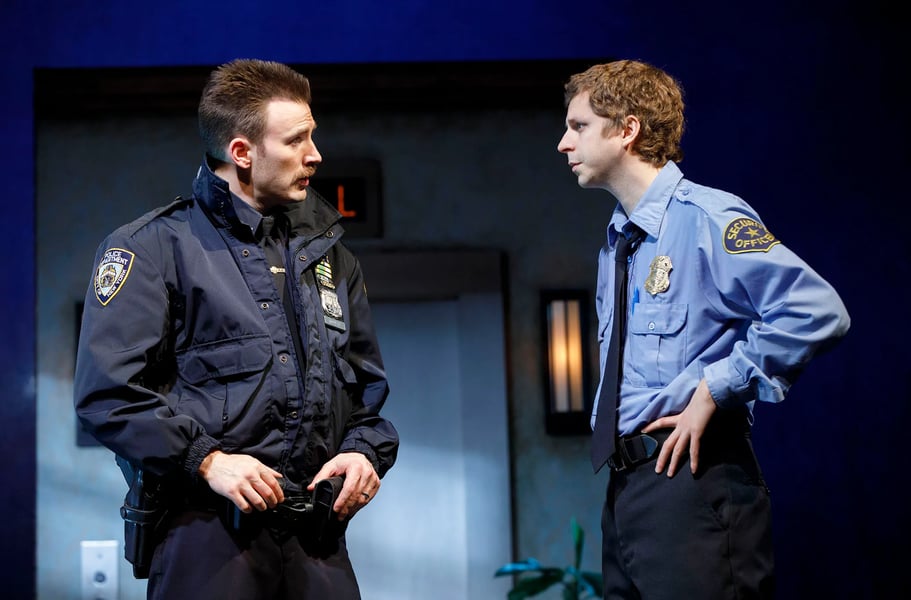
His performance in Lobby Hero earned him a Tony Award nomination for Best Featured Actor in a Play. The New York Times critic Ben Brantley described his performance as “a marvel of uncomfortable stillness.” On stage, there are no multiple takes, no editing to save a joke. Cera’s success here silenced any remaining critics who claimed he was a “one-trick pony.” He held his own against heavyweights like Chris Evans and Kieran Culkin, proving that his command of dialogue was world-class.
Phase IV: The Meta-Modern Icon (2020–Present)
We are currently in the fourth phase: The Meta-Cera. This era is defined by roles that comment on his own celebrity. It started with his cameo in Twin Peaks: The Return as Wally Brando, a bizarre, Marlon Brando-impersonating drifter that felt like a fever dream. It continued with Barbie and his role in Life & Beth alongside Amy Schumer.
In Life & Beth, Cera plays a character based on Schumer’s real-life husband, a farmer on the autism spectrum. It is a performance of profound tenderness, lacking irony. It suggests that Cera has come full circle: he is no longer running from his awkwardness, nor is he relying on it for cheap laughs. Instead, he is using it to explore deep, human connection.
The “True That” Sound: Cera as a Musician
It would be a mistake to discuss Cera without mentioning his auditory legacy. His 2014 album True That was released with zero promotion via Bandcamp. It is a collection of lo-fi, home-recorded folk tracks that sound like they were discovered in a dusty attic. Tracks like “Clay Pigeons” display a fragility that mirrors his acting.

He is not a “celebrity DJ” or a vanity project rocker; he is a legitimate musician. He played bass and toured with the indie supergroup Mister Heavenly. His music has appeared in his films, adding a layer of personal authorship to his projects. This musicality explains his acting rhythm, Cera hears the beat of a scene differently than others, often choosing to play the “rest” rather than the “note.”
Beyond the Hoodie: Defining the Michael Cera Archetype
To understand Cera’s enduring appeal, one must look beyond the hoodies and striped polos of his early filmography. Between 2007 and 2010, Cera had one of the most impressive runs in modern comedy history. Superbad, Juno, and Scott Pilgrim vs. the World established him as the patron saint of the sensitive beta-male, a sharp deviation from the frat-pack bravado that dominated the era.
However, Cera refused to be trapped by this persona. His pivot to indie cinema in the 2010s demonstrated a desire to deconstruct his own image. In Crystal Fairy & the Magical Cactus and Magic Magic, he played characters that were abrasive, unsettling, and often unlikeable. His appearance in This Is The End (2013), where he played a coke-fueled, deviant version of himself, remains one of the most brilliant pieces of self-parody in comedy history. It was a signal to the industry: Michael Cera is in on the joke, and he is steering the ship.
From Actor to Auteur: The 2025 Directorial Debut
As of late 2025, Cera has entered a new phase of his career: filmmaking. In November 2025, production began on his directorial debut, a romantic comedy titled Love Is Not the Answer. Filmed in the quiet town of Carleton Place, Ontario, the project sees Cera returning to his Canadian roots. Starring Pamela Anderson (IMDB), another figure enjoying a massive cultural re-evaluation, the film explores themes of love and disillusionment.
The choice to film in the Ottawa Valley, rather than a soundstage in Los Angeles, speaks to Cera’s method. He seeks environments that foster intimacy and oddity. Local reports from the set describe a director who is precise, collaborative, and unpretentious, qualities that have defined his acting career. This move into directing is a natural evolution for Cera, whose understanding of rhythm and timing has always felt directorial in nature.
The Private Life of Michael Cera: Wife, Children, and Normalcy
In an age of oversharing, Cera’s personal life is a fortress. He has been married to Nadine, a German woman he met at a bar in Paris, since approximately 2018. The couple’s relationship is a study in privacy; they rarely walk red carpets together and their wedding was so low-key that the public only realized they were married when Cera was spotted wearing a gold band.
They share two children. Their first son was born in the fall of 2021, a fact famously, and accidentally, revealed by Amy Schumer during a press tour for Life & Beth. In early 2024, Cera confirmed the birth of their second son. He has spoken candidly about fatherhood, describing it as a shifting of gravity that made leaving home for long shoots, like Barbie in London, emotionally difficult.
This commitment to normalcy is not a pose; it is the engine of his longevity. By keeping his family life separate from his work, Cera preserves a sense of mystery that allows him to disappear into roles. He lives a bicoastal life, splitting time between New York, where he has received acclaim for his Broadway performances in Lobby Hero and The Waverly Gallery, and Canada.
Music, Net Worth, and the “True That” Ethos
Cera’s creativity is not limited to the screen. He is an accomplished musician, having released the lo-fi folk album True That in 2014, which gained a cult following for its intricate piano work and home-recorded aesthetic. He has also toured as the bassist for the indie supergroup Mister Heavenly. This musicality informs his acting; his dialogue often has a jazz-like cadence, relying on off-beats and silences.
Financially, Cera has built a substantial empire through steady work and smart choices. His estimated net worth sits comfortably around $20 million. While he could easily chase blockbuster paychecks, he prioritizes scripts that interest him, from voice work in Sausage Party: Foodtopia to the surreal comedy of A24’s Dream Scenario.
Why Michael Cera Matters Now
Why does Michael Cera remain so relevant in 2025? Perhaps it is because he represents an antidote to the curated perfection of modern celebrity. He is awkward, he is aging naturally, and he is unconcerned with being “cool.” In doing so, he has become the coolest person in the room.
Whether he is playing a plastic doll, a neurotic father in Life & Beth, or directing Pamela Anderson in a Canadian winter, Cera approaches his art with a sincerity that is impossible to fake. He is a reminder that in a loud world, the quietest voice is often the one worth listening to.