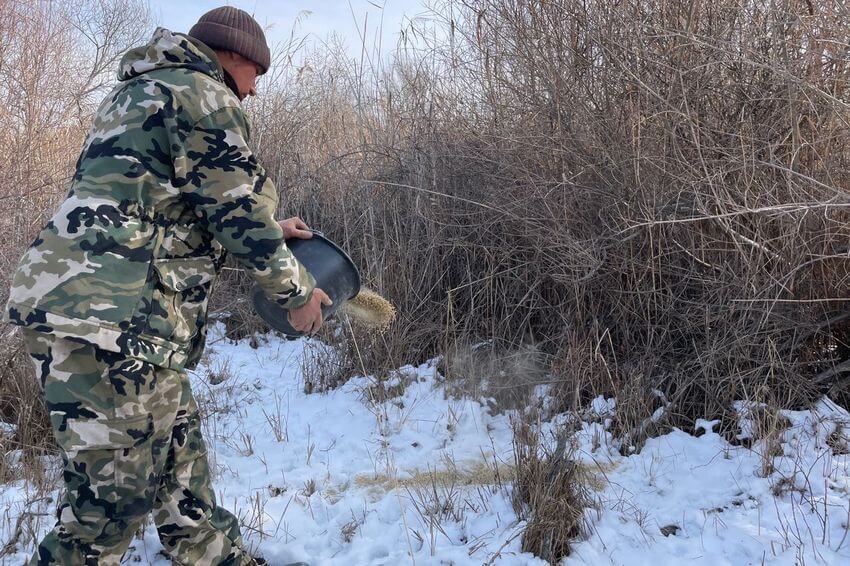

There are still two hours to go until sunrise, and hunters Gulchoro Maatkerimov, Turar Kazakbaev and Chon-Kemin Park lead researcher Taalaibek Kozhomkulov are already on the road. Sacks of grain and salt, bales of hay were loaded onto the horses.- The way is long, so we leave at night, – explained Taalaibek Kozhomkulov to the correspondent of “RG”. – We must have time to lay out the stream before lunch and, at the same time, check the camera traps. By the way, great tool. They were installed several years ago with the help of the German Nature Conservation Union (NABU) to monitor animal migration. The devices are of great help in the fight against poachers. These “comrades”, unfortunately, are not afraid of either frost or deep snow. For a trophy, they go every turn and wait for prey when the beast goes to feed.According to Taalaibek Kozhomkulov, there are now more than a hundred deer, several dozen roe deer and mountain goats in the Chon-Kemin reserve. Animal feed is harvested in the summer. Rangers cut tree branches, mow grass, buy grain and salt.- If winter is already gradually receding in the valleys of Kyrgyzstan, then it will persist in the mountains, – says Taalaibek Kozhomkulov. – During the day the thermometer rises to -15, but at night it sometimes drops to -30 degrees. The snow in the mountains melts, at best, at the end of March. The other day there was heavy rain, and now where the feeders are placed, you can’t even get on the coolest SUV. And the smell of exhaust gases scares animals away. They also have a keen sense of smell.After a snowfall, snowdrifts in the mountains increased in some places up to 80 centimeters. Under these conditions, it is very difficult for deer and roe deer to move. The rangers must clear the surroundings so that the animals can access the feeders.- Animals are accustomed to the fact that food appears again and again in the same place and constantly walk nearby, waiting for rangers, – explained Turar Kazakbaev. – They do not approach – animals are cautious and timid. Their activity is observed in the dark. We don’t have many hunters, so from time to time the hunters help lay out the food. Salt is very important for animals, especially now, when the body is weakened due to winter, so its disposal takes place regularly throughout the reserve.In the Bakai-Ata district of the Talas region, in turn, rangers feed not only wild artiodactyls, but also pheasants. These birds here at one time all but disappeared. It was possible to restore – albeit partially – their population with enormous effort. Now conservationists are fighting to increase the number of rare birds.”When it’s hot, we protect the pheasant from poachers, and in winter we save it from starvation,” Bekmurza Ashimov told the Talas regional department of the Ministry of Natural Resources, Ecology and Technical Supervision of the Kyrgyz Republic. – And now in the Bakai-Ata region there is an action to feed the pheasants. We lead it with the community of hunters and fishermen in the region. Birds need food the most. Winter is a big test for them. Insects, fruits and berries hibernating under the snow. From morning to night, the birds are looking for at least one kind of food. The warm and fluffy plumage protects from the cold, but not from hunger. During snowfalls, blizzards and severe frosts, birds starve and die en masse. We therefore try to equip as many places as possible for food.