
The Chinese rover Zhuzhong, which has not been in contact for almost a year, made an important discovery – it found unusual polygonal cracks on the surface, formed during the evaporation of water from the surface of the planet in the recent past. This is stated in the study published by Chinese scientists in Geophysical Research Letters.
The other day, Chinese scientists finally clarified the fate of their Zhuzhong rover, which has not been heard from for many months. Delivered to the planet in May 2021, it was to go into hibernation a year later to survive the Martian winter, and was to wake up automatically in December 2022 when light levels allowed it to continue operating. However, in February 2022, experts noticed that mission leaders had not reported on the state of the device for a long time.
It was not until April 25 that Zhang Rongqiao, chief designer of the rover, reported that most likely the reason for the device’s failure was too much Martian dust covering the device. The rover’s solar panels were unable to generate enough power to charge the batteries, so it still hasn’t woken up from sleep mode.
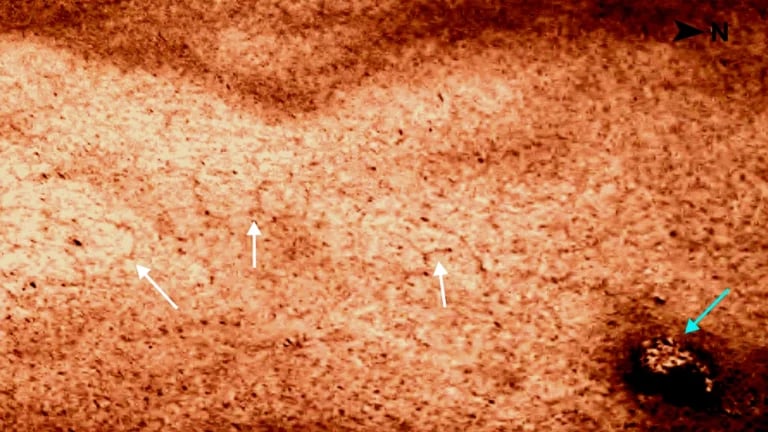
Meanwhile, the rover team published a study in which they talked about an important discovery made by the rover even before it entered hibernation. The plain of Utopia, where the Zhuzhong rover landed, is covered with interesting geological formations, the so-called transverse wind ridges (TAR), made up of very coarse sand. These dunes actively move with the wind, sweeping away the darker dust, making them brighter. Typically, they are located perpendicular to the direction of the wind, so their orientation can indicate the direction of the wind when they form. Moving through the area of these ridges, the rover, using its on-board camera, discovered unusual fissures, the so-called dewatering polygons, well known to geologists, and to anyone who could often see such figures at the bottom of dry puddles.
Geophysical Research Letters / Volume 50, Number 6
“We analyzed the morphology and evolution of the ridges at the Zhurong landing site and found several polygonal structures with hydrated minerals, such as gypsum, on the surface of the ridges that formed last,” said said scientists led by Zan Wang of the University of China. Geosciences (Wuhan).
Previously, similar polygonal structures of larger sizes have been encountered on Mars, but were formed by non-water-related processes, for example during the cooling of ancient lava. New structures, only a few tens of centimeters in size, were first discovered on the transverse aeolian ridges, and scientists precisely associate their origin with the action of water.
They proposed two possible mechanisms for the formation of cracks. The first involves the cracking of the ground during the evaporation of water contained under the surface, the second – during the mutual exchange of water between the atmosphere and solid rocks.
“We suggest that the second option is more likely and provides a clue to understanding the hydrological cycle of Mars and the water exchange between the Martian surface and the atmosphere during the ‘cold and dry’ Amazon era (begun is 3 billion years old and continues to the present day),” the study says.
Read the Latest Ukraine War News on The Eastern Herald.